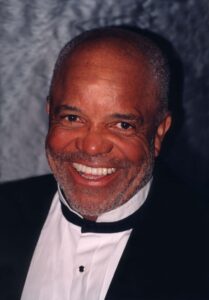
Berry Gordy
Berry Gordy (Born 1929)
- Founded Motown Records in Detroit in January 1959 with an $800 family loan, and within five years had built the most successful Black-owned business in America — producing more than fifty number one Billboard pop singles across the 1960s, developing Diana Ross and the Supremes, Stevie Wonder, Marvin Gaye, the Temptations, the Jackson 5, Smokey Robinson and Gladys Knight, and creating the Motown Sound that crossed racial lines in a deeply divided America and permanently changed the landscape of popular music.1Britannica — Berry Gordy ↗
- Applied the discipline of the Ford assembly line — where he had worked before founding Motown — to the production of popular music, creating an in-house songwriting and production system, a quality control process in which tracks competed for release, and an Artist Development Department that taught performers how to walk, sit, speak and behave in public — a systematic approach to cultural production that has no parallel in the history of the music industry.2Motown Museum — Berry Gordy ↗
- Released the recorded speeches of Martin Luther King Jr., moved his artists onto television at a time when Black performers were largely excluded from mainstream programmes, and built an entertainment company that by the early 1970s was recognised as the number one Black-owned or managed business in America — before selling Motown Records to MCA in 1988 for $61 million while retaining the publishing catalogue that represented the true long-term value of what he had created.3Kennedy Center — Berry Gordy ↗
Berry Gordy Jr. was born on 28 November 1929 in Detroit, Michigan, the seventh of eight children of a family that had relocated from Georgia and built a successful construction, printing and plastering business — a family, in other words, that understood enterprise and what it required.4EBSCO — Berry Gordy ↗ He tried boxing, ran a record store that went bankrupt, worked on the Ford assembly line, and spent his early twenties as a songwriter — learning the mechanics of popular music production from the inside, understanding what made a song commercially compelling, and watching the money that his songwriting generated flow to other people's businesses rather than his own. The $800 loan from the Gordy family cooperative in January 1959 is the most analytically precisely documented founding moment in the Cultural domain dataset. Gordy bought a two-family house on West Grand Boulevard in Detroit, moved his family into the upper floor, and built his record company on the ground floor of a building he named Hitsville U.S.A.2Motown Museum — Berry Gordy ↗ The first single was released on 21 January 1959. Within eighteen months he had produced a gold record. Within five years he had the most successful independent record label in American history. The analytical distinctiveness of Gordy's leadership profile in the Cultural domain lies in the Process variable. The Ford assembly line metaphor is his own — he explicitly described his approach to music production in those terms — but the precision with which he implemented it was not metaphorical. Songs went through a quality control process in which they were played against the current chart hits on a specific speaker system, evaluated by a committee that included writers, producers and executives, and released only if they were judged competitive.5uDiscover — Berry Gordy ↗ The Artist Development Department — staffed by professionals who taught choreography, deportment, elocution and media relations — was not an optional extra. Every artist who performed under the Motown name was processed through it. The goal was not authenticity but controlled excellence at scale, delivered consistently across a roster of acts that at its peak included a dozen simultaneously charting artists. The Civil Rights dimension of his leadership is analytically significant and analytically rare in the Cultural domain. Gordy believed — and the success of the Motown Sound proved — that Black artists performing at the highest level of commercial and artistic quality could reach audiences across racial lines that segregation had made functionally impermeable.4EBSCO — Berry Gordy ↗ He released Martin Luther King Jr.'s recorded speeches. He moved his artists onto Ed Sullivan and American Bandstand at a time when Black performers had effectively no access to national television. The Value variable in his profile reflects both the commercial output and the cultural consequence: Motown did not merely sell records across racial lines — it contributed to changing the conditions that made those lines so difficult to cross. He sold Motown Records to MCA for $61 million in 1988, retaining the publishing catalogue. The catalogue was the correct decision — the recordings generate royalties in perpetuity and have been licensed into thousands of subsequent productions. He received Kennedy Center Honours in 2021. He announced his retirement in 2019 at the age of eighty-nine, from a company he had started with $800 sixty years earlier.
Score Comparison
Add up to 10 leaders. Click a name to visit their profile.
The 13 Equations
Scores for: Motown Industries — Expansion to LAThe 22 Variables
Canonical scoresWhat changed: Motown — The Golden Age → Motown Industries — Expansion to LA
Sources & Bibliography
The scores assigned to this leader are derived from publicly available sources. Variable inputs reflect documented behaviour, structural conditions, and historical record at the time of each snapshot.