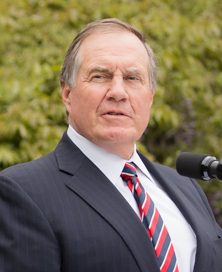
Bill Belichick
Bill Belichick (Born 1952)
- Led the New England Patriots to six Super Bowl victories from 2001 to 2019 — the most Super Bowl wins by any head coach in NFL history — across a dynasty spanning nearly two decades that included nine Super Bowl appearances, seventeen AFC East division titles and thirteen AFC Championship Game appearances, while operating a system described by observers as 'value-based' roster construction that routinely identified and maximised undervalued players who had not succeeded in other environments.1Wikipedia — Bill Belichick ↗
- Publicly committed to specific measurable performance targets before each season and delivered against them with a consistency unmatched in the history of American professional sport — introducing the phrase 'Do your job' as both a management instruction and a cultural philosophy in which every player's role was precisely defined, every player was expected to execute that role regardless of the game situation, and individual performance was evaluated against that role-specific standard rather than against general athletic metrics.2EBSCO — Bill Belichick ↗
- Created defensive game plans that were described as 'chameleon-like' — redesigned entirely each week to neutralise the opponent's primary strength rather than imposing a fixed system — an approach that required players to learn and execute entirely new assignments on a weekly basis and that reflected a Process variable operating at maximum analytical sophistication: not a fixed system but an adaptive meta-system for generating situation-specific tactical solutions.3Athlon Sports — Belichick Philosophy ↗
William Stephen Belichick was born on 16 April 1952 in Nashville, Tennessee, the son of Steve Belichick, a naval academy football coach and scout who wrote what became the standard reference work on football scouting, and grew up in an environment where the detailed analysis of football — its personnel, its formations, its situational requirements — was the primary intellectual activity of the household.1Wikipedia — Bill Belichick ↗ He played football and lacrosse at Wesleyan University, graduated with a degree in economics, began his coaching career at the Baltimore Colts in 1975, and spent fifteen years as an assistant before his first head coaching role with the Cleveland Browns in 1991 — where he compiled a 36-44 record over five seasons, made the playoffs once, and was fired when the franchise relocated to Baltimore. The analytical significance of the Cleveland period is precisely its failure. In Cleveland, Belichick was, by his own later account, attempting to coach in a style modelled on his mentor Bill Parcells rather than developing his own approach. The subsequent failure taught him what the New England version would require: a system built on his own analytical framework rather than an imitation of someone else's. When he resigned from the New York Jets after a single day to take the Patriots job in January 2000, the approach he implemented was categorically different from what he had tried in Cleveland.2EBSCO — Bill Belichick ↗ The Process variable in Belichick's profile scores at its absolute ceiling and is the defining analytical characteristic of his leadership. His preparation system — comprehensive film study, opposition research that extended to weather conditions and specific official tendencies, game plans redesigned entirely each week, players drilled in situation-specific assignments rather than generic formations — was not merely thorough. It was the systematic elimination of every source of performance variance that could be addressed through preparation. The phrase 'Do your job' encodes a Process philosophy: the team's success depends on every player executing their defined assignment, and the coach's job is to define those assignments with sufficient precision that execution becomes the only variable.3Athlon Sports — Belichick ↗ The Congruence variable carries a specific analytical complication: the Spygate incident in 2007, in which the Patriots were found to have illegally filmed opponents' signals, resulted in a $500,000 fine for Belichick personally, a $250,000 team fine, and the loss of a first-round draft pick. The conflict between his stated commitment to preparation and fair competition and his conduct in this incident is a Congruence failure that the equations register. It does not erase the institutional achievement — the dynasty continued, producing two more Super Bowl victories in the following three seasons — but it is analytically present in the profile. He left the Patriots after the 2023 season having coached 302 regular season wins and 31 playoff wins — the most playoff wins in NFL coaching history. He subsequently became head coach at the University of North Carolina. The post-Brady Patriots compiled a losing record in his final four seasons, raising the analytically interesting question of how much of the dynasty's Effective Power derived from Belichick's system and how much from Tom Brady's execution of it. The equations score what Belichick built and led. Brady's contribution is a separate analytical profile.
Score Comparison
Add up to 10 leaders. Click a name to visit their profile.
The 13 Equations
Scores for: Patriots — Post-Spygate Continued DominanceThe 22 Variables
Canonical scoresWhat changed: Patriots Dynasty — Pre-Spygate Peak → Patriots — Post-Spygate Continued Dominance
Sources & Bibliography
The scores assigned to this leader are derived from publicly available sources. Variable inputs reflect documented behaviour, structural conditions, and historical record at the time of each snapshot.