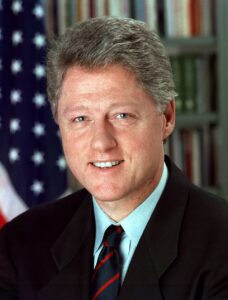
Bill Clinton
Bill Clinton (born 1946)
- Born William Jefferson Blythe III in Hope, Arkansas — his father killed in a road accident three months before his birth — became the youngest governor in the country at 32, lost re-election, made a political comeback that earned him the nickname "Comeback Kid," then in 1992 defeated an incumbent president who had won the Gulf War and still lost the election, with the campaign mantra "It's the economy, stupid" as a precise diagnosis of what voters actually respond to.1Wikipedia — Bill Clinton
- Presided over the longest peacetime economic expansion in American history — 22 million jobs created, the first budget surpluses since the 1960s, NAFTA ratified, the Brady Bill passed2Miller Center — Bill Clinton — while simultaneously failing to intervene in Rwanda as 800,000 people were killed in three months, a decision he later described as his worst foreign policy failing, and in 1998 looking the American people in the eye and saying "I did not have sexual relations with that woman" — a statement that was false, and that became the basis for his impeachment by the House of Representatives.3Britannica — Bill Clinton Presidency
- Was acquitted by the Senate in February 1999 and completed his second term — leaving office in January 2001 with a 66 percent approval rating, higher than Reagan, higher than either Bush2Miller Center — Bill Clinton — a number that captures precisely the analytical problem his presidency presents: the public separated his personal conduct from his systemic performance in a way that the Codex equations also record, holding both truths simultaneously.
Bill Clinton served as the 42nd President of the United States from 1993 to 2001, presiding over the longest peacetime economic expansion in American history and becoming only the second president to be impeached by the House of Representatives. His presidency is a study in the gap between systemic performance and personal conduct — a leader whose policy variables were consistently high and whose character variables were consistently problematic.
Clinton came to office as the first Baby Boomer president, defeating an incumbent who had won the Gulf War and still lost the election because of a recession he could not control. The famous campaign mantra — "It's the economy, stupid" — was not just a slogan. It was a precise diagnosis of what voters actually respond to, and Clinton understood it better than almost any politician of his generation.1Wikipedia — Bill Clinton
The economic record was genuinely transformational. 22 million jobs created. The first budget surpluses since the 1960s. Welfare reform, NAFTA, the Brady Bill. The dot-com boom ran through his presidency like a tide that lifted every variable simultaneously. His k variable was exceptional — he governed during one of the most benign external environments any modern president has enjoyed.2Miller Center — Bill Clinton
The foreign policy record is more contested. The early years were chaotic — Somalia, Haiti, the failure to intervene in Rwanda, the confused response to Bosnia. By the second term, the intervention in Kosovo was effective and largely justified. But the failure to act on Rwanda — where intelligence reports indicate Clinton was aware of what was occurring long before the administration publicly used the word genocide — remains one of the most consequential moral failures of any modern presidency, and Clinton himself has acknowledged it as his greatest regret.4Wikipedia — Presidency of Bill Clinton
The impeachment in 1998 over the Monica Lewinsky affair was the defining event of the second term — not because it succeeded (it did not; the Senate acquitted him) but because of what it revealed about the Congruence variable. Clinton had looked the American people in the eye and denied the affair. The say-do gap was not about policy. It was about character. And character, in the Codex framework, runs through Congruence, Trust, and Virtue — all of which took permanent damage.3Britannica — Bill Clinton Presidency
What makes Clinton analytically fascinating is that the impeachment barely dented his approval ratings. He left office with a 66 percent approval rating — higher than Reagan, higher than either Bush. The public separated the man's personal conduct from his systemic performance in a way that the Codex equations also capture: his policy variables remained high throughout, while his character variables collapsed. The equations can hold both truths simultaneously.
In Codex terms Clinton represents a leader with genuine Transformational capacity in his economic and political variables, undermined by Pride and Ego variables that were structurally damaging throughout. He was never as good as his best moments suggested, and never as bad as his worst moments implied. The equations land somewhere in between — which is probably the most honest verdict available.
Score Comparison
Add up to 10 leaders. Click a name to visit their profile.
The 13 Equations
Scores for: Impeachment and AcquittalThe 22 Variables
Canonical scoresWhat changed: Second Term Peak → Impeachment and Acquittal
Sources & Bibliography
The scores assigned to this leader are derived from publicly available sources. Variable inputs reflect documented behaviour, structural conditions, and historical record at the time of each snapshot.