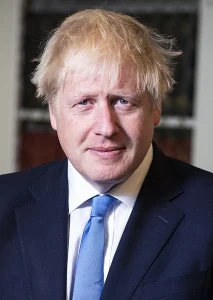
Boris Johnson
- Born in New York, educated at Eton and Oxford, fired by The Times in 1987 for fabricating a quote1Wikipedia — Boris Johnson — led the Vote Leave campaign in 2016, won the Conservative leadership in July 2019, and in December 2019 delivered the largest Conservative majority since 1987 by mobilising working-class Leave voters in constituencies that had not voted Conservative in living memory.2NPR — Boris Johnson resigns
- Oversaw the UK's Covid vaccination rollout — among the fastest in the developed world — while simultaneously hosting parties at Downing Street during the lockdowns he had imposed on the public, for which he was fined by police in April 2022, becoming the first sitting Prime Minister in history confirmed to have broken the law while in office.3PBS News — Boris Johnson timeline
- Survived a confidence vote in June 2022, then lost nearly sixty ministers and officials in forty-eight hours after it emerged he had appointed Chris Pincher as deputy chief whip while knowing of sexual misconduct allegations against him — resigned on 7 July 2022 saying "them's the breaks"4Britannica — Boris Johnson — and later resigned as an MP in June 2023 after a parliamentary committee found he had deliberately misled Parliament over Partygate, which he dismissed as a kangaroo court.5NPR — Boris Johnson resigns Parliament
Boris Johnson served as Prime Minister of the United Kingdom from July 2019 to September 2022. A former journalist, Mayor of London and Foreign Secretary, he was the defining figure of the Brexit era — the campaign's most recognisable face, its most effective communicator, and ultimately the leader who delivered it.
His path to the premiership was built on one of the most improbable political achievements in modern British history. He inherited a Conservative Party in open civil war, a parliament that had defeated the government three times on its own flagship legislation, and a political establishment that had largely concluded Brexit could not be delivered. He called a general election, asked for a mandate to Get Brexit Done, and won an 80-seat majority — the largest Conservative victory since Margaret Thatcher — by mobilising working-class Leave voters in constituencies that had not voted Conservative in living memory.2NPR — Boris Johnson resigns
The collapse was equally extraordinary. The Partygate scandal — the revelation that his government had held parties during Covid lockdowns he had imposed on the public — destroyed not just his premiership but the specific bond that had made him electorally unique. He had won in 2019 partly because voters trusted him to be different. Partygate proved he considered himself exempt from the rules he imposed on others. The Conservative Party, which had tolerated his behaviour for years, concluded it could no longer survive him. Nearly sixty ministers and officials resigned in forty-eight hours. He left office on 7 July 2022.4Britannica — Boris Johnson
Boris Johnson is the purest case study in the Codex of Charisma without Virtue. His Charisma score at peak was extraordinary — he could move crowds, define narratives, and win elections that no one else in his party could have won. His Congruence score was always near the floor — the gap between his public statements and private behaviour was documented throughout his career, not just in Partygate. He had fabricated a quote as a journalist in 1987. He had campaigned on a figure — £350 million a week returned to the NHS — that was false.2NPR — Boris Johnson resigns He had been dismissed from the Shadow Cabinet for lying about a private affair. The Partygate fixed penalty notice was not a departure from his established pattern. It was its logical terminus.
The equations capture something his supporters and critics both missed: he was genuinely effective when his Charisma, Conviction and Defined Output were aligned on a single mission. Get Brexit Done was that mission. When it was complete, there was no second mission — only the character variables that had always been there, now without a purpose to redeem them.1Wikipedia — Boris Johnson
His Pride and Ego scores at the end of his premiership reached their ceiling. He refused to resign until physically forced to by collective cabinet action. Even then, he framed his departure as an injustice — telling assembled staff outside Downing Street that "them's the breaks" and comparing himself to Cincinnatus, the Roman general recalled from his farm to save the republic. The Privileges Committee, which later found he had deliberately misled Parliament, he dismissed as a kangaroo court determined to drive him out regardless of the facts.5NPR — Boris Johnson resigns Parliament The Codex records that a leader who cannot acknowledge failure cannot correct it.
Score Comparison
Add up to 10 leaders. Click a name to visit their profile.
The 13 Equations
Scores for: Mayor of London · 2012The 22 Variables
Canonical scoresSources & Bibliography
The scores assigned to this leader are derived from publicly available sources. Variable inputs reflect documented behaviour, structural conditions, and historical record at the time of each snapshot.