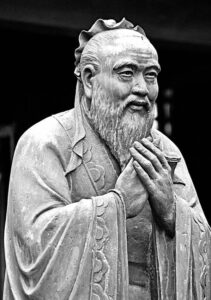
Confucius
Confucius (551–479 BCE)
- Born Kong Qiu on 28 September 551 BCE in Qufu, in the state of Lu in what is now Shandong Province — his father, a minor military official, died when he was three, leaving him to be raised in poverty by his mother1Wikipedia — Confucius — educated himself voraciously, held minor administrative posts, rose to senior positions in the Lu government around 501 BCE reportedly achieving genuine improvements in public order, then was forced into voluntary exile around 497 BCE following political opposition from the ruling class to his reformist agenda.
- Spent the next thirteen years travelling the states of Zhou China with a small group of disciples — accepting any student who presented him with a bundle of dried meat, charging no tuition, teaching virtue, ritual propriety and humaneness to approximately ninety-six disciples recorded by name1Wikipedia — Confucius — seeking a ruler who would implement his vision of government grounded in ethics rather than force, finding none, returning to Lu around 484 BCE, spending his final years teaching, and dying in 479 BCE convinced he had failed: no ruler had adopted his framework, no state had been reformed, and the gap between what he had attempted and what he had accomplished was, in his own assessment, absolute.
- Was posthumously vindicated on a timescale the Codex has no variable to capture — within a few centuries his thought became the foundation of Chinese statecraft, by the Han dynasty it was state orthodoxy, and for two thousand years it shaped governance, education, family structure and moral reasoning across East Asia2Internet Encyclopedia of Philosophy — Confucius — the Analects, compiled by his disciples after his death and never intended as a systematic work, remaining in print ever since and outselling almost every text produced by any leader in this dataset.
Born Kong Qiu in 551 BCE in the state of Lu, in what is now Shandong Province, China, Confucius came from minor nobility that had fallen into poverty. His father died when he was three. He educated himself voraciously, held minor administrative posts in Lu, and developed an early reputation for learning and moral seriousness. His public career began in earnest around 501 BCE when he rose to senior administrative positions in Lu, reportedly achieving real improvements in public order and governance. But political opposition — and the indifference of the ruling class to his reforms — forced him into voluntary exile around 497 BCE. For the next thirteen years he travelled the states of Zhou China with a small group of disciples, seeking a ruler who would implement his vision of government grounded in virtue, ritual propriety and humaneness. None did. He returned to Lu around 484 BCE, spent his final years teaching, and died in 479 BCE. He considered himself a failure.3Britannica — Confucius
He never held the senior position from which he might reshape a state. No ruler adopted his framework wholesale. The Analects, compiled by his disciples after his death, record a man acutely conscious of the gap between what he was trying to achieve and what he actually accomplished. The Han period Records of the Historian describe him as possessing all the qualities needed to govern well, but wandering from state to state because those qualities had not been recognised. Wang Chong's description — the "uncrowned king" — captures the structural problem precisely: royal in everything except power.
The equations capture something the bare historical record can obscure. His Leadership score is exceptional — disciples who follow a teacher across states for thirteen years with no salary, no institutional backing, and no prospect of material reward represent followership in its most distilled form. Conviction at its maximum, Congruence total, Chaos at its minimum. He accepted students of every class and background, charged nothing beyond the symbolic gift of dried meat, and replied to identical questions from different disciples with answers suited to the needs of each — a pedagogical precision that requires no ego to be expressed.4Stanford Encyclopedia of Philosophy — Confucius
What the framework then shows is that Leadership alone does not produce Effective Power. Recognition was limited to his immediate circle. Resources were negligible. Autonomy was constrained by the structural reality of a man with no position and no patron. Those conditions correctly collapse his Effective Power during his lifetime despite the extraordinary quality of his direction.
The posthumous story is the inverse. Within a few centuries his thought became the foundation of Chinese statecraft. By the Han dynasty it was state orthodoxy. For two thousand years it shaped governance, education, family structure and moral reasoning across East Asia.5Wikipedia — Confucianism
The framework scores the life he actually lived — the reach during his lifetime was limited, the structural conditions resistant, the direct power negligible. The legacy, had we a variable for it, would be off the chart.
Score Comparison
Add up to 10 leaders. Click a name to visit their profile.
The 13 Equations
Scores for: Teaching and Philosophy 484–479 BCEThe 22 Variables
Canonical scoresWhat changed: Public Life and Political Career 501–484 BCE → Teaching and Philosophy 484–479 BCE
Sources & Bibliography
The scores assigned to this leader are derived from publicly available sources. Variable inputs reflect documented behaviour, structural conditions, and historical record at the time of each snapshot.