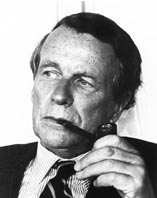
David Ogilvy
David Ogilvy (1911-1999)
- Founded Hewitt, Ogilvy, Benson and Mather in New York in 1948 with $6,000 in his account and no advertising experience — and within fifteen years had built one of the world's largest agencies, winning Rolls-Royce, Shell, Dove, American Express and General Foods, being called by Time magazine 'the most sought-after wizard in today's advertising industry' in 1962, and pioneering the concept of brand image as the primary vehicle of commercial persuasion.1Wikipedia — David Ogilvy ↗
- Codified the principles of effective advertising in Confessions of an Advertising Man (1963) and Ogilvy on Advertising (1983) — insisting that the function of advertising is to sell, that research must precede creative work, and that the agency's job is to serve the client's commercial interest rather than to win creative awards — creating a philosophy of commercial communication that has influenced more practitioners than any other single body of work in the history of the industry.2Britannica — David Ogilvy ↗
- Built an agency culture defined by the principle that leaders should hire people larger than themselves — insisting that if each person hires someone smaller, the company becomes a company of dwarfs, and building Ogilvy and Mather into a global network of 132 offices in 83 countries that outlasted his retirement and continues to operate under his name, representing the most durable institutional legacy in the advertising industry.3Creative Hall of Fame — David Ogilvy ↗
David Mackenzie Ogilvy was born on 23 June 1911 at West Horsley, Surrey, the son of a classics scholar and stockbroker whose financial reverses left the family in straitened circumstances during his childhood.4London Business School — David Ogilvy ↗ He won a scholarship to Fettes College and then to Christ Church, Oxford, left Oxford without a degree, worked as an apprentice chef at the Hotel Majestic in Paris, became a door-to-door salesman of AGA cooking stoves in Scotland — with such success that his employer asked him to write an instruction manual — and entered advertising through his brother's London agency Mather and Crowther, with no prior experience of the field. The analytical distinctiveness of Ogilvy's profile in the Cultural domain is the question of whether advertising belongs there. The case for Cultural is precise and defensible: Ogilvy's Defined Output was not the sale of individual products but the establishment of a system for manufacturing cultural meaning around brands — attaching identities, values and aspirations to commercial objects and thereby changing how those objects were perceived and desired by their audiences.5New World Encyclopedia — David Ogilvy ↗ The brand image concept — that what a product means is as commercially significant as what it does — is a Cultural contribution of the first order. Every luxury brand, every corporate identity programme, every political campaign that operates on the basis of image rather than product specification is working within the framework Ogilvy codified. His Process variables score at their ceiling because his approach to advertising was built on research rather than intuition — trained by George Gallup's research institute in New Jersey before the war, applying Gallup's methods to consumer behaviour, and insisting throughout his career that campaigns be tested before deployment and evaluated against actual sales rather than creative awards.1Wikipedia — David Ogilvy ↗ The Hathaway shirt campaign — featuring a model with a mysterious eye patch, creating a character the audience wanted to understand — was not accidental inspiration but the direct application of Harold Rudolph's 1947 research on 'story appeal' in visual advertising. Ogilvy read the research and acted on it. His agency culture is where the People variable earns its highest scores. The 'hire people larger than yourself' principle was not a platitude — it was a structural decision about how the agency would be organised and what kind of talent it would attract.3Creative Hall of Fame — David Ogilvy ↗ Ogilvy believed that the best advertising came from people who were smarter than he was in their specific domains, combined with a clear overarching philosophy about what advertising was for. This combination — strong institutional philosophy, deference to individual expertise within that philosophy — produced an agency that consistently attracted the best practitioners in the industry. He retired as Chairman in 1973 and moved to his chateau at Touffou in France, where he continued corresponding with the agency so extensively that the volume of mail handled by the local post office increased enough to trigger a reclassification of the postmaster's salary. He died on 21 July 1999. Ogilvy and Mather had by then been acquired by WPP and expanded to 132 offices in 83 countries. His name remains on the door.
Score Comparison
Add up to 10 leaders. Click a name to visit their profile.
The 13 Equations
Scores for: Ogilvy and Mather — Building the AgencyThe 22 Variables
Canonical scoresSources & Bibliography
The scores assigned to this leader are derived from publicly available sources. Variable inputs reflect documented behaviour, structural conditions, and historical record at the time of each snapshot.