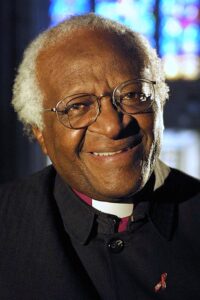
Desmond Tutu
Desmond Tutu (1931–2021)
- Desmond Mpilo Tutu — son of a Methodist school headmaster and a domestic worker, trained teacher, Anglican priest, Dean of Johannesburg, Bishop of Lesotho, Bishop of Johannesburg, and Archbishop of Cape Town — became the most visible and morally authoritative opponent of apartheid outside the imprisoned leadership of the ANC, winning the Nobel Peace Prize in 1984 for his advocacy of nonviolent resistance to a system of racial classification and legal subjugation that the equations record as one of the most comprehensively Value-destructive governance structures in the twentieth-century dataset.1Britannica — Desmond Tutu
- His post-apartheid role as Chairman of the Truth and Reconciliation Commission from 1995 to 1998 — presiding over public hearings in which perpetrators of apartheid-era atrocities could apply for amnesty in exchange for full public disclosure, and in which victims and their families could testify to what had been done to them — produced the most ambitious attempt at institutionalised national reconciliation in the late twentieth century, and a framework for transitional justice that subsequent post-conflict societies have repeatedly studied and selectively adopted.2South African Department of Justice — Truth and Reconciliation Commission
- The theological framework that grounded every public position Tutu took — the Ubuntu philosophy of human interconnectedness, the assertion that apartheid was a heresy rather than merely a policy, and the insistence that reconciliation required neither forgetting nor vengeance but truth — gave his Communication variable a moral architecture that purely political advocacy could not match, and made him the most internationally recognised African religious leader of the twentieth century at a moment when that recognition was the most effective instrument available for sustained external pressure on the apartheid state.3Nobel Prize — Desmond Tutu 1984
Desmond Tutu is the most analytically distinctive profile in the Religious domain and the one whose variable profile most precisely illustrates the relationship between institutional constraint and moral authority. He operated within the structures of the Anglican Church — with all the bureaucratic friction, hierarchical limitation, and institutional conservatism that implies — and used those structures as a platform for advocacy that the South African state could not silence without the international consequences it was not yet willing to accept. The equations capture a leader whose Autonomy was structurally constrained and whose Influence operated globally despite that constraint.
The formation period is defined by the encounter with Trevor Huddleston — the Anglican priest whose visible humanity toward Black South Africans made an impression on the young Tutu that he described as the formative moment of his moral development.1Britannica — Desmond Tutu The decision to enter the priesthood rather than medicine — which he had originally intended — after the state's introduction of Bantu Education made teaching under apartheid conditions morally untenable, reflects the Conviction and Congruence variables operating from the earliest stage of the career: he would not participate in a system he considered unjust, and he found an institutional framework — the Church — that gave him a platform from which to say so. The Learning variable in the subsequent theological training at King's College London — where he encountered academic theology, ecumenical Christianity, and a world outside South Africa — established the intellectual framework that made the Ubuntu theology more than local sentiment.
The episcopal career from the mid-1970s is where the Influence variable first operates beyond the ecclesiastical domain. As Dean of Johannesburg and then Bishop of Lesotho, Tutu began the public advocacy that the South African government found increasingly difficult to manage — not because he was advocating violence, which he consistently refused to do, but because his institutional legitimacy as an Anglican bishop gave him access to international audiences and media that the state's censorship apparatus could not reach.4South African History Archive — Desmond Tutu The Communication variable in this period is operating at its characteristic register — moral, specific, and calibrated to audiences ranging from township congregations to the United Nations General Assembly — with a consistency of message that the Congruence variable records at its highest point in the profile.
The Nobel Peace Prize of 1984 is the canonical snapshot's defining external validation and the moment at which the Visibility variable reaches its ceiling in the global domain. The Nobel Committee's citation identified Tutu as a unifying symbol for the campaign to resolve the problem of apartheid — which is a precise description of the Communication variable functioning as a strategic instrument.3Nobel Prize — Desmond Tutu 1984 The prize gave him a platform and a protection that the South African state had to accommodate — arresting or silencing a Nobel laureate carried international costs that even the apartheid government calculated carefully. The Autonomy variable, which the ecclesiastical structure constrained in one direction, was expanded by the Nobel recognition in another — he could speak to audiences and in contexts that the South African government could not prevent without unacceptable diplomatic cost.
The Archbishop of Cape Town period from 1986 is the canonical snapshot and the highest institutional position of the career. Tutu used the platform to maintain sustained international pressure on the apartheid state through a period — the State of Emergency from 1985 — when the government was attempting to suppress all organised internal opposition.1Britannica — Desmond Tutu His interventions — physically interposing himself between township mobs and individuals accused of collaboration, conducting funerals for activists killed by the state, delivering sermons that were simultaneously theological and political — reflect the Decisiveness variable operating in a context where the personal risk was genuine and the institutional protection incomplete. The People variable at this snapshot reflects the network of international church leaders, politicians, and activists that Tutu had built across the preceding decade and that functioned as both an intelligence network and an amplification system for his advocacy.
The Truth and Reconciliation Commission from 1995 to 1998 is the most analytically complex achievement of the career. Tutu chaired hearings at which the perpetrators of murder, torture, and systematic human rights violation testified in exchange for amnesty — and at which he wept publicly, repeatedly, in front of cameras and audiences that reached globally.2South African Department of Justice — Truth and Reconciliation Commission The weeping is analytically significant rather than merely humanly moving — it was not performed vulnerability but the authentic expression of a Humility variable that had never separated the leader from the suffering he was witnessing. The Process variable at the TRC reflects both the strength and the limitation of the framework: the hearings were conducted with procedural rigour, the amnesty mechanism was legally coherent, and the public testimony produced a historical record of apartheid's operation that no subsequent government could erase. The limitation — that full accountability was traded for full disclosure rather than prosecution — is a Value variable question that South African society continues to debate.
The post-TRC period reflects a variable profile that maintained its moral authority while the institutional position declined. Tutu's criticism of the ANC government — over HIV/AIDS policy under Mbeki, over corruption under Zuma, and in his final years over the failure to arrest Omar al-Bashir when the International Criminal Court warrant required it — demonstrates a Congruence variable operating without the calculation that most leaders apply when criticising their former allies.5The Guardian — Tutu criticises ANC He had supported the ANC's liberation struggle for decades. He criticised the ANC government with the same directness when it failed to meet the standards he had advocated. That consistency is the Congruence variable at its most operationally precise.
His opposition to the Iraq War, his advocacy for Palestinian rights, his support for LGBT inclusion in the Anglican Church — each position cost him support in constituencies that had previously supported him, and each was maintained without modification when challenged.5The Guardian — Tutu and International Advocacy The Humility variable records a leader who changed his mind publicly when evidence warranted it — he acknowledged that the TRC's amnesty mechanism had not produced the full reconciliation he had hoped for — but who did not change his positions under political or institutional pressure. That distinction is the analytical difference between Humility and weakness, and it is one of the clearest illustrations of the variable in the dataset.
The number that matters most across all four snapshots is the Congruence variable — specifically its consistency across every context in which Tutu operated. He said the same things in front of the apartheid government that he said in front of international audiences. He criticised his allies with the same directness he applied to his opponents. He wept at the TRC and maintained the procedural rigour the hearings required simultaneously. A Congruence variable that holds at nine across fifty years of public life — across apartheid, liberation, post-apartheid disappointment, and international controversy — is the rarest score in the dataset. It is the analytical foundation of everything else in the profile, and it is the Leaderment signature of Desmond Tutu.
Score Comparison
Add up to 10 leaders. Click a name to visit their profile.
The 13 Equations
Scores for: Episcopal Advocacy and Nobel PrizeThe 22 Variables
Canonical scoresSources & Bibliography
The scores assigned to this leader are derived from publicly available sources. Variable inputs reflect documented behaviour, structural conditions, and historical record at the time of each snapshot.