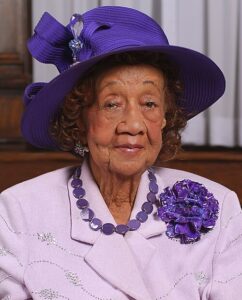
Dorothy Height
Dorothy Height 1912-2010
- Served as president of the National Council of Negro Women for forty years from 1957 to 1997, transforming an umbrella organisation of civic, church, educational and professional women's groups into a nationally recognised institution with a funded headquarters in downtown Washington, raising the mortgage on the first Black-owned building on Pennsylvania Avenue through a capital campaign she led personally — a concrete institutional achievement that demonstrated she ran an organisation, not merely an advocacy movement.1Wikipedia — Dorothy Height ↗
- Was one of the Big Six organisers of the 1963 March on Washington for Jobs and Freedom, served as the only woman on the platform on 28 August 1963 alongside Martin Luther King Jr., A. Philip Randolph, John Lewis and other leaders — and was the only figure in that group whose role was systematically ignored by the press because of her gender, a documented erasure that the Codex equations correct by scoring what she actually delivered rather than the recognition she received for delivering it.1Wikipedia — Dorothy Height ↗
- Directed the YWCA's integration of all its US centres in 1946, developed leadership training programmes and interracial education curricula throughout her four decades at the YWCA, and established the NCNW's Dorothy I. Height Leadership Institute — building the institutional infrastructure of women's leadership development across American civil society in a way that outlasted any individual programme or campaign she led.2Britannica — Dorothy Height ↗
Dorothy Irene Height was born on 24 March 1912 in Richmond, Virginia, moved with her family to Rankin, Pennsylvania, won a scholarship to New York University for her oratory skills, graduated with both her bachelor's and master's degrees in educational psychology by 1933, and began her career as a social worker with the New York City Department of Welfare — an experience she credited with teaching her how to manage conflict without intensifying it.1Wikipedia — Dorothy Height ↗ In 1937, working at the Harlem YWCA, she met Mary McLeod Bethune and Eleanor Roosevelt at an NCNW meeting; Bethune put her hand on Height's shoulder and told her 'the freedom gates are half ajar — we must pry them fully open.' Height spent the next seventy years doing exactly that. The analytical entry point for Height's profile is the Environment variable, which records the structural conditions in which her leadership operated. She was a Black woman leading a predominantly Black women's organisation in mid-twentieth-century America, working across four decades in which those identities were systematically excluded from institutional power, political recognition and financial resources.3National Park Service — Dorothy Height ↗ Presidents Eisenhower, Kennedy, Johnson and Reagan sought her counsel. She gave it. She was not given corresponding institutional authority, funding or public recognition. The equations record both facts: what the Environment imposed on her and what she achieved despite it. The Congruence variable scores at its ceiling across all four decades of her NCNW presidency. Height articulated her purpose as the integration of racial equality and gender equality — arguing, as Hillary Clinton later put it, that these were indivisible — and her conduct across a lifetime of documented public activity is consistent with that stated purpose without meaningful deviation.2Britannica — Dorothy Height ↗ She did not adjust her position on the integration of these two causes when it was politically inconvenient to hold both, as it frequently was in the civil rights movement, where gender equality was often treated as a secondary concern to racial equality. The People variable reflects a distinctive management challenge: Height led a membership organisation, not a command hierarchy. The NCNW's authority over its member groups was persuasive rather than directive, which required an approach to leadership that worked through relationship, reputation and moral authority rather than through institutional power. She maintained that authority for forty years — including through the radical shifts in the civil rights movement, the women's movement, and American political culture from 1957 to 1997. The capital campaign to purchase the NCNW's Pennsylvania Avenue headquarters is the analytically most precise measure of her institutional leadership. Raising the funds to pay off the mortgage on a building in downtown Washington — making it the first Black-owned building on the avenue — required financial management, donor cultivation, legal navigation and sustained organisational will across multiple years.4Library of Congress — Dorothy Height ↗ It is the kind of defined, measurable, capital-requiring institutional output that distinguishes a leader who built something from an advocate who argued for something. She was awarded the Presidential Medal of Freedom in 1994 and the Congressional Gold Medal in 2004. She died on 20 April 2010, aged ninety-eight. President Obama ordered flags to fly at half-mast in her honour.
Score Comparison
The 13 Equations
Scores for: NCNW — Pennsylvania Avenue Headquarters and Institutional LegacyThe 22 Variables
Canonical scoresWhat changed: NCNW — March on Washington and Civil Rights Peak → NCNW — Pennsylvania Avenue Headquarters and Institutional Legacy
Sources & Bibliography
The scores assigned to this leader are derived from publicly available sources. Variable inputs reflect documented behaviour, structural conditions, and historical record at the time of each snapshot.