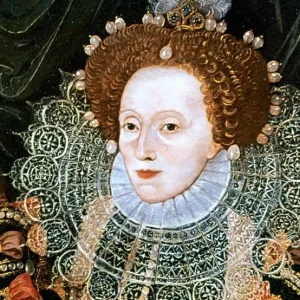
Elizabeth I
Elizabeth I (1533–1603)
- Born on 7 September 1533 at Greenwich — declared illegitimate when her mother Anne Boleyn was executed and the marriage annulled two years later, restored to the succession by Parliament at ten, survived the reign of her Catholic half-sister Mary by performing loyalty while giving the Protestant faction no actionable evidence of commitment1Wikipedia — Elizabeth I — imprisoned in the Tower of London in 1554 on suspicion of involvement in Wyatt's Rebellion against Mary, released without trial, placed under house arrest at Hatfield — and in November 1558, at twenty-five, inherited the throne of a country that had been Catholic, then Protestant, then Catholic again within a decade, with a disputed religious settlement, empty treasury, and no heir.
- Established the Elizabethan Religious Settlement within her first year — the Acts of Supremacy and Uniformity, the revised Book of Common Prayer, the Thirty-Nine Articles — a deliberate via media between Roman Catholicism and Calvinist Protestantism that she described herself: "There is only one Jesus Christ and all the rest is a dispute over trifles"2The Royal Family — Elizabeth I — then spent the next thirty years using her marriage prospects as a foreign policy instrument, committing to no suitor, maintaining the fiction of availability while never intending to surrender the independence it would cost, and presiding over the defeat of the Spanish Armada in August 1588 that secured England's survival as a Protestant state.
- Reigned for forty-five years — the longest Tudor reign — dying on 24 March 1603 at Richmond Palace in circumstances her court described as melancholy, having in her final years lost Cecil, Walsingham and Leicester, watched the Essex rebellion of 1601 collapse, retreated from Parliament on monopolies, and faced harvest failures, economic depression and an unresolved Irish war3Britannica — Elizabeth I — her last act the naming of James VI of Scotland as her successor, closing the Tudor line she had kept technically open for four decades.
Elizabeth I ruled England from 1558 to 1603. Before she ruled, she survived. The survival period — twenty-five years from birth to accession — is the most analytically undervalued phase of her career and the one that produced the governing instincts that defined everything that followed. A child who had been declared a bastard, whose mother had been executed by her father, who had been imprisoned by her sister on evidence insufficient to convict, learned that survival in a Tudor court required the capacity to present no surface that could be attacked. She became the most accomplished political performer of her generation before she held any power to perform with.
The Religious Settlement is her first and most consequential achievement. England in 1558 had been torn between Catholicism and Protestantism for thirty years — through Henry's break with Rome, Edward's Protestant reformation, Mary's Catholic restoration. France at the same moment was entering the Wars of Religion that would kill hundreds of thousands. Scotland was fracturing. The Netherlands were beginning the revolt against Spain. Elizabeth's settlement — the via media that asked for outward conformity rather than inward conviction — was the one solution available that could hold the country together without civil war, and she deployed it with the precise instinct for what the English political temperament would accept.4Britannica — Elizabeth I Religion
The marriage question is the most analytically interesting feature of the middle reign. Every Parliament urged her to marry. Every foreign policy calculation required the fiction of her availability. Every advisor told her the succession must be secured. She refused, evaded, deferred and ultimately outlived the question. The Codex records this as an extremely high Defined Output score: she understood precisely what she was doing. The marriage prospect was more valuable as a diplomatic instrument than any actual marriage could have been — a permanent option that committed her to nothing while keeping every potential rival uncertain. This is the Confidence and Ability variables operating at their ceiling, and the Ego variable at its floor: a leader with no need for the validation that marriage would have provided.5Encyclopedia Virginia — Elizabeth I
The canonical snapshot — the period from the mid-1580s through the Armada — is the peak of her effective power across all variables. Walsingham's intelligence network had uncovered and neutralised the Ridolfi, Throckmorton and Babington plots. The execution of Mary Queen of Scots in 1587 removed the focal point of Catholic conspiracy. The Armada defeat in 1588 secured the Protestant settlement and transformed her public image from careful administrator to national symbol. Drake, Raleigh and Hawkins were extending English reach into the Atlantic. Shakespeare and Marlowe were writing. The Process variable at this period — Cecil's administrative machine, Walsingham's intelligence architecture, the naval infrastructure that had been quietly funded throughout her reign — is among the highest in the Political domain dataset.6EBSCO Research Starters — Elizabeth I
The Congruence variable in the middle period warrants specific attention. The Virgin Queen persona was not a performance layered over a different private reality. It was a policy instrument that happened to be true: she did not marry, did not produce an heir, and the persona served the policy for forty years. The gap between image and reality in most monarchical profiles is where Congruence collapses. In Elizabeth's case the image was constructed so precisely from the reality that the variable sits close to ceiling throughout the middle reign.
The late period is where the hagiography fails the history. The 1590s brought harvest failures, inflation, economic depression, and the costly, unresolved Irish wars. The Counter Armada of 1589 — eleven thousand to fifteen thousand dead, forty ships lost — was a catastrophe the Armada mythology immediately absorbed and suppressed. Essex, her last favourite, led a disastrous Irish campaign and then an armed rebellion that she was forced to crush and execute. Parliament challenged her on monopolies in 1601 and she retreated — the first major parliamentary defeat of her reign. She died isolated, her great advisers gone, the succession technically unresolved until the last days.1Wikipedia — Elizabeth I
The Codex records both the peak and the decline, which is what it is designed to do. The Elizabethan golden age is real — the cultural output, the religious stability, the naval achievement, the survival of Protestant England. So is the late reign entropy that no hagiographic tradition fully acknowledges. She was England's best Tudor and one of the most politically intelligent leaders in this dataset. The equations record that the late period was real, the intelligence was genuine, and the forty-five years were not equally distributed.
Score Comparison
Add up to 10 leaders. Click a name to visit their profile.
The 13 Equations
Scores for: Late Reign — Essex, Parliament and DeclineThe 22 Variables
Canonical scoresWhat changed: Armada and Peak Power — Gloriana → Late Reign — Essex, Parliament and Decline
Sources & Bibliography
The scores assigned to this leader are derived from publicly available sources. Variable inputs reflect documented behaviour, structural conditions, and historical record at the time of each snapshot.