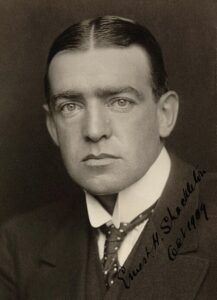
Ernest Shackleton
Ernest Shackleton (1874-1922)
- Led the Nimrod Expedition of 1907–09, reaching within 97 miles of the South Pole before turning back to save his men from certain death — a decision he described as choosing 'a live donkey over a dead lion' and which Roald Amundsen later said would be written in Antarctic history 'in letters of fire'.1Britannica — Ernest Shackleton ↗
- Ernest Shackleton and his crew were stranded for approximately 2 years and 4 months during his famous Endurance Expedition, during which his ship Endurance was crushed by pack ice in the Weddell Sea — leading all 27 men across drifting ice floes, open ocean and the mountains of South Georgia to safety without a single loss of life, a feat that has never been replicated in comparable conditions.2Wikipedia — Imperial Trans-Antarctic Expedition ↗
- Sailed 800 miles in a 22-foot open lifeboat across the Southern Ocean to South Georgia in winter conditions, then crossed the island's uncharted glaciated mountains to reach the Stromness whaling station and mount four successive rescue attempts until every man on Elephant Island was brought home.3Aurora Expeditions — Endurance Timeline ↗
Ernest Shackleton was born in County Kildare in February 1874, entered the merchant marine at sixteen, and spent the years before the Endurance expedition accumulating a record of polar ambition that was consistently impressive and consistently short of its stated objective.1Britannica — Ernest Shackleton ↗ He had been invalided home from Scott's Discovery Expedition in 1903. He had turned back 97 miles from the South Pole on the Nimrod Expedition in 1909 because the alternative was the death of his men. Both events shaped him in ways that the Endurance expedition would make visible. The decision on the Nimrod Expedition is the first analytical entry point. Shackleton understood, with 97 miles remaining and his men failing, that the goal was no longer reachable at acceptable cost. The Defined Output variable — reach the South Pole — was in conflict with the People variable — bring the men home. He chose People.4Endurance22 — History of Endurance ↗ Amundsen reached the Pole two years later with a better-supplied expedition and a different risk calculus. Scott reached it and died. Shackleton turned back and lived, and the men with him lived, and that choice — not the failure to reach the Pole — is what the leadership equations measure. The Endurance expedition began in August 1914, the same week the First World War started, under conditions of public indifference and private fundraising difficulty.4Endurance22 — History of Endurance ↗ The ship entered the Weddell Sea pack ice in January 1915 and did not escape it. For ten months the crew lived aboard a ship that was slowly being crushed. On 27 October 1915, Shackleton gave the order to abandon Endurance. Twenty-five days later she sank.5History.com — Shackleton Endurance Survival ↗ What followed across the next twenty-two months is the most complete expression of the People and Trust variables in the Explorers domain — and arguably in the entire dataset. The analytical signature of Shackleton's leadership during the survival phase is the management of what the Progress equation describes as the k variable — the external conditions that are entirely outside the leader's control. The Weddell Sea in winter, the Southern Ocean in an open boat, the uncharted glaciated mountains of South Georgia — k in each of these environments sits at its minimum. Shackleton's response was to hold every other variable at or near its ceiling simultaneously. Conviction never wavered. Congruence between his stated commitment to bring every man home and his actual decisions was absolute. Intent — the shared understanding of purpose across the entire group — was maintained through the constant management of morale, the rationing of food, the allocation of labour, and the suppression of dissent.1Britannica — Ernest Shackleton ↗ The open boat journey of April–May 1916 — 800 miles in the 22-foot James Caird, in the worst ocean on earth, in winter — was the operational expression of a decision made when all other options had been exhausted.3Aurora Expeditions — Endurance Timeline ↗ Shackleton took five men, including the navigator Frank Worsley, whose navigational precision across 800 miles of open ocean with minimal instruments was the technical foundation of the rescue. They reached South Georgia. They crossed the island. They found the whaling station. Shackleton then mounted four separate relief expeditions before the ice conditions allowed him to reach the men on Elephant Island on 30 August 1916.3Aurora Expeditions — Endurance Timeline ↗ All 27 men were alive. He died at South Georgia in January 1922, at the start of what would have been his fourth Antarctic expedition, aged 47.6Wikipedia — Ernest Shackleton ↗ His wife asked that he be buried there. He is the anchor profile for the Explorers domain not because he reached his stated destination — he never did — but because the equations that measure what a leader actually produces in the conditions they actually face produce their most instructive output when applied to the twenty-two months between the crushing of the Endurance and the rescue from Elephant Island.
Score Comparison
Add up to 10 leaders. Click a name to visit their profile.
The 13 Equations
Scores for: Quest ExpeditionThe 22 Variables
Canonical scoresWhat changed: Endurance — Survival and Rescue → Quest Expedition
Sources & Bibliography
The scores assigned to this leader are derived from publicly available sources. Variable inputs reflect documented behaviour, structural conditions, and historical record at the time of each snapshot.