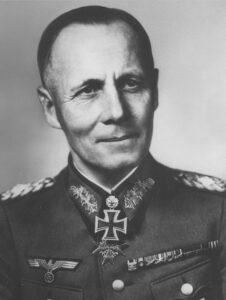
Erwin Rommel
Erwin Rommel (1891–1944)
- At Caporetto in October 1917, led 150 men to capture more than 8,000 prisoners and 81 guns at a loss of six dead and thirty wounded — by attacking when he had orders to the contrary, reading terrain instinctively, and exploiting the psychological collapse of an enemy that believed its lines had already broken. The Pour le Mérite followed.1Wikipedia — Erwin Rommel
- Commanded the Afrika Korps from February 1941, earning the nickname the Desert Fox for audacious surprise attacks that repeatedly defeated larger and better-supplied Allied forces2Britannica — Erwin Rommel — before being broken not by enemy generalship but by fuel shortages, Ultra intelligence, and an industrial capacity that Germany could not match in the theatre.3History Skills — Erwin Rommel
- Implicated in the 20 July 1944 plot to assassinate Hitler, given the choice between the People's Court and suicide by his own government,1Wikipedia — Erwin Rommel and chose death — wearing his Afrika Korps jacket, carrying his field marshal's baton, explaining his decision to his wife and son before getting into Burgdorf's car.1Wikipedia — Erwin Rommel
Erwin Rommel is a very analytically contested Military domain profile, and the equations handle the contestation honestly. The Rommel myth — apolitical genius, victim of Nazi Germany, clean warrior in a dirty war — is a construction that served specific post-war political purposes and that the historical record does not fully support.4Holocaust Encyclopedia — Erwin Rommel The equations do not score the myth. They score the variables.
The World War I and interwar period establishes the template precisely. At Caporetto in 1917, Rommel and 150 men captured more than 8,000 prisoners and 81 guns at a loss of six dead and thirty wounded — by taking the initiative to attack when he had orders to the contrary, by reading terrain instinctively, by exploiting the psychological collapse of an enemy that believed its lines had already broken.3History Skills — Erwin Rommel The Pour le Mérite followed. Infantry Attacks, published in 1937, became a bestseller that influenced armies across the world and landed on Hitler's desk.1Wikipedia — Erwin Rommel The pattern is established in both directions simultaneously — exceptional tactical Ability and the beginning of a relationship with patronage and propaganda that the Congruence variable must record. Rommel's rapid promotion over more senior officers was explicitly Hitler-backed. He knew it and accepted it, noting that Hitler was extraordinarily friendly to him.4Holocaust Encyclopedia — Erwin Rommel Ego tracks upward here, fed by genuine achievement and by an institutional environment that rewarded the performance of heroism as much as its practice.
The North Africa peak campaign is where the equations produce their most instructive output. The gap between his personal variable quality and his Effective Power is the North Africa campaign in a single ratio. The personal variable quality — high Ability, Confidence, People, Process and Defined Output — was operating against depleted Resources, a deteriorating Environment, and an opponent with growing air superiority, Ultra intelligence, and industrial capacity that Germany could not match in this theatre.3History Skills — Erwin Rommel The equations score what he actually achieved with what he actually had, not what his reputation claims. The result is a general who repeatedly fought outnumbered and outgunned and kept winning until the material constraints became insurmountable.
The Congruence score at this period requires specific justification. The Rommel myth rests significantly on the war without hate narrative — the chivalrous Desert Fox who respected prisoners and conducted a clean campaign. The historical record is more complex. Axis propaganda leaflets in Egypt carried antisemitic content. An SS unit under Walter Rauff was attached to his command to murder Jews in North Africa had German forces reached Egypt and Palestine — and Rommel was aware planning was underway.4Holocaust Encyclopedia — Erwin Rommel The counter-evidence is also real: he refused to pass on the Commando Order to his subordinates, he protested reprisals against Arab civilians, multiple sources record him treating prisoners with genuine respect.1Wikipedia — Erwin Rommel The Congruence score sits in the middle — not the high score the myth requires, not the low score his harshest critics would assign. The historical balance of evidence sits in the middle, and the equations sit there with it.
The El Alamein to Normandy period records the progressive collapse of the structure around a leader whose personal variables had not fundamentally changed. Resources declining as Axis supply lines deteriorated under Allied naval and air interdiction. Corporate Drag increasing as Hitler's directives overrode operational judgement with growing frequency — the stand-fast order at Second El Alamein that Rommel initially complied with and later called his greatest mistake in Africa, the Atlantic Wall command structure in which he needed Hitler's approval to commit panzer divisions, the fundamental strategic disagreement with Rundstedt over where to hold the armoured reserves.3History Skills — Erwin Rommel His conclusion — recorded in his diary after Alam el Halfa — that the war in Africa could no longer be won was analytically correct and operationally irrelevant. The system did not permit him to act on it.
The growing disillusionment with Hitler is recorded in Conviction declining across these snapshots — not through ideological conversion but through the accumulation of evidence that Hitler's strategic decisions were accelerating German defeat. The letter to Hitler on 15 July 1944 — giving him what Rommel described as a last chance to end hostilities with the Western Allies, urging him to draw the proper conclusions without delay — is Conviction and Pride operating simultaneously. The conviction that the war was lost and must be ended. The pride that believed a field marshal's direct ultimatum to the Führer was both appropriate and potentially effective. Both readings of the man are in that letter.1Wikipedia — Erwin Rommel
The forced suicide snapshot produces the highest Congruence score in his record. Choosing death over the People's Court — which would have meant public denunciation of the conspirators and disgrace for his family — is the most congruent act of his career precisely because it required the suppression of every self-preservation instinct in favour of a value his entire public record had claimed to hold. He wore his Afrika Korps jacket. He carried his field marshal's baton. He got into Burgdorf's car.1Wikipedia — Erwin Rommel Effective Power is near zero because Autonomy, Resources and Environment had all reached their minimum. Congruence is the highest in his record because there was nothing left to perform it for.
The History Association of Aalen arrived at a verdict the equations support: Rommel was neither war criminal nor resistance fighter, but perpetrator and victim — he willingly served as figurehead for the regime, recognised his mistake, and paid with his life.4Holocaust Encyclopedia — Erwin Rommel The myth required him to be one thing. The equations record that he was several things simultaneously, and that the gap between his personal variable quality and his Effective Power score across every snapshot is an accurate measurement of what it meant to be an exceptional tactical commander operating inside a system that was consuming everything he produced.
Score Comparison
Add up to 10 leaders. Click a name to visit their profile.
The 13 Equations
Scores for: El Alamein — NormandyThe 22 Variables
Canonical scoresWhat changed: North Africa — Peak Campaign → El Alamein — Normandy
Sources & Bibliography
The scores assigned to this leader are derived from publicly available sources. Variable inputs reflect documented behaviour, structural conditions, and historical record at the time of each snapshot.