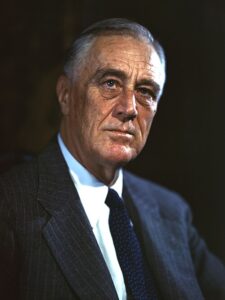
Franklin D. Roosevelt
Franklin D. Roosevelt (1882–1945)
- Franklin Delano Roosevelt — fifth cousin of Theodore Roosevelt, New York state senator, Assistant Secretary of the Navy under Wilson, Democratic vice-presidential nominee in 1920, and Governor of New York — contracted polio in 1921 at thirty-nine, spent seven years rebuilding his physical capacity and political network before returning to win the governorship in 1928 and the presidency in 1932, carrying into the White House a formation experience of prolonged physical suffering that reshaped the Humility and Resilience variables in ways his patrician background alone would never have produced.1Britannica — Franklin D. Roosevelt
- His twelve years as president — the only leader in American history elected to four terms — encompassed the New Deal reconstruction of American economic and social architecture, the mobilisation of the United States as the arsenal of democracy, the strategic direction of the Second World War across two theatres simultaneously, and the foundational design of the postwar international order through the United Nations framework, making him the most consequential American president of the twentieth century by measurable institutional output.2Miller Center — Franklin Roosevelt Key Events
- The private record beneath the public achievement — the managed deception of his physical condition throughout his presidency, the internment of 120,000 Japanese Americans under Executive Order 9066, the failure to act on the Holocaust with the urgency the intelligence available to him warranted, and a personal life of sustained marital infidelity — documents a leader whose Congruence variable operated at full capacity in his public role and at significant discount in his private one, a distinction the equations record without resolving.3History.com — Franklin D. Roosevelt
Franklin Roosevelt is the most complete political leader in the American dataset and the most complex. He governed longer than any other president, across a wider range of crises, with a higher sustained output of institutional consequence. The equations capture both the scale of the achievement and the mechanisms — some admirable, some not — that produced it.
The polio period is the analytical hinge of the entire profile. Roosevelt contracted the disease in August 1921 at the peak of his political trajectory and spent the following seven years in a form of enforced formation that no amount of patrician privilege could have substituted for.4FDR Presidential Library — Polio The physical suffering produced a Humility variable that his background — Groton, Harvard, wealthy Hudson Valley family — would not have generated on its own. His engagement with the polio community at Warm Springs, Georgia, gave him direct exposure to deprivation and limitation that permanently altered his People variable. Eleanor Roosevelt's political evolution during this period — becoming an independent political force in her own right — gave him an intelligence network and public conscience that functioned as a correcting variable on his natural instinct toward political accommodation.
The First Term is the canonical snapshot and the most concentrated burst of institutional construction in American presidential history. The first hundred days alone produced the Emergency Banking Act, the Federal Emergency Relief Administration, the Agricultural Adjustment Act, the Tennessee Valley Authority, the Securities Act, the Glass-Steagall Banking Act, and the Civilian Conservation Corps.2Miller Center — Franklin Roosevelt Key Events The Process variable at this moment is operating at its ceiling — Roosevelt understood that the legitimacy window opened by the 1932 election result would close, and he moved through it at maximum speed. The Decisiveness variable is equally high: he acted before the intellectual framework for each intervention was fully developed, relying on the Learning variable to adjust in real time.
The Communication variable across the presidency is the second highest in the American dataset after Lincoln, and for different reasons. Lincoln's communication was architectural — he constructed arguments that reshaped how people understood their situation. Roosevelt's was relational — the fireside chats worked because he spoke to individuals rather than audiences, collapsing the distance between the presidency and the living room in a way that the medium of radio made possible and his natural register made feel effortless.5FDR Presidential Library — Fireside Chats The Intent variable captures this: Roosevelt always knew exactly what effect he was trying to produce and calibrated his language accordingly.
The court-packing scheme of 1937 is the most analytically revealing failure of the presidency. Frustrated by Supreme Court rulings striking down New Deal legislation, Roosevelt proposed expanding the court from nine to fifteen justices — allowing him to appoint a majority sympathetic to his programme.2Miller Center — Franklin Roosevelt Key Events The plan failed in Congress, including among Democrats who had supported everything else. The Humility variable at this snapshot dips — Roosevelt had mistaken his electoral mandate for institutional authority that the constitutional system was not designed to provide. The Adaptability variable recovers quickly: he absorbed the defeat, adjusted, and the court's composition shifted through natural attrition within two years anyway. The episode is instructive precisely because it is the exception — a leader whose Adaptability was otherwise among the highest in the dataset briefly forgot to apply it.
The war period reflects a variable profile operating under maximum pressure across multiple simultaneous demands. The strategic decisions — Europe first over Pacific first, unconditional surrender as the negotiating position, the Lend-Lease framework that sustained Britain before American entry — were each analytically complex and each correct in the long-run assessment.6US State Department — Lend-Lease The People variable at this period is the strongest in the profile: Marshall, Eisenhower, King, Arnold, Stimson, and Morgenthau represent a cabinet and military command structure of exceptional collective capability, selected on merit rather than loyalty — the same logic Lincoln applied eighty years earlier and for the same reasons.
The Japanese American internment under Executive Order 9066 requires explicit treatment in the Value and Congruence variables. Roosevelt signed the order in February 1942 with full knowledge of what it meant — 120,000 people of Japanese ancestry, the majority American citizens, removed from their homes and confined in camps for the duration of the war.7History.com — Japanese American Internment The military justification was thin at the time and has not improved with historical scrutiny. The Value variable records the outcome for those affected. The Congruence variable records the gap between Roosevelt's stated democratic principles and this specific application of executive power. Neither score is high at this snapshot for these variables.
The Yalta Conference of February 1945 — Roosevelt's last major act of statecraft, conducted while visibly dying — reflects the variable profile under terminal physical decline.8US State Department — Yalta Conference His concessions to Stalin on Eastern Europe have been retrospectively criticised as naïve, but the alternative — a separate Soviet peace or exclusion from the Pacific war — carried its own costs. The People variable at Yalta reflects a specific failure: the absence of a sufficiently sceptical adviser on Soviet intentions at the table, a gap that Harry Hopkins's declining health and Roosevelt's own physical deterioration had opened.
The number that matters most across all four snapshots is the Learning variable — specifically its interaction with Decisiveness. Roosevelt acted fast and corrected fast. The New Deal was not a coherent ideological programme; it was a sequence of experiments, some of which worked and some of which were abandoned when they did not. The Agricultural Adjustment Act was modified. The NRA was allowed to die after the Supreme Court struck it down. The war strategy was adjusted as theatre conditions changed. A leader who scores high on both Decisiveness and Learning simultaneously is rare in the dataset. Roosevelt sustained both across twelve years of continuous crisis. That combination — act, observe, correct, act again — is the operational signature of the most effective executive leadership the American system has produced.
Score Comparison
Add up to 10 leaders. Click a name to visit their profile.
The 13 Equations
Scores for: Polio, Recovery and New York GovernorshipThe 22 Variables
Canonical scoresSources & Bibliography
The scores assigned to this leader are derived from publicly available sources. Variable inputs reflect documented behaviour, structural conditions, and historical record at the time of each snapshot.
- Britannica — Franklin D. Roosevelt biography
- Miller Center — Franklin Roosevelt Key Events
- History.com — Franklin D. Roosevelt
- FDR Presidential Library — Polio
- FDR Presidential Library — Fireside Chats
- US State Department — Lend-Lease
- History.com — Japanese American Internment
- US State Department — Yalta Conference