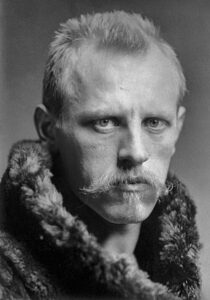
Fridtjof Nansen
Fridtjof Nansen (1861-1930)
- Led the first crossing of Greenland's ice cap in 1888, starting from the uninhabited east coast to eliminate any possibility of retreat — a deliberate leadership choice that bound his team of six to completion — then designed and commissioned the Fram, a ship built specifically to be lifted rather than crushed by pack ice, and drifted deliberately frozen into the Arctic Ocean for thirty-five months, reaching a new farthest north record of 86°14'N in 1895.1Britannica — Fridtjof Nansen ↗
- Appointed League of Nations High Commissioner for Refugees in 1921, repatriated approximately 430,000 prisoners of war stranded after the First World War, created the Nansen Passport — an internationally recognised identity document eventually accepted by more than fifty governments — organised famine relief credited with saving between seven and twenty-two million Russians, and received the Nobel Peace Prize in 1922, donating the prize money to international relief efforts.2Nobel Prize — Fridtjof Nansen ↗
- Advised Roald Amundsen, Ernest Shackleton and Robert Falcon Scott — lending Amundsen the Fram for his South Pole expedition — establishing the methodological foundations of modern polar exploration through his innovations in equipment, nutrition, clothing, ship design and the use of skis, while simultaneously serving as a scientist, oceanographer, diplomat and the defining symbol of Norwegian national identity during the country's path to independence in 1905.3UNHCR — Fridtjof Nansen ↗
Fridtjof Nansen was born on 10 October 1861 near Kristiania, into a family of lawyers and administrators with a record of public service, and grew up in a rural household where his mother introduced him to skiing at age four.4EBSCO — Fridtjof Nansen ↗ He was a national skiing champion and world record holder in ice skating before he was twenty. He studied zoology at the University of Kristiania, published a doctoral thesis on the nervous systems of lower vertebrates, and in 1882 joined a sealing ship to the waters off Greenland — where he first saw the ice cap that would consume the next decade of his life. The decision to start the Greenland crossing from the uninhabited east coast rather than the west is the first analytical entry point in his profile. It was a deliberate removal of the option to turn back, forcing completion as the only viable outcome. It is Conviction and Process operating simultaneously at their ceiling. The Greenland crossing of 1888 took forty-nine days across ice at temperatures as low as −45°C, with six men on skis hauling sledges across terrain no one had mapped.5Arctic Portal — Fridtjof Nansen ↗ They reached the west coast safely and returned with the first systematic scientific data on Greenland's interior — ice thickness, altitude, meteorological records — that informed Arctic science for decades. The expedition transformed Nansen's reputation from a promising young scientist into an international figure, and made him the reference point that Amundsen, Shackleton and Scott would all seek out before their own expeditions. The Fram expedition of 1893–96 is the most analytically innovative act of exploration in the Arctic dataset.2Nobel Prize — Fridtjof Nansen ↗ Nansen's theory — that Arctic sea ice drifted westward from Siberia toward Greenland — had been dismissed by contemporary polar authorities. Rather than arguing the point, he commissioned a ship specifically designed to test it: the Fram, built with a hull shaped to be lifted upward by pack ice rather than crushed. He sailed to the Siberian coast, deliberately allowed the ship to freeze in, and drifted for thirty-five months across the Arctic Ocean. The theory was correct. On 14 March 1895, satisfied the Fram would continue its drift safely, he left the ship with one companion, Hjalmar Johansen, and two months' rations for an attempt on the North Pole by dog sledge and kayak. They reached 86°14'N on 8 April 1895 — the highest latitude any human had achieved — before turning south toward Franz Josef Land, where they wintered for nine months in a stone hut roofed with walrus hides, surviving on polar bear and walrus meat.1Britannica — Fridtjof Nansen ↗ They met a British expedition the following spring and returned to Norway in August 1896 — on the same day the Fram, having completed its drift, arrived independently at Spitsbergen. The second phase of Nansen's life belongs analytically in the Political domain but is inseparable from his Explorers profile because it was his polar reputation that made him effective as a statesman and humanitarian. During the dissolution of the union between Norway and Sweden in 1905, he campaigned publicly for Norwegian independence and was appointed the new country's first ambassador to London.3UNHCR — Fridtjof Nansen ↗ He was celebrated in British high society not as a politician but as the man who had wintered on the Arctic ice — and that credibility opened doors that no diplomat of conventional background could have reached. The humanitarian phase is where the People variable reaches its ceiling. The League of Nations gave him no meaningful budget. He was a fundraiser, an advocate, an organiser, and a moral force rather than an institutional one — and across a decade he repatriated hundreds of thousands of prisoners of war, created a legal identity document for stateless people that was accepted by over fifty governments, organised famine relief for millions of Russians at a time when Western governments were actively hostile to aiding the Soviet state, and attempted — largely unsuccessfully in institutional terms but with lasting practical effect — to create a national home for the Armenian people.2Nobel Prize — Fridtjof Nansen ↗ He received the Nobel Peace Prize in 1922 and donated the entire amount to the relief work. He died on 13 May 1930 and was buried on Norway's Constitution Day. The Nansen Passport outlived him — and the office he created, the Nansen International Office for Refugees, won its own Nobel Peace Prize in 1938.
Score Comparison
Add up to 10 leaders. Click a name to visit their profile.
The 13 Equations
Scores for: League of Nations High CommissionerThe 22 Variables
Canonical scoresWhat changed: Norwegian Independence and Ambassador → League of Nations High Commissioner
Sources & Bibliography
The scores assigned to this leader are derived from publicly available sources. Variable inputs reflect documented behaviour, structural conditions, and historical record at the time of each snapshot.