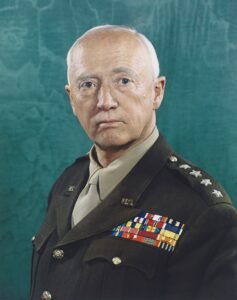
George Patton
George S. Patton (1885–1945)
- The most feared American commander in the German High Command's estimation,1National WWII Museum — George S. Patton Patton rehabilitated the demoralised II Corps after Kasserine Pass, commanded the Seventh Army in Sicily, and led the Third Army in the fastest armoured advance in history — covering more ground, taking more prisoners, and killing more enemy troops than any comparable formation in the Western theatre.2Britannica — George S. Patton
- Slapped two shell-shocked soldiers in Sicily in 1943, was removed from battlefield command for eleven months, and was used by Eisenhower as a deliberate deception asset — the Germans' respect for him was so high that his fictional command held their attention away from the real Normandy landing for weeks after D-Day.3Wikipedia — George S. Patton
- Relieved the besieged 101st Airborne at Bastogne in 48 hours — disengaging six divisions, rotating them ninety degrees in mid-winter, and executing a pre-planned counterattack that Patton himself called the Third Army's most outstanding achievement of the war1National WWII Museum — George S. Patton — before being relieved of command in October 1945 for antisemitic statements and publicly opposing Allied denazification policy.2Britannica — George S. Patton
George Patton is the dataset's clearest demonstration of a leader whose variables were not intrinsically good or bad but context-dependent — effective when the context provided external constraint and direction, catastrophic when it did not. The same Ego that generated the charisma to inspire demoralised troops at Kasserine generated the antisemitic diary entries in Bavaria.3Wikipedia — George S. Patton The same Pride that made him refuse to accept the possibility of defeat made him refuse to accept the possibility that he was wrong about denazification. The equations record the same variables producing opposite outcomes across three snapshots, and the difference is not in the variables. It is in whether the war was still happening.
The North Africa and Sicily period establishes the template. What Patton did to the II Corps after Kasserine Pass was not sophisticated — it was elemental. He imposed discipline, imposed appearance standards, imposed schedules, and moved continuously through the command conveying by physical presence that the expectation of performance had not changed because the performance had recently failed. This works when the leader doing it has Conviction at maximum and Ability at the level required to back the expectation with credible operational direction. Patton had both. The demoralised formation responded because it could tell the difference between a leader performing confidence and a leader who genuinely could not conceive of the outcome being anything other than forward. The German High Command, which had more respect for Patton than for any other Allied commander, was not being polite.1National WWII Museum — George S. Patton They were being accurate.
The slapping incidents are analytically significant not because they were morally egregious — they were — but because they were the first documented instance of the system signalling that its own internal friction was exceeding safe operational limits.3Wikipedia — George S. Patton Chaos at this period is the product of Ego and Pride at their near-maximum levels. The incidents were not aberrations from Patton's character. They were expressions of it, directed at the wrong target under conditions of insufficient external check. Eisenhower's response — private reprimand, enforced apology, eleven months removed from battlefield command — was the external management of a variable profile that could not manage itself.
The Third Army breakout is the peak and the paradox simultaneously. This is the most analytically extraordinary snapshot in the Military domain dataset — Conviction and Ability at maximum, Defined Output at maximum, People and Intent at maximum, operating in a focused operational context with sufficient Resources and a favourable k reflecting the timing of the breakout relative to German defensive collapse.2Britannica — George S. Patton The Chaos score does not change from the previous snapshot. Ego and Pride remain at their near-maximum levels throughout. What changes is the Autonomy variable — operating under Bradley and Eisenhower provided the external command architecture that managed Patton's self-destructive tendencies without suppressing his operational genius. The equations record this correctly: his highest Effective Power score is achieved not when he has maximum freedom but when he has maximum focus within managed constraint.
The Bastogne relief deserves specific analytical attention. The ability to disengage six divisions from front-line combat in the middle of winter, rotate them ninety degrees, and commence a counterattack within forty-eight hours was not improvisation. It was the product of a staff that had been trained to anticipate Patton's operational instincts and had prepared contingency orders before the crisis arrived.2Britannica — George S. Patton The two words "Play ball" initiated a pre-planned response to a situation that had not yet occurred. That is Process and Intent operating at their documented maximum — the opposite of the chaotic impressionism his critics attributed to him.
The post-war Germany snapshot is the dataset's most complete illustration of what happens when a leader whose variables require external focus is placed in a context that provides none. The war ended. The Defined Output disappeared. The Intent collapsed. The Conviction — previously directed at a precise military objective — had nowhere to go except inward, and inward for Patton meant the antisemitic beliefs he had held throughout his career but had been insufficiently notable to record as operational variables when there was a war to fight.3Wikipedia — George S. Patton Blumenson's verdict — that he had become delusional — is the layman's description of what happens when Chaos at 100 operates without the numerators that had previously overcome it.3Wikipedia — George S. Patton The system produced its own relief from command because that was the only available correction mechanism. It had done the same in Sicily. Without the war to restart the cycle, there was no next chapter.
Eisenhower's private assessment placed Patton fourth among his senior American commanders in February 1945. Stalin stated that the Red Army could not have planned or executed the advance across France. De Gaulle placed his achievements alongside Napoleon's. Rommel credited him with the most astonishing achievement in mobile warfare. These are not the assessments of a simple leader. They are the assessments of a specific kind of leader — one whose profile produced outcomes at the extreme end of the distribution in both directions, depending entirely on whether the context was providing what his variables could not generate internally: focus, constraint, and a Defined Output precise enough to direct a Chaos score that could not be reduced.
Score Comparison
Add up to 10 leaders. Click a name to visit their profile.
The 13 Equations
Scores for: North Africa — SicilyThe 22 Variables
Canonical scoresSources & Bibliography
The scores assigned to this leader are derived from publicly available sources. Variable inputs reflect documented behaviour, structural conditions, and historical record at the time of each snapshot.