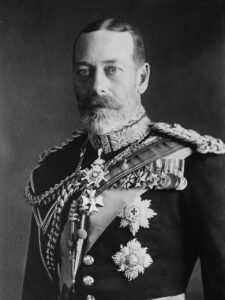
George V
George V (1865–1936)
- A naval officer who became heir to the throne only on the unexpected death of his elder brother in 1892,1Wikipedia — George V George V reigned for twenty-six years through the constitutional crisis of 1910, the First World War, the Irish question, the first Labour government, and the General Strike — while every other major European royal house collapsed around him.2Britannica — George V
- Renamed the royal house from Saxe-Coburg-Gotha to Windsor in 1917 to defuse republican sentiment during the war,1Wikipedia — George V visited the Western Front repeatedly, and managed the appointment of the first Labour government in 1924 with sufficient tact that it allayed Labour suspicions about royal intentions and set the terms for a relationship between the monarchy and the labour movement that persisted for generations.2Britannica — George V
- Refused asylum to Tsar Nicholas II in 1917, against the advice of his government, for reasons of political self-preservation during a period of acute republican sentiment in Britain — then recorded the subsequent murder as "a foul murder" and expressed private grief for "Cousin Nicky."1Wikipedia — George V Predicted with complete accuracy that his eldest son Edward would ruin himself within months of his own death — wrong only on the timeline.2Britannica — George V
George V is the dataset's clearest illustration of what constitutional constraint does to a leader of genuine quality. The Autonomy variable never exceeds a low ceiling across his entire reign — a structural limitation imposed not by personal failure but by the architecture of constitutional monarchy itself. A king who possesses only the rights to be consulted, to encourage, and to warn cannot produce Effective Power proportional to his personal variables regardless of how good those variables are. The equations record this honestly, and the result is a profile that consistently underperforms what the personal variable quality would produce in any other structural context. That underperformance is not a criticism of George V. It is a description of the role.
What makes the profile analytically significant is what he did within that constraint. Harold Nicolson, his official biographer, despaired of the pre-accession period — nothing but killing animals and sticking in stamps. The assessment is not wrong as a description of the man's habits. It misses entirely what the man was doing institutionally. George V spent the pre-war years learning, with genuine Humility, how to operate a role whose formal powers were minimal and whose informal influence was everything. The constitutional crisis of 1910 — inheriting a throne already committed by his predecessor to threatening the Lords with new peers, being given conflicting advice by his two private secretaries, feeling browbeaten into a decision he disagreed with — was not a comfortable beginning.2Britannica — George V He absorbed it, recorded his discomfort, and operated within the constraint. That is Humility and Process functioning correctly in a role that demanded both.
The World War I period is where the profile's most significant Congruence event is recorded. The Romanov decision — refusing asylum to Tsar Nicholas II against the advice of his government, for reasons of political self-preservation during a period of republican sentiment in Britain, while describing the subsequent murder as "a foul murder" and recording his devotion to "Cousin Nicky" — is a documented say-do gap that the equations cannot ignore.1Wikipedia — George V The historical record is clear that it was George, not Lloyd George, who blocked the rescue. The gap between his private grief and his public decision is where the Congruence score takes its principal hit. It does not collapse the profile because it was a single decision under genuine political pressure, and the surrounding variable record is strong. But it is there, and the equations record it.
What surrounds it is genuinely impressive for a constitutional monarch operating in the most severe external conditions of his reign. The renaming of the royal house from Saxe-Coburg-Gotha to Windsor was not merely symbolic — it was a precise reading of the political Environment, executed with sufficient Conviction to defuse a genuine threat to the monarchy's legitimacy at a moment when every other major European royal house was falling.1Wikipedia — George V He visited the front repeatedly, was seriously injured when his horse rolled on him during a troop review in France, and continued. His reply to H. G. Wells's comment about Britain's "alien and uninspiring court" — "I may be uninspiring, but I'll be damned if I'm alien" — is the most precise self-assessment in the Royalty domain. He understood exactly what his variables were and what they were not.
The interwar stabilisation period is the profile's analytical peak. His management of the first Labour government appointment in 1924 is the clearest illustration of the role functioning at its maximum effectiveness.2Britannica — George V A less skilled constitutional monarch would have allowed the appointment to become a crisis. George V managed it with sufficient tact and deliberate inclusivity that it allayed Labour suspicions about his intentions and set the terms for a relationship between the monarchy and the labour movement that persisted for generations. During the General Strike of 1926 he advised against inflammatory government action and refused to characterise the strikers as revolutionaries, saying privately that people should try living on their wages before judging them.1Wikipedia — George V That is Congruence and Value operating at their documented maximum — a leader whose stated commitment to operating across class lines was matched by his actual behaviour when the stakes were highest.
The interwar period also contains his most perceptive single act of leadership: the prediction about his eldest son. In 1935 he said of Edward that after his death the boy would ruin himself within twelve months, and expressed the hope that nothing would come between Bertie and Lilibet and the throne.2Britannica — George V He was wrong only on the timeline — Edward lasted slightly longer than twelve months before the abdication. The accuracy of the prediction reflects a Defined Output and Intent that his public role never permitted him to state directly but that he understood with complete clarity. The succession was the mission. Everything else was operational.
His final words to his secretary — "How is the Empire?" — are the profile in miniature. Not self-referential. Not concerned with his own condition. Oriented entirely toward the system he had spent twenty-six years trying to keep stable. The British monarchy survived the collapse of every other major European royal house during his reign. The equations suggest that was not entirely accidental.
Score Comparison
Add up to 10 leaders. Click a name to visit their profile.
The 13 Equations
Scores for: World War IThe 22 Variables
Canonical scoresWhat changed: Pre-war Constitutional Crisis → World War I
Sources & Bibliography
The scores assigned to this leader are derived from publicly available sources. Variable inputs reflect documented behaviour, structural conditions, and historical record at the time of each snapshot.