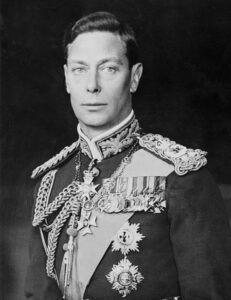
George VI
George VI (1895–1952)
- Assumed the throne unexpectedly in December 1936 after his brother's abdication, having wept when he realised it was inevitable — wrote to Edward that he had reluctantly inherited "a rocking throne" and tried "to make it steady again"1Wikipedia — George VI — and spent years working with speech therapist Lionel Logue to manage a severe stammer that made the public duties of his role a sustained act of personal courage.1Wikipedia — George VI
- Remained at Buckingham Palace throughout the Blitz — the Palace was bombed nine times — made morale visits to troops in North Africa, Normandy, Italy and the Low Countries,1Wikipedia — George VI and built with Churchill what the King's diary records as the closest personal relationship in modern British history between a monarch and a prime minister, the two meeting privately every Tuesday for four and a half years.1Wikipedia — George VI
- Travelled to London Airport on 31 January 1952, against medical advice, to see Elizabeth and Philip depart for their Commonwealth tour. It was the last time he was seen in public. Six days later he was dead, aged 56. On Churchill's wreath at the funeral were the words inscribed on the Victoria Cross: "For Valour."2The Royal Family — George VI
George VI presents the Codex with its purest case of leadership through character rather than power. He held no executive authority. He could not initiate policy, command forces, or act without ministerial advice. He did not seek the role, was not prepared for it, and wept when it was given to him. And yet the variables that define his profile are among the most consistent in the dataset — not because the circumstances were easy, but because the man never deviated from what the role required regardless of personal cost.
The abdication is the event that defines his starting conditions and shapes every variable in the first snapshot. He did not inherit a stable institution. He inherited, in his own words, a rocking throne — a monarchy whose public faith had been shattered by his brother's failure and whose legitimacy needed to be rebuilt from almost nothing.1Wikipedia — George VI The Congruence variable begins its work immediately: he said he would serve, assumed the regnal name George to emphasise continuity, and began the long process of making the throne steady again. The say-do gap that characterises so many profiles in this dataset is absent from the first entry.
The stammer is not a biographical footnote. It is an analytical variable. A leader whose primary instrument of public influence is speech, operating with a severe impediment that required years of therapy with Lionel Logue, is a leader whose Confidence score tells a more complex story than the number alone suggests.1Wikipedia — George VI What the profile records is not absence of anxiety but the sustained effort to project composure despite it. The arc from the closing speech at the British Empire Exhibition, which was in his own account an ordeal for both him and his listeners, to the wartime broadcasts a decade and a half later is the Conviction variable working across time — not held positions against external opposition, but held performance standards against internal resistance.
The Wartime snapshot is where the profile produces its highest scores and where the mechanism becomes analytically clear. George VI stayed in London. He accepted rationing. Buckingham Palace was bombed while he and the Queen were present. He made morale visits to troops in North Africa, Normandy, Italy and the Low Countries.1Wikipedia — George VI The Queen's response to the bombing — that she was glad of it because it meant she could look the East End in the face — is the Congruence variable stated explicitly. The institutional decision to stay was not merely symbolic. It was the alignment between a stated commitment to shared sacrifice and actual conduct under genuine risk. The Congruence score sits at its highest point in this snapshot accordingly.
The relationship with Churchill is analytically significant and analytically distinct from his role as symbol. Every Tuesday for four and a half years, the two men met privately for lunch, discussing the war in secret with a frankness that no staff presence permitted.3International Churchill Society — The Dutiful King George's diary is the only extant first-hand account of those conversations. A constitutional monarch who had initially preferred Halifax over Churchill, who overcame that preference, built the closest personal relationship in modern British history between a monarch and a prime minister, and maintained it through five years of existential war — that is not passive symbolism. That is the Ability and Congruence variables operating through the one channel of genuine informal influence available to him. When the war ended and Churchill appeared on the VE Day balcony at Buckingham Palace, the invitation came from the King. That detail belongs to the Humility variable — a leader at his moment of greatest recognition sharing the recognition without apparent difficulty.
The post-war snapshot records what the equations produce when the conditions that elevated the wartime scores are removed. The imperial dissolution — India and Pakistan independent in 1947, Ireland departed — is processed through the Defined Output variable rather than the Value variable, because these were not failures of his leadership but the managed consequences of forces larger than any constitutional monarch could redirect.4Britannica Kids — George VI What he managed was the transition itself: the Commonwealth reconstituted, the Head of the Commonwealth role established, and his successor prepared with sufficient care that the handover in 1952 was entirely seamless.
The health decline in the final years is the profile's most analytically significant late variable. He continued public duties despite serious illness. He travelled to London Airport on 31 January 1952, against the advice of those around him, to see Elizabeth and Philip depart for their Commonwealth tour. It was the last time he was seen in public. Six days later he was dead.2The Royal Family — George VI The Conviction variable records this not as stubbornness but as the final expression of a career-long pattern: the role came first, the man came second, and that order never reversed.
The Chaos variable sits at its floor across all three snapshots. Pride near-absent. Ego near-absent. No score-settling, no memoirs, no public complaints about the burden of a role he had never wanted. The equations reward this structurally, as they do for every leader in this dataset who suppresses the variables that destroy from the inside. But what distinguishes George VI from other low-Chaos profiles is that his suppression was not discipline imposed on a naturally high level — it appears to have been genuine. He did not contain his Ego. He appears not to have had much to contain.
George VI wrote to his brother that he had tried to make a rocking throne steady again. The Codex records that he succeeded — and identifies the mechanism: minimum Chaos, maximum Congruence, and the quiet performance of duty until there was no more duty left to perform.
Score Comparison
Add up to 10 leaders. Click a name to visit their profile.
The 13 Equations
Scores for: Wartime 1939–1945The 22 Variables
Canonical scoresWhat changed: Accession and Pre-War 1936–1939 → Wartime 1939–1945
Sources & Bibliography
The scores assigned to this leader are derived from publicly available sources. Variable inputs reflect documented behaviour, structural conditions, and historical record at the time of each snapshot.