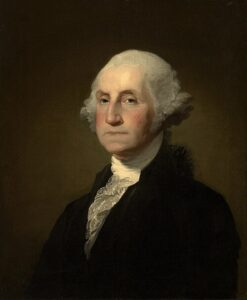
George Washington
George Washington (1732–1799)
- George Washington — Virginia planter, surveyor, Lieutenant Colonel in the Virginia Regiment during the French and Indian War, delegate to the Continental Congress, Commander-in-Chief of the Continental Army from 1775 to 1783, presiding officer of the Constitutional Convention of 1787, and first President of the United States from 1789 to 1797 — was the indispensable figure of the American founding not because he was its most brilliant mind, which he was not, but because he was the one leader whose personal authority, Congruence, and voluntary surrender of power made the entire constitutional experiment credible to the people it governed and the world that was watching.1Britannica — George Washington
- His military career encompassed more defeats than victories — Long Island, Kip's Bay, Fort Washington, Brandywine, Germantown — and the strategic insight to understand that losing battles while preserving the army was the correct approach to a war of attrition against a professional force that could not be defeated in conventional engagement, producing at Trenton, Princeton, and ultimately Yorktown a record that vindicates the strategic Vision even as the tactical record remains mixed.2Miller Center — George Washington Key Events
- The voluntary relinquishment of power — twice, first as Commander-in-Chief in 1783 and then as President in 1797 — is the most consequential single act of political self-denial in the dataset, the moment that most precisely separates Washington from every other revolutionary military leader of his era, and the variable score that most directly explains why the American republic survived its founding period when every comparable revolutionary republic of the eighteenth and nineteenth centuries did not.3Mount Vernon — Resignation of Command
George Washington is the most institutionally consequential profile in the American Political domain and the one whose variable analysis diverges most sharply from the conventional heroic framing. He was not the most brilliant, the most eloquent, or the most militarily gifted leader of the American founding. He was the most necessary — and the equations explain precisely why necessity and brilliance are different variables.
The formation period establishes the baseline with unusual clarity. Washington's early military career in the French and Indian War — including the ambush at Jumonville Glen that he initiated and which contributed to the outbreak of a world war, and the surrender at Fort Necessity that followed — is the formation experience of a leader who learned from catastrophic failure at a young age in high-stakes conditions.1Britannica — George Washington The Learning variable in this period is analytically significant: Washington drew specific and durable lessons from the Braddock campaign — about the limitations of European linear tactics against irregular warfare, about logistics, about the relationship between political authority and military command — that directly informed his conduct of the Revolutionary War two decades later. The Humility variable at this snapshot is higher than the planter-aristocrat background would predict, because the Fort Necessity surrender had been a direct and public failure that he could not attribute to anyone else.
The appointment as Commander-in-Chief in June 1775 is analytically unusual in the dataset because the appointment was made on political rather than military grounds — Washington was selected partly because a Virginia commander would broaden the geographical coalition of the rebellion beyond New England.2Miller Center — George Washington Key Events The People variable in the Continental Congress that made this selection was operating correctly: the political requirement and the military requirement happened to converge in the same individual. Washington understood the political dimension of his appointment — he wore his Virginia militia uniform to the Congress sessions before his selection, a Communication variable operating with deliberate precision before he held any formal authority.
The military record from 1775 to 1783 requires honest treatment of both its failures and its strategic coherence. The defeats were real and significant — the loss of New York in 1776 nearly ended the war, and the subsequent retreat through New Jersey tested the army's survival.1Britannica — George Washington The strategic framework that Washington eventually settled on — avoiding decisive engagement, preserving the army as a symbol of continuing resistance, using terrain and mobility to impose disproportionate costs on British logistics — was not obvious at the outset and was disputed by officers who wanted more aggressive action. The Adaptability variable records the shift from the conventional engagement instinct of the early campaign to the Fabian strategy that produced eventual victory: a leader updating his strategic method without abandoning his strategic objective.
Trenton on 26 December 1776 is the canonical military snapshot and the most analytically precise expression of the Decisiveness variable in the Revolutionary period. Washington crossed the Delaware in deteriorating weather conditions with a demoralised and poorly equipped force, achieved complete tactical surprise against the Hessian garrison, and produced a victory whose military significance was modest and whose political and psychological significance was transformative.4Mount Vernon — Battles of Trenton and Princeton The Communication variable at this moment reflects a leader who understood that the war was being fought simultaneously in the field and in public opinion, and that a visible victory at the moment of maximum despair was worth more than its tactical weight. The k variable scores its lowest point in the profile in the winter of 1776 to 1777 — and the Trenton decision reflects a leader who moved decisively when fortune was most hostile rather than waiting for conditions to improve.
The Valley Forge winter of 1777 to 1778 is the Resilience variable at its most operationally significant. Washington held the army together through conditions of cold, starvation, and desertion that reduced the Continental Army to fewer than half its established strength, managed the Conway Cabal — an attempt by congressional and military figures to replace him with General Gates — through a combination of political patience and the loyalty of officers who preferred Washington to the alternative, and emerged in spring 1778 with a force that had been trained by Baron von Steuben to a standard of professional competence it had not previously achieved.5History.com — Valley Forge The People variable at this snapshot reflects both the management of the Cabal and the recognition of von Steuben's value — a leader who could identify capability in an unlikely source and deploy it without ego investment in the existing institutional arrangements.
The Constitutional Convention of 1787 is analytically significant not for what Washington said — he said almost nothing in the formal proceedings — but for what his presence signified.6Constitution Center — Washington and the Convention His willingness to attend and preside over the Convention was the signal to the political class that the document produced would be worth ratifying — that the new constitutional order had the endorsement of the one figure whose authority transcended factional interest. The Influence variable at this snapshot is the highest in the profile, operating entirely through presence and reputation rather than argument or action. A leader whose Influence is sufficient to reshape political outcomes without speaking is operating the variable at its most refined expression.
The presidency from 1789 to 1797 established every precedent the office subsequently required. The cabinet system, the relationship between executive and legislative authority, the management of foreign policy, the suppression of the Whiskey Rebellion, the Neutrality Proclamation during the French Revolutionary Wars — each decision was made in the explicit knowledge that it would function as precedent, which is the Vision variable operating at its most institutionally responsible.2Miller Center — George Washington Key Events The Farewell Address of 1796 — warning against permanent foreign alliances, sectional division, and the spirit of party — is the Communication variable producing its most durable output: a document whose analytical framework remained relevant to American political debate for more than a century after his death.
The resignation from the presidency in 1797 — voluntary, after two terms, when he could have continued — is the most consequential single Congruence act in the American dataset.3Mount Vernon — Resignation of Command King George III, on being told that Washington intended to resign his military command and return to his farm, reportedly said that if he did so, he would be the greatest man in the world. He did so. The Value variable at this snapshot reaches its ceiling not because of any specific policy output but because the voluntary surrender of power demonstrated that the constitutional system was more durable than any individual within it — which is the definition of institutional Value in the Leaderment model.
The number that matters most across all four snapshots is Congruence — specifically its consistency across the full arc of public life. Washington said he would serve without pay as Commander-in-Chief and did. He said he would return to civilian life after the war and did. He said the presidency should be a temporary public trust and treated it as one. The say-do gap across forty years of public life is among the smallest in the entire dataset. In a leader whose position depended entirely on the trust of a fractious coalition of colonies, states, and political factions that had no other binding mechanism, that Congruence was not merely a personal virtue — it was the structural load-bearing variable of the entire American founding. That is the Leaderment profile of George Washington.
Score Comparison
Add up to 10 leaders. Click a name to visit their profile.