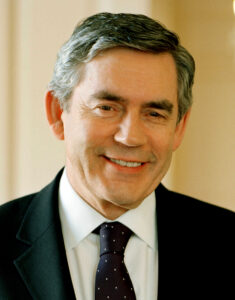
Gordon Brown
Gordon Brown (born 1951)
- Born in Giffnock, Scotland, the son of a Church of Scotland minister, accepted into the University of Edinburgh at sixteen — Britain's longest-serving modern Chancellor of the Exchequer, from 1997 to 20071GOV.UK — Gordon Brown — granting the Bank of England operational independence in monetary policy within days of taking office, presiding over the longest period of sustained economic growth in British history, and delivering eleven successive budgets without a recession.
- Became Prime Minister in June 2007, saw his authority permanently damaged within months when he called and then failed to call a general election in a single catastrophic week of indecision — then in October 2008 co-ordinated the recapitalisation of the British banking system over an exhausting weekend with Chancellor Alistair Darling, producing a five-point plan that became the template other governments followed and drew public credit from President Obama.2Museum of the Prime Minister — Gordon Brown
- Hosted the G20 summit in London in April 2009 to coordinate the global economic response to the financial crisis3Britannica — Gordon Brown — then lost the 2010 general election, resigned as Prime Minister and Labour leader on the same day, and departed with unusual dignity having been unable to recover the domestic authority that Black Wednesday had permanently destroyed — subsequently serving as UN Special Envoy for Global Education and WHO Ambassador for Global Health Financing.
Gordon Brown served as Chancellor of the Exchequer from 1997 to 2007 and Prime Minister from 2007 to 2010. His career produces one of the most striking analytical contrasts in the Codex — an extraordinary Leaderment score during the 2008 financial crisis, and near zero as Prime Minister across the full arc of his premiership. The same man. The same variables. Radically different contexts.
As Chancellor, Brown presided over the longest period of sustained economic growth in British history.4Wikipedia — Chancellorship of Gordon Brown The decision to grant the Bank of England operational independence in his first week in office was one of the most consequential and correct acts of economic management of the era. He was disciplined, data-driven, obsessively focused on defined outputs, and possessed of a genuine intellectual framework for what he was trying to achieve. Ability, Conviction, Process, and Defined Output were all at their ceiling.
The transition to Prime Minister exposed every structural weakness the Chancellor role had concealed. Brown had no political charm, no ability to read a room, and a temperament forged entirely in the culture of internal rivalry rather than public leadership. The decade-long briefing war against Blair had corroded his relationship with the parliamentary party. He called and then failed to call a general election in 2007 in a single catastrophic week of indecision — a moment that destroyed his Confidence variable before he had properly established his authority.5Wikipedia — Premiership of Gordon Brown Competition, Corporate Drag, and Pride began accumulating as Chaos Tax.
Then the financial crisis arrived — and for one extraordinary period, the job became exactly the job Brown was built for. Technical, high-stakes, globally coordinated, requiring iron Conviction and systematic Process. His coordination of the global banking recapitalisation became the template other governments followed. Obama credited him publicly. The crisis did not make Brown a better politician. It briefly made the political role irrelevant.
When it passed, everything that had been suppressed reasserted itself. The domestic damage was permanent, the authority never recovered, and the 2010 election defeat was emphatic.3Britannica — Gordon Brown
He departed with unusual dignity — resigning the Labour leadership on the same day he left Downing Street — closing a premiership that the Codex scores not as a failure of character but as a failure of fit. The variables that produced a transformational Chancellor produced a powerless Prime Minister. The office changed. The man did not.
Score Comparison
Add up to 10 leaders. Click a name to visit their profile.
The 13 Equations
Scores for: Chancellor of the Exchequer 1997–2007The 22 Variables
Canonical scoresSources & Bibliography
The scores assigned to this leader are derived from publicly available sources. Variable inputs reflect documented behaviour, structural conditions, and historical record at the time of each snapshot.