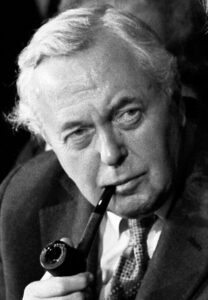
Harold Wilson
Harold Wilson (1916–1995)
- Harold Wilson — son of a works chemist from Huddersfield, Oxford scholar, wartime economist at the Board of Trade, MP from 1945, President of the Board of Trade under Attlee, Shadow Chancellor, Leader of the Labour Party from 1963, and Prime Minister in two separate administrations from 1964 to 1970 and 1974 to 1976 — won four of the five general elections he fought as Labour leader, more than any other Labour politician in history, governing Britain through the most turbulent decade of the postwar period with a political survival capability that his contemporaries found inexplicable and his biographers have found difficult to separate from the question of whether survival was sufficient.1Britannica — Harold Wilson
- His two administrations produced the Open University, the decriminalisation of homosexuality and abortion under the liberal legislation of Roy Jenkins, the Equal Pay Act, the Race Relations Act, the renegotiation of British EEC membership and the 1975 referendum that confirmed it, the Social Contract with the trade unions, and the management of the 1974 minority government through a period of industrial and economic crisis that would have ended most political careers — while simultaneously failing to resolve the fundamental economic contradictions of the British economy, managing rather than reforming the trade union structure that produced the Winter of Discontent under his successor, and presiding over a devaluation he had promised would not happen and a sterling crisis he had promised to prevent.2History Extra — Harold Wilson
- The private record of a man who was simultaneously more intellectually capable than his opponents acknowledged and more politically calculating than his supporters preferred — whose Huddersfield pipe and flat cap were as carefully constructed a political persona as Macmillan's Edwardian ease, whose paranoia about MI5 surveillance of his government has been partially vindicated by subsequent disclosure, and whose resignation in March 1976 at the age of sixty, citing exhaustion, occurred at a moment when his cognitive decline was already visible to those closest to him — is the most analytically complex Congruence profile in the postwar British Political domain, a leader whose public performance and private reality operated in sustained and deliberate tension throughout.3Oxford DNB — Harold Wilson
Harold Wilson is the most analytically contested profile in the postwar British Political domain — contested because the variable profile that produced four election victories, thirteen years of Labour leadership, and a significant legislative record is the same profile that produced the devaluation, the failed economic reform, and a political style so focused on tactical management that strategic transformation was consistently sacrificed to short-term survival. The equations do not resolve this tension. They record it precisely.
The formation period is analytically distinctive in the British Political dataset for the combination of genuine intellectual ability and specific economic expertise that it produced. Wilson was a genuinely exceptional economist — his first class degree at Oxford, his wartime work with William Beveridge on the statistical framework for the welfare state, and his Board of Trade presidency under Attlee reflect a Learning and Ability variable baseline that most politicians of his era did not approach.1Britannica — Harold Wilson The resignation from the Attlee government in April 1951 alongside Aneurin Bevan — over the introduction of NHS charges to fund rearmament — is the formation period's most analytically significant political decision: it established left credentials, demonstrated Conviction, and positioned him as Bevan's heir in a way that the subsequent career both exploited and was constrained by.
The Leader of the Opposition period from 1963 is where the Communication variable reaches its highest point in the profile. Wilson's 1963 conference speech — promising to forge a new Britain in the white heat of a technological revolution — is the most effective single conference address of any postwar Labour leader, capturing a cultural moment of modernising optimism with a rhetorical precision that Gaitskell's more earnest style had never achieved.4British Political Speech — Wilson White Heat Speech The Intent variable at this snapshot is at its highest point in the profile — Wilson understood exactly what the moment required and delivered it with complete precision. The subsequent question — whether the white heat of technology was a governing programme or a Communication strategy — is the Congruence variable beginning its long divergence from the Communication variable.
The 1964 election victory — a majority of four, sufficient for a mandate, insufficient for legislative transformation — is the k variable operating at its most constraining. Wilson inherited a balance of payments deficit of 800 million pounds, a sterling crisis, and a parliamentary majority that made any controversial legislation a potential vote of confidence.1Britannica — Harold Wilson The Environment variable at this snapshot is among the most hostile of any incoming British government of the postwar period. The Adaptability variable records the strategic response — Wilson managed the constraints rather than confronting them, preserving the government's survival at the cost of the economic reform programme that the white heat speech had implied.
The devaluation of November 1967 is the canonical Congruence failure of the first administration. Wilson had publicly and repeatedly committed to defending the sterling parity — "the pound in your pocket" broadcast following devaluation, in which he argued that the pound's value in domestic purchasing power had not changed, is the most analytically precise Communication variable failure in the postwar British dataset.5Bank of England — Sterling Devaluation 1967 The statement was technically accurate and politically catastrophic — it confirmed precisely the gap between what Wilson said and what the electorate understood him to have said that the Congruence variable records. The devaluation itself was economically correct and two years overdue — the economic management that had prevented it had consumed the policy space that structural reform required.
The liberal legislation of the first administration is the most durable Value output of the career and the one most consistently underattributed to Wilson's government. The Sexual Offences Act decriminalising homosexuality, the Abortion Act, the abolition of capital punishment, the Race Relations Act, and the establishment of the Open University were all passed or initiated under Wilson's government — reflecting a Vision of social modernisation that the white heat speech had signalled and that Roy Jenkins as Home Secretary delivered.6UK Parliament — Homosexuality Legislation The People variable records the Jenkins appointment as the most consequential single personnel decision of the career — Wilson identified the right person for the right role and gave him the space to deliver, which is the People variable functioning correctly even when the relationship between the two men was personally difficult.
The 1974 minority government is the most analytically underrated period of the career. Wilson won the February 1974 election without a majority, formed a minority government, won a second election in October with a majority of three, and governed through a period of oil shock, inflation, and trade union militancy with a Social Contract framework that traded wage restraint for social policy commitments.2Britannica — Harold Wilson The Resilience variable at this snapshot is among the highest in the profile — a leader who had lost in 1970, rebuilt the party, and returned to govern in conditions more hostile than those he had left. The EEC referendum of 1975 — in which Wilson held the Labour Party together by allowing cabinet ministers to campaign on opposing sides — is the Adaptability variable at its most politically sophisticated: a constitutional innovation designed to manage an internal party contradiction that no other mechanism could have resolved.
The resignation in March 1976 is the most analytically unusual exit in the British Political dataset. Wilson resigned voluntarily at sixty, having told the Queen of his intention months earlier, at a moment when his government was functioning and his parliamentary position was stable.3Oxford DNB — Harold Wilson The subsequent disclosure that he was experiencing early symptoms of the cognitive decline that Alzheimer's disease would eventually produce gives the resignation an analytical dimension that was not publicly understood at the time — a leader whose self-knowledge was sufficient to identify the moment at which his capability was beginning to degrade, and who acted on that knowledge rather than clinging to office. The Humility variable at this snapshot is the highest in the profile.
The number that matters most across all four snapshots is the gap between the Communication variable and the Defined Output variable. Wilson could articulate a direction — the white heat of technology, the pound in your pocket, the Social Contract — with a political precision that moved electoral opinion consistently and effectively. The gap between what the Communication variable promised and what the Defined Output variable delivered is the central analytical tension of the career. It is not hypocrisy in the simple sense — the constraints were real, the environment was hostile, and the survival that the tactical management produced was the precondition for the liberal legislation that constitutes the most durable Value output. But the gap is real and the equations record it. That is the Leaderment profile of Harold Wilson.
Score Comparison
Add up to 10 leaders. Click a name to visit their profile.
The 13 Equations
Scores for: First Administration — Liberal Legislation and DevaluationThe 22 Variables
Canonical scoresWhat changed: White Heat — Opposition Leadership and 1964 Victory → First Administration — Liberal Legislation and Devaluation
Sources & Bibliography
The scores assigned to this leader are derived from publicly available sources. Variable inputs reflect documented behaviour, structural conditions, and historical record at the time of each snapshot.