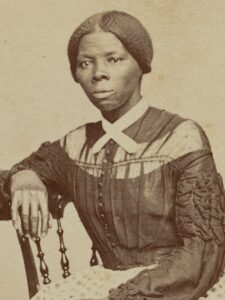
Harriet Tubman
Harriet Tubman (c.1822–1913)
- Harriet Tubman — born Araminta Ross into slavery on a Maryland plantation, beaten and injured so severely as a child that she suffered debilitating narcoleptic episodes for the rest of her life, escaped alone to Philadelphia in 1849, and returned south thirteen times over the following decade to lead approximately seventy enslaved people to freedom via the Underground Railroad — operated the most consequential personal liberation network in American history under conditions of legal jeopardy that made every return journey a potential death sentence, earning from those she led the title Moses, and from the slaveholders who could not catch her a bounty that reached forty thousand dollars without ever being collected.1Britannica — Harriet Tubman
- Her Civil War service as a spy, scout, and intelligence coordinator for the Union Army — culminating in the Combahee River Raid of June 1863 in which she guided Colonel James Montgomery's gunboats through Confederate minefields to liberate more than seven hundred enslaved people in a single night, the largest single liberation action of the war — demonstrated that the operational capability she had developed on the Underground Railroad could be scaled to military intelligence operations of strategic consequence, making her the first woman in American history to lead an armed military raid.2National Park Service — Combahee River Raid
- The forty years of post-war advocacy — for women's suffrage alongside Susan B. Anthony and Elizabeth Cady Stanton, for the welfare of elderly African Americans through the home she established in Auburn, New York, and for the recognition of Black women's contribution to American civic life — extended a career of active leadership from the 1840s to the 1910s, making Tubman the longest-serving active leader in the American dataset and the one whose Resilience variable sustained the highest output across the most hostile sequence of environments in the record.3Harriet Tubman Bicentennial — Biography
Harriet Tubman is the most analytically unusual profile in the American dataset and the one that most completely tests the model's capacity to record leadership that operated entirely outside institutional frameworks. She held no office, commanded no formal authority, controlled no budget, and operated within a legal environment that defined her existence as property rather than person. The equations record what she did anyway — and in doing so, demonstrate that the Autonomy variable measures permission space rather than institutional position, and that permission space can be self-created.
The formation period is defined by conditions of institutional violence that the dataset does not elsewhere record for a leader who subsequently achieved significant output. Tubman was born into chattel slavery — a legal and social system that denied her personhood, physical integrity, and any form of self-determination — and was subjected to physical abuse that left her with permanent neurological damage.1Britannica — Harriet Tubman The narcoleptic episodes that resulted from a head injury inflicted by an overseer when she was approximately twelve years old — sudden losses of consciousness that occurred throughout her life including during Underground Railroad missions — are not a biographical footnote. They are the formation condition that most precisely captures the Resilience variable: a leader who operated at sustained high output under physical constraint that would have ended most careers before they began. The Conviction variable in this period is built not through ideological formation but through direct personal experience of what the system she was fighting actually did to human beings.
The 1849 escape is the canonical formation event and the one that most precisely captures the Autonomy variable operating in its most self-created form. Tubman escaped alone, on foot, following the North Star, covering approximately ninety miles through hostile terrain with no institutional support, no maps, and no guarantee that the contacts she had been told about would materialise.4National Park Service — Harriet Tubman Escaping Slavery The Decisiveness variable at this moment is at its ceiling — she made the decision to go alone after two of her brothers turned back, understanding that waiting for others to be ready was a constraint she could not afford. The arrival in Philadelphia is the foundation snapshot of the entire subsequent career: every mission that followed was built on the operational knowledge that the solo escape produced.
The Underground Railroad period from 1850 to 1860 is the canonical snapshot and the most analytically concentrated expression of the profile. Tubman returned south thirteen times, operating in a legal environment made more hostile by the Fugitive Slave Act of 1850 — which required free states to return escaped slaves and made her Philadelphia base no longer safe, pushing the endpoint of each mission to Canada.5Britannica — Underground Railroad The Process variable at this snapshot is among the highest in the dataset for a non-institutional operator: Tubman developed a specific operational methodology — moving on Saturday nights when newspaper offices were closed and wanted notices could not be printed until Monday, using the specific network of safe houses along established routes, carrying a gun and making clear to those she was leading that turning back was not an option — that was refined across thirteen missions without a single capture. The Defined Output variable records the same operational precision from a different analytical angle: she set a specific objective for each mission and delivered it every time.
The People variable in the Underground Railroad period reflects a specific and unusual capability. Tubman was leading people who were terrified, physically exhausted, and operating under conditions where a single moment of hesitation or noise could produce capture and return to slavery. The management of that human material — keeping people moving, managing fear without suppressing the alertness that fear produces, maintaining group cohesion under conditions of extreme stress — required a People capability that most institutional leaders never face in equivalent form.6National Park Service — Underground Railroad The gun that Tubman carried was not primarily a weapon against slave catchers — it was a management instrument, ensuring that anyone who lost their nerve and considered turning back understood that the consequences of doing so extended to the entire group. That is the People variable operating under conditions where the normal institutional mechanisms of authority, incentive, and accountability have all been replaced by the single credible instrument of personal conviction.
The Civil War period from 1862 to 1865 is where the operational variables reach their highest institutional expression. Tubman's work for the Union Army — as cook, nurse, spy, and ultimately intelligence coordinator — reflected the specific capabilities the Underground Railroad had developed, now applied within a military institutional framework that gave her resources and authority she had not previously had access to.2National Park Service — Combahee River Raid The Combahee River Raid is the most analytically significant single operation of the career — Tubman had spent months developing an intelligence network among enslaved people in the Combahee River region, identifying Confederate minefield locations, troop dispositions, and plantation locations, and provided the operational intelligence that allowed Montgomery's gunboats to navigate safely and extract more than seven hundred people in a single night. The Defined Output variable at this moment is at its ceiling: a specific military objective, precisely executed, with a measurable and historically recorded outcome.
The post-war period from 1865 to 1913 is the most sustained expression of the Resilience variable in the dataset — forty-eight years of continued advocacy and community service, conducted in conditions of poverty, physical illness, and institutional neglect that the federal government did not begin to address until Congress passed a pension bill in 1899, thirty-four years after the war she had served in ended.3Harriet Tubman Bicentennial — Biography Tubman's suffrage work — speaking at women's suffrage conventions, maintaining a relationship with the leading figures of the movement, and living long enough to see the Nineteenth Amendment pass seven years before her death — reflects a Conviction variable that did not distinguish between the liberation of enslaved people and the enfranchisement of women as separate causes but understood both as expressions of the same foundational principle.
The Autonomy variable requires explicit analytical treatment across all snapshots. In institutional terms, Tubman's Autonomy was near the floor for most of her life — she was legally enslaved for the first quarter-century of her existence, operated without formal authority throughout the Underground Railroad period, and was denied the pension recognition that would have given her financial autonomy for most of her post-war life. In operational terms, her Autonomy was among the highest in the dataset — she made every significant decision independently, operated without oversight or accountability to any institutional structure, and designed her own operational methodology without reference to any existing model. The score reflects the operational reality rather than the institutional position.
The number that matters most across all four snapshots is Conviction — sustained at 10 from the 1849 escape to the suffrage conventions of the 1900s across sixty years of active leadership, under conditions of physical illness, institutional neglect, legal jeopardy, and poverty that would have justified a lower score at every point in the arc. Tubman did not experience her Conviction as a choice — she described her actions as directed by God, which is the language of a leader for whom the distance between belief and action has been reduced to zero. That reduction — Conviction operating without the gap that most leaders maintain between what they believe and what they do — is the analytical signature of Harriet Tubman, and it is the reason the dataset records her output as extraordinary against the most hostile sequence of environmental variables in the American record.
Score Comparison
Add up to 10 leaders. Click a name to visit their profile.
The 13 Equations
Scores for: Underground Railroad — Escape and Liberation MissionsThe 22 Variables
Canonical scoresSources & Bibliography
The scores assigned to this leader are derived from publicly available sources. Variable inputs reflect documented behaviour, structural conditions, and historical record at the time of each snapshot.