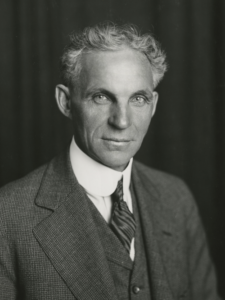
Henry Ford
Henry Ford (1863–1947)
- Left his father's farm at sixteen, taught himself engineering through apprenticeships, founded the Ford Motor Company in 1903, introduced the Model T in 1908, and by 1918 half of all cars in the United States were Model Ts1History.com — Henry Ford — introducing the moving assembly line in 1913 and the five-dollar daily wage in 1914, more than doubling what most workers earned and pulling the best mechanics in Detroit to Ford's factories.2History.com — Ford's antisemitism and worker treatment
- From 1920 distributed through Ford dealerships a sustained antisemitic campaign whose articles were bound into four volumes as The International Jew: The World's Foremost Problem, translated into sixteen languages and distributed across Europe3Holocaust Encyclopedia — Henry Ford and The International Jew — Adolf Hitler kept a life-size portrait of Ford behind his desk, cited him by name as the only American in Mein Kampf, and awarded him the Grand Cross of the German Eagle in 1938.4JSTOR Daily — Henry Ford's Anti-Semitism
- Resisted hydraulic brakes, all-metal roofs, annual model changes and consumer financing while General Motors dismantled his market dominance around him1History.com — Henry Ford — then spent his final years too frail to make decisions while his Service Department beat union organisers and the company lost ten million dollars a month, until his wife and daughter-in-law threatened to sell their combined shareholding if he did not hand control to his grandson.
Henry Ford did not invent the automobile. He did something more consequential — he made it affordable, and in doing so reshaped American life, American industry, and the physical landscape of the modern world. That achievement belongs to his first two decades at the Ford Motor Company. What followed belongs to a different story entirely.
Ford came to the automobile through mechanical obsession rather than business calculation. He left his father's farm at sixteen, taught himself engineering through apprenticeships and relentless experimentation, and after two failed ventures founded the Ford Motor Company in 1903.1History.com — Henry Ford The Model T arrived in 1908 — simple, reliable, cheap, and transformative. By 1918, half of all cars in the United States were Model Ts. In 1913, moving assembly belts entered the plants, compressing production time and cost in ways that permanently altered manufacturing. The five-dollar daily wage followed in 1914, more than doubling what most workers earned and pulling the best mechanics in Detroit to Ford's factories. The five-day working week came in 1926.2History.com — Ford's antisemitism and worker treatment Ford's argument was straightforward: workers needed wages high enough to buy what they made, and leisure time enough to want it. He was right on both counts, and the broader economy proved it.
That changed in 1919, when Ford manoeuvred the remaining shareholders out of the company through a calculated bluff and achieved sole ownership.1History.com — Henry Ford From that moment he answered to nobody. The equations register the shift immediately — Autonomy and Resources reach their ceiling. What they also register, with equal precision, is what Ford did with that freedom.
The Dearborn Independent had been running since 1918 under Ford's ownership. In 1920 it began publishing a sustained antisemitic campaign, distributing fabricated material through Ford dealerships to a readership of hundreds of thousands. Ford bound the articles into four volumes under the title The International Jew: The World's Foremost Problem, which was translated into sixteen languages, distributed across Europe, and read in Germany by people who would shape what came next.3Holocaust Encyclopedia — Henry Ford and The International Jew Heinrich Himmler described Ford as one of their most valuable fighters. Adolf Hitler kept a life-size portrait of Ford behind his desk and cited him favourably in Mein Kampf. Baldur von Schirach, who deported 65,000 Jews to camps in Poland, testified at Nuremberg that Ford's book had made him antisemitic.4JSTOR Daily — Henry Ford's Anti-Semitism Ford never genuinely recanted. The 1927 apology was drafted by Louis Marshall of the American Jewish Committee, not by Ford.4JSTOR Daily — Henry Ford's Anti-Semitism
Simultaneously, General Motors under Alfred Sloan was dismantling Ford's market dominance with a brand architecture, annual model changes, and consumer financing that Ford had dismissed and resisted. Ford ran the Model T for sixteen years while GM restructured the industry around him. He resisted hydraulic brakes, all-metal roofs, and payment plans long after competitors had adopted them.1History.com — Henry Ford Pride is a variable that measures the defensive refusal to adapt when adaptation requires admitting error. During this period Ford's Pride sits at a level the framework describes as a primary constraint. The market was telling him he was wrong. He did not hear it.
The result is a Peak and Overreach snapshot that the equations rate at a level that will strike many readers as paradoxical. The most powerful industrialist on earth, with full ownership of one of the largest companies in the world, scoring at the same level as a leader just finding their footing. The framework is not malfunctioning. It is making a precise distinction between raw power and effective power — between what a leader controls and what they do with it. Ford at peak autonomy was distributing material that inspired mass murder and refusing to read market signals that were costing him industry leadership. The Congruence score is not punitive. It is accurate.
The final period removes ambiguity by removing capacity. A series of strokes left Ford increasingly debilitated through the late 1930s. His son Edsel, who might have provided correction, died of cancer in 1943.1History.com — Henry Ford Ford nominally resumed the presidency but decisions were being made in his name by subordinates whose Service Department had already beaten union organisers, overseen deaths at the River Rouge plant, and used forced labour at Ford-Werke in Germany. The company was losing ten million dollars a month. Ford's wife Clara and his daughter-in-law Eleanor finally confronted him and threatened to sell their combined shareholding if he did not hand control to his grandson Henry Ford II. He had no choice. The equations rate this period at their floor. On the evidence, that is the correct word.
Willow Run deserves acknowledgement in any honest account. The bomber plant Ford constructed near Detroit produced 9,000 B-24s during the war, completing one every 58 minutes at peak production.1History.com — Henry Ford It was a genuine industrial achievement, delivered by a man whose mind was failing. It does not alter the arc. It sits within it.
Ford died in 1947. He left most of his wealth to the Ford Foundation, and control of the company to his family. The grandson rebuilt what the grandfather had nearly destroyed.
What the equations show across Ford's three snapshots is a leader whose variables were almost perfectly configured for a specific moment — the founding of a mass market industry requiring mechanical genius, absolute conviction, and contempt for received wisdom. Those same variables, left unchecked by Humility, Congruence, or any meaningful corrective mechanism, produced a trajectory from strong to Emergent to Powerless. The Model T ran too long. The newspaper ran too long. The Bennett era ran too long. Ford could not stop any of them, because stopping them would have required admitting he had been wrong. That is what a Pride score at maximum means in practice. Henry Ford is the worked example.
Score Comparison
Add up to 10 leaders. Click a name to visit their profile.
The 13 Equations
Scores for: Ford Motor Company — The Model T Years (1903–1918)The 22 Variables
Canonical scoresSources & Bibliography
The scores assigned to this leader are derived from publicly available sources. Variable inputs reflect documented behaviour, structural conditions, and historical record at the time of each snapshot.