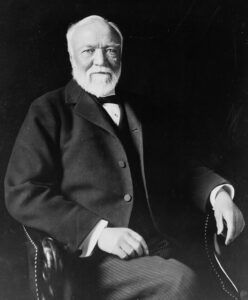
Andrew Carnegie
Andrew Carnegie (1835–1919)
- Born on 25 November 1835 in a one-room weaver's cottage in Dunfermline, Scotland — his father's handloom trade destroyed by the power loom — emigrated to Pennsylvania at twelve with borrowed money, worked as a bobbin boy in a cotton mill at $1.20 a week for twelve hours a day six days a week, educated himself through a private library opened to working boys on Saturday evenings1Wikipedia — Andrew Carnegie — and went on to fund the construction of over 2,500 public libraries across the English-speaking world, the thread between the boy borrowing books and the old man building temples to hold them being one of the most direct lines of Congruence in the dataset.
- Built Carnegie Steel into the largest steel operation ever owned by a single individual — by 1900 producing more steel than all of Great Britain2History.com — Andrew Carnegie — then in July 1892 was in Scotland when Henry Clay Frick, to whom he had delegated the Homestead labour dispute, brought 300 Pinkerton agents up the Monongahela River by barge and left ten men dead: a man who had written publicly that workers deserved a share of productivity gains and that unions had a legitimate role, telegraphing Frick from Scotland the day after: "Never employ one of those rioters. Let grass grow over the works."3History.com — Carnegie and the Homestead Strike
- Sold Carnegie Steel to J.P. Morgan in 1901 for $480 million, becoming the richest man in the world4Britannica — Andrew Carnegie — then spent the remaining eighteen years of his life giving almost all of it away: $350 million in total to libraries, universities, scientific institutions, pension funds, church organs, and the Carnegie Endowment for International Peace — funding the Peace Palace at The Hague and watching the First World War begin anyway — dying on 11 August 1919 having made almost exactly true the statement he had written at thirty-three: that a man who dies rich dies disgraced.
Andrew Carnegie was born in 1835 in a one-room weaver's cottage in Dunfermline, Scotland. His father's handloom trade was destroyed by industrialisation. At twelve, the family emigrated to Pennsylvania with borrowed money and the hope of work. Carnegie spent his first American years as a bobbin boy in a cotton mill, twelve hours a day, six days a week, for $1.20 a week. He was thirteen years old.
He educated himself through a local library opened to working boys on Saturday evenings, and he never forgot it. When he became the richest man in the world he funded over 2,500 public libraries across the English-speaking world. The thread between the boy borrowing books and the old man building temples to hold them is one of the most direct lines of Congruence in the dataset.1Wikipedia — Andrew Carnegie
His ascent was methodical and ruthless in equal measure. Telegraph operator, railroad superintendent, bond salesman, iron investor — each position taught him something that compounded into the next. By 1892 Carnegie Steel was the largest steel operation ever owned by a single individual, built on vertical integration, relentless cost reduction, and the deliberate elimination of competitors.2History.com — Andrew Carnegie
His intellectual framework was Herbert Spencer, the Victorian philosopher who applied Darwinian natural selection to human society and coined the phrase "survival of the fittest." Spencer argued that competition was the natural engine of progress and that the strong deserved to thrive. For Carnegie, Spencer provided philosophical cover for methods that needed it. The problem was that Carnegie's actual relationship with Spencer's ideas was selective to the point of inversion. Spencer was explicitly against monopoly power — Carnegie built one. Spencer opposed government subsidies and tariffs — Carnegie lobbied Congress for both. Spencer believed charity that sustained the weak was reckless — Carnegie built 2,500 public libraries for them. Carnegie used Spencer's framework where it justified his methods and quietly discarded it where it condemned them. That selective application is itself a Congruence observation — and it runs through his entire career.
The Homestead Strike of 1892 is the defining event of his biography and the most analytically significant moment in his Congruence arc. Carnegie had written publicly that workers deserved a share of productivity gains and that unions had a legitimate role. He then left for Scotland, delegated the dispute to Henry Clay Frick — a man whose anti-union convictions were well known — and remained in Scotland while Pinkerton agents fought Carnegie's workers on the banks of the Monongahela, leaving ten men dead.3History.com — Carnegie and the Homestead Strike He did not return until it was over. The gap between Carnegie's stated values and his conduct at Homestead is not subtle.
He sold Carnegie Steel to J.P. Morgan in 1901 for $480 million. Morgan told him he was now the richest man in the world. Carnegie replied that he had once been. He then spent the remaining eighteen years of his life giving almost all of it away — $350 million in total, to libraries, universities, scientific institutions, pension funds, church organs, and the Carnegie Endowment for International Peace.4Britannica — Andrew Carnegie He funded the Peace Palace at The Hague and watched the First World War begin anyway.
The equations capture his trajectory accurately. The Rise snapshot reflects exceptional structural advantages partially constrained by the Chaos his ego and pride generated during the consolidation years. The Peak snapshot is where Homestead lands — Congruence collapses at the precise moment his Power and Resources reach their maximum, which is why the score does not reflect the scale of his structural position. The Philanthropy snapshot shows Congruence recovering sharply as his actions finally align with his stated beliefs, but Resources and operational Autonomy have transferred to foundations rather than remaining in his direct control.
He wrote at thirty-three that the amassing of wealth was one of the worst forms of idolatry and that a man who dies rich dies disgraced. He spent the next thirty years accumulating the largest private fortune in American history. He spent the thirty years after that trying to prove himself wrong about what that meant.
Score Comparison
Add up to 10 leaders. Click a name to visit their profile.
The 13 Equations
Scores for: Peak and Homestead 1892–1901The 22 Variables
Canonical scoresWhat changed: Rise of Carnegie Steel 1865–1892 → Peak and Homestead 1892–1901
Sources & Bibliography
The scores assigned to this leader are derived from publicly available sources. Variable inputs reflect documented behaviour, structural conditions, and historical record at the time of each snapshot.