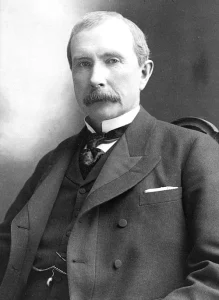
John D. Rockefeller
John D. Rockefeller (1839–1937)
- Born on 8 July 1839 in Richford, New York, the son of a travelling salesman and patent medicine dealer and a devout Baptist mother — became an assistant bookkeeper at sixteen, entered the oil business in 1863, founded Standard Oil of Ohio in 18701Wikipedia — John D. Rockefeller — and within twelve years controlled approximately 90 percent of US oil refining and pipelines, tithing throughout from his first pay cheque, keeping meticulous account ledgers from the age of sixteen, and suffering severe insomnia, hair loss and depression under the sustained commercial and legal pressure of building the most systematic monopoly in American history.
- The Supreme Court dissolved Standard Oil in 1911 into 34 companies — several of which became ExxonMobil, Chevron, and BP — having found it in violation of antitrust law after Ida Tarbell's nineteen-part investigation in McClure's Magazine had documented its methods with devastating precision2Britannica — John D. Rockefeller — with the breakup making Rockefeller richer, his personal wealth reaching $900 million in 1913, nearly 3 percent of US GDP, making him by most measures the wealthiest private individual in modern history.
- Spent the last forty years of his life in systematic philanthropy — founding the University of Chicago, the Rockefeller Institute for Medical Research, the General Education Board, and the Rockefeller Foundation, near-eradicating hookworm in the American South through the Rockefeller Sanitary Commission by 1927, funding the research that led to the yellow fever vaccine, and seeding the modern American medical system through the Flexner Report3Philanthropy Roundtable — John D. Rockefeller — dying on 23 May 1937 at ninety-seven, having given away more than $530 million.
John Davison Rockefeller was born in 1839 in upstate New York, the son of a con artist father who taught him to negotiate hard and a devout Baptist mother who taught him to save, tithe, and account for every penny. The tension between those two inheritances — ruthless commercial instinct and genuine moral conviction — ran through everything he built.
He became an assistant bookkeeper at sixteen, went into business at twenty, and founded Standard Oil of Ohio in 1870. What followed was the most systematic commercial conquest in American history. Within twelve years Standard Oil controlled 90% of US oil refining.4History.com — John D. Rockefeller The method was vertical integration pursued with religious discipline: eliminate waste, control transport, absorb competitors, drive costs below what any rival could match. Where persuasion failed, he used the threat of ruin. Where ruin was threatened, he usually delivered it.
The equations capture the structural reality of his peak: exceptional Management reflects process architecture that was genuinely transformational — 20,000 wells, 4,000 miles of pipeline, standardised distribution that reduced kerosene costs by 80 percent for ordinary American households.5Citizendium — John D. Rockefeller The constraint that keeps Effective Power below something stratospheric is Congruence — his stated values and his methods were in visible tension throughout, a gap his contemporaries noticed and Ida Tarbell documented with devastating precision.
The Supreme Court dissolved Standard Oil in 1911 into 34 companies, several of which became ExxonMobil, Chevron, and BP. Rockefeller held over 25% of the stock. The breakup made him richer.1Wikipedia — John D. Rockefeller His personal wealth reached $900 million — nearly 3% of US GDP — making him by most measures the wealthiest private individual in modern history.
He spent his final forty years redeploying that wealth with the same systematic precision he had applied to oil. The Rockefeller Foundation, the University of Chicago, Rockefeller University, the near-eradication of hookworm in the American South, the seeding of the modern American medical system through the Flexner Report — these were not acts of guilt or reputation management. They were the same man applying the same methods to a different defined output.3Philanthropy Roundtable — John D. Rockefeller His Dissolution and Philanthropy snapshot records Resources and Recognition at ceiling, Congruence finally closing the gap that had been visible throughout his commercial career, but Autonomy and operational Influence declining as he moves from builder to funder.
He died in 1937 at ninety-seven, having given away $530 million and still leaving substantial wealth in family trusts. He considered money-making a God-given gift and tithed from his first pay cheque. Whether that framing resolves the moral complexity of his methods is a question the equations do not answer — they simply record what he built, what it cost, and what he did with it afterwards.
Score Comparison
Add up to 10 leaders. Click a name to visit their profile.
The 13 Equations
Scores for: Standard Oil Peak 1882–1897The 22 Variables
Canonical scoresWhat changed: Rise of Standard Oil 1870–1882 → Standard Oil Peak 1882–1897
Sources & Bibliography
The scores assigned to this leader are derived from publicly available sources. Variable inputs reflect documented behaviour, structural conditions, and historical record at the time of each snapshot.