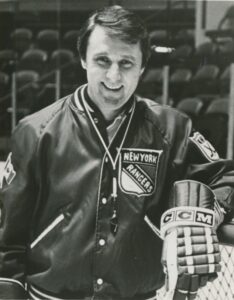
Herb Brooks
Herb Brooks 1937-2003
- Coached the 1980 US Olympic men's ice hockey team to a gold medal at Lake Placid — defeating the Soviet Union 4-3 in the medal round and Finland 4-2 in the gold medal game — with a roster of college players who were the seventh seed in the tournament facing a Soviet team widely considered the greatest hockey team ever assembled, a team that had beaten the NHL All-Stars and destroyed the US squad 10-3 in an exhibition match the week before the Olympics began, in an upset voted by Sports Illustrated the greatest sporting moment of the twentieth century.1Wikipedia — Herb Brooks ↗
- Spent an entire year selecting, training and psychologically conditioning his twenty players — choosing a roster specifically for their capacity to play a hybrid American-European style that could match the Soviet system's pace and fluidity, rather than selecting the most individually talented American players available — and subjected them to a conditioning programme so relentlessly demanding that player Jim Craig recalled the pre-tournament months as the hardest physical experience of his life, a foundation that gave the team the physiological capacity to match the Soviets in the third period when American teams had historically collapsed.1Wikipedia — Herb Brooks ↗
- Was the last player cut from the 1960 US Olympic team that won gold at Squaw Valley — cut, by an irony documented in every account of his life, by the same coach Hal Almendinger who assembled the team that produced America's first hockey gold — carrying that specific knowledge of what it felt like to be on the outside of a championship team for twenty years before building the team that produced America's second, and managing the psychological and tactical preparation for that achievement without the validation of having previously held the prize himself.2US Olympic Hall of Fame — Herb Brooks ↗
Herbert Paul Brooks was born on 5 August 1937 in St Paul, Minnesota, the son of a working-class hockey family, attended the University of Minnesota, was the last player cut from the 1960 US Olympic team that went on to win gold, played in the 1964 and 1968 Olympics without winning a medal, and began his coaching career at his alma mater in 1972 — leading the Minnesota Golden Gophers from last place to three NCAA championships across eight seasons before being hired to coach the 1980 US Olympic team.1Wikipedia — Herb Brooks ↗ The analytical profile of Brooks within the Sports domain is built around a single, precisely defined, time-limited Defined Output: win the gold medal at the 1980 Winter Olympics. This is analytically unusual because the timeline was fixed, the constraints were known in advance, and the opposition was both publicly identified and quantitatively documented — the Soviet team had won four consecutive Olympic gold medals and was widely regarded as the best hockey team ever assembled. Brooks knew exactly what he needed to do, knew exactly what he was working against, and had eleven months to prepare. The Player Selection decision is the most analytically significant Process decision in his profile. He did not select the best individual American players. He selected the players who could execute a specific hybrid tactical system — faster than the traditional American defensive game, more disciplined than pure offensive play — that he had determined in advance was the only approach with a realistic chance of competing with the Soviet system.2US Olympic Hall of Fame — Herb Brooks ↗ Several of the most talented American players available were not selected because they could not execute what Brooks needed. The players who were selected were subjected to a conditioning programme designed to give them the physical endurance to match the Soviets in the third period, which was where American teams had previously been overtaken. The Conviction variable scores at its ceiling. Brooks consistently told his players that they could beat the Soviet team when almost no one else believed it was possible — not as a motivational cliché but as an analytical conviction, backed by a tactical plan he had developed over months of study.3Character and Leadership — Herb Brooks ↗ His pre-game address before the Soviet match — 'You were born to be a player. You were meant to be here. This moment is yours' — was not improvised. It was the culmination of eleven months of deliberate psychological preparation. The career after Lake Placid is analytically instructive precisely because it was significantly less successful. His NHL coaching career with the New York Rangers, the Minnesota North Stars and the New Jersey Devils was mixed — periods of genuine achievement interspersed with firings and disappointments — suggesting that the specific conditions that produced the Miracle on Ice (clear Defined Output, fixed timeline, full player selection authority, a single opponent to prepare against) were not replicable in the ongoing operational environment of professional hockey. He died on 11 August 2003 in a single-car accident on Interstate 35, Minnesota, aged sixty-six, returning from events at the US Hockey Hall of Fame. He was serving as director of player personnel for the Pittsburgh Penguins. His casket was carried by the twenty members of the 1980 Olympic team. The Olympic arena in Lake Placid where the Miracle on Ice was played is named Herb Brooks Arena.
Score Comparison
Add up to 10 leaders. Click a name to visit their profile.
The 13 Equations
Scores for: New York Rangers — NHL CoachingThe 22 Variables
Canonical scoresWhat changed: 1980 Olympic Gold — Miracle on Ice → New York Rangers — NHL Coaching
Sources & Bibliography
The scores assigned to this leader are derived from publicly available sources. Variable inputs reflect documented behaviour, structural conditions, and historical record at the time of each snapshot.