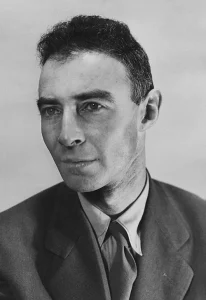
J. Robert Oppenheimer
J. Robert Oppenheimer 1904-1967
- Appointed director of the Los Alamos Laboratory in 1943 with no prior management experience beyond a graduate seminar, and led a team that grew from a few hundred to more than 6,000 scientists, engineers and military personnel — managing simultaneously the scientific problem of weapons design, the interpersonal problem of coordinating Nobel laureates who would not accept military authority, the security problem of operating a classified facility, and the moral problem of building a weapon whose consequences he could foresee — to produce the first nuclear detonation on 16 July 1945, 28 months after his appointment.1Wikipedia — J. Robert Oppenheimer ↗
- Transformed himself, in Hans Bethe's direct testimony, from a theoretical physicist with no administrative track record into 'an efficient and persuasive administrator' who 'completely changed to fit his new role' and 'brought out the best in us' — a People variable achievement of particular analytical significance because the people he was managing included some of the most intellectually formidable, professionally competitive, and institutionally difficult scientists ever assembled in a single facility, many of whom had fled fascism in Europe and were deeply sceptical of military authority.2NPS — Oppenheimer Manhattan Project Years ↗
- After the war, as director of the Institute for Advanced Study at Princeton from 1947 to 1966 — the longest tenure of any IAS director — promoted interdisciplinary collaboration, intellectual freedom, and the integration of scholars from diverse fields in a manner that made the IAS the most prestigious pure research institution in the United States, before having his security clearance revoked in 1954 in a proceeding widely regarded as a political persecution that ended his role as a government science adviser.3IAS — Oppenheimer Legacy ↗
Julius Robert Oppenheimer was born on 22 April 1904 in New York City, the son of a wealthy German Jewish textile merchant, graduated from Harvard in chemistry in three years, completed his doctorate in theoretical physics at Göttingen under Max Born in 1927, and returned to the United States to build simultaneously the first serious schools of theoretical physics at the University of California Berkeley and Caltech.1Wikipedia — J. Robert Oppenheimer ↗ By 1942, when General Leslie Groves selected him to lead the weapons laboratory, he was recognised as one of the finest theoretical physicists in America and one of the most gifted teachers of his generation — but had no record as an administrator and no Nobel Prize, both of which Groves's colleagues considered disqualifying. The Los Alamos directorship is the analytically central event of Oppenheimer's profile. He arrived in 1943 to build and run a secret scientific facility on a New Mexico plateau with a specific Defined Output — a functional nuclear weapon — and a fixed timeline imposed by the war. The challenge was not primarily scientific. The scientific problems, though extraordinary, were ultimately solvable by the assembled talent. The leadership challenge was managing that talent: physicists who had won or would win Nobel Prizes, who were accustomed to operating as autonomous intellectual agents, who resented military authority, who competed fiercely with each other, and who were being asked to subordinate their individual research programmes to a collective industrial objective.4EBSCO — J. Robert Oppenheimer ↗ Oppenheimer solved this through a specific People management approach: he kept the laboratory intellectually open rather than compartmentalised, running weekly colloquia in which the entire scientific community discussed the state of the project across all divisions simultaneously. This transparency — which violated conventional military security practice — was negotiated with Groves on the grounds that it was the only way to maintain the collaborative momentum that the timeline required. The Process variable in his profile reflects this: he identified the management approach the Defined Output required and implemented it despite institutional resistance. The post-war period presents a different analytical profile. As chairman of the General Advisory Committee of the Atomic Energy Commission from 1947, he opposed development of the hydrogen bomb on technical and moral grounds — a position that brought him into conflict with Edward Teller and with the political apparatus of the early Cold War. The 1954 security hearing, which revoked his clearance on the grounds of his past left-wing associations rather than any documented act of disloyalty, is recorded in the profile as an Environment variable event: a hostile political environment that removed his operational authority without altering his intellectual contribution or his moral integrity. The Institute for Advanced Study directorship from 1947 to 1966 — nineteen years — is the longest continuous leadership role of his career and the one least discussed in popular accounts of his life. He took a research institution that had been run by its founder as a personal intellectual preserve and developed it into a genuinely collaborative community in which physicists, mathematicians, historians and social scientists worked in the same building and interacted with each other. The IAS director Oppenheimer was a different institutional leader from the Los Alamos Oppenheimer — quieter, more patient, less intensely focused on a single defined objective — but the People variable reflects the same underlying capability: an ability to sustain the intellectual engagement of exceptional individuals over extended periods. His security clearance was formally restored in 2022, sixty-eight years after it was revoked and fifty-five years after his death. He died of throat cancer on 18 February 1967.
Score Comparison
Add up to 10 leaders. Click a name to visit their profile.
The 13 Equations
Scores for: Los Alamos — Manhattan Project DirectorThe 22 Variables
Canonical scoresSources & Bibliography
The scores assigned to this leader are derived from publicly available sources. Variable inputs reflect documented behaviour, structural conditions, and historical record at the time of each snapshot.