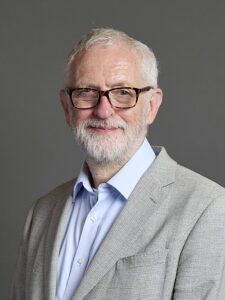
Jeremy Corbyn
Jeremy Corbyn (Born 1949)
- Has served as Member of Parliament for Islington North continuously since June 1983 — first elected as Labour MP at age thirty-four, holding the seat across twelve general elections including the July 2024 general election when he was returned as an Independent against Labour's official candidate with a majority of 7,247 in his first contest as an Independent, having had the Labour whip suspended in October 2020 over his response to the Equality and Human Rights Commission report on antisemitism in the Labour Party and never restored.1Wikipedia — Jeremy Corbyn ↗
- Won the Labour Party leadership in September 2015 with 59.5 percent of the membership vote on the first round — the largest leadership mandate in Labour Party history, secured under the £3 supporter scheme that opened the leadership election to the broader left, re-elected with an even larger mandate in the September 2016 challenge from Owen Smith, led Labour into the June 2017 general election that produced a hung parliament with Labour gaining 30 seats and 40 percent of the vote, and led Labour into the December 2019 general election that produced the party's worst result since 1935 before resigning the leadership in April 2020.2Wikipedia — 2015 Labour leadership election ↗
- Co-founded Your Party with Zarah Sultana in summer 2025 — a new left-of-Labour electoral vehicle launched following his 2024 Independent re-election to Westminster, registered as a political party with the Electoral Commission, drawing organisational continuity from the Corbyn-era Momentum movement and from former Labour MPs and councillors who had been suspended or had resigned over the Starmer leadership's direction, and registering single-digit polling numbers through 2025 with strongest support among young voters and in former Labour heartland constituencies that have shown Reform UK gains.3Wikipedia — Your Party ↗
Jeremy Bernard Corbyn was born on 26 May 1949 in Chippenham, Wiltshire, the youngest of four sons of David Corbyn, an electrical engineer, and Naomi Josling, a maths teacher, both of whom had met at a 1936 Spanish Civil War solidarity rally in support of the Republican side.1Wikipedia — Jeremy Corbyn ↗ He was educated at Castle House preparatory school in Newport and at Adams' Grammar School in Newport, Shropshire, attended North London Polytechnic without graduating, and worked as a trade union organiser for the National Union of Public Employees and the Amalgamated Union of Engineering Workers through the 1970s before being elected to Haringey Council in 1974. He was elected to the House of Commons for Islington North in June 1983 and has held the seat across twelve general elections through to the present. He has been married three times, has three sons, and has been an active backbench parliamentarian, movement organiser, and party leader across more than four decades of British political life. The framework reads three distinct phases of his career. The analytical context for scoring Corbyn requires the framework discipline that Effective Power is measured separately from political evaluation. The Codex measures effective power, not whether the political values pursued are agreeable to the reader. The Conviction, Confidence, and Congruence variables reading at the upper-mid band capture the directional energy that built a 32-year backbench dissident career, won the Labour Party leadership with the largest mandate in its history, took Labour to 40 percent of the vote in the 2017 general election, sustained a movement infrastructure through suspension and through electoral defeat, and continues to operate as a functional left-populist political vehicle in 2025. Whether the reader regards the values as good or harmful is a separate question that the framework's variable scoring does not collapse into. The Defined Output reading captures the real institutional outputs alongside the constraints of operating outside executive power for the entirety of the period. The backbench MP and movement organiser phase from 1983 to 2015 covers Corbyn's first thirty-two years in Parliament. He became the most rebellious Labour MP under Tony Blair's premiership, voting against the Labour whip more than four hundred times across the Blair and Brown governments combined — a record exceeded by no other Labour parliamentarian of the period. He chaired Stop the War Coalition from 2011, organised the parliamentary opposition to the Iraq War from before its 2003 launch, and was the rebel-of-record on civil liberties, anti-austerity, public ownership, and Middle Eastern policy throughout the period. The Defined Output during this phase reads modestly because backbench dissident work produces limited specific deliverables; the Recognition reads modestly because the Blair-Brown era Labour Party reduced the visibility of figures whose positioning was electorally inconvenient. The Conviction variable reads strong because the directional energy through three decades of political wilderness was sustained without significant ideological drift. The phase ended with the unexpected events of summer 2015 that elevated Corbyn from backbench obscurity to the Labour leadership. The Leader of the Opposition phase from 2015 to 2020 produced what may prove to be the snapshot at which Corbyn's leadership variables read at their highest levels in the dataset.2Wikipedia — 2015 Labour leadership election ↗ He was nominated for the Labour leadership in summer 2015 by parliamentary colleagues who explicitly described their nominations as wanting to "broaden the debate" rather than support his candidacy. Under the £3 supporter scheme that Ed Miliband had introduced before resigning, Corbyn won the leadership on 12 September 2015 with 59.5 percent of the first-round vote — the largest leadership mandate in Labour Party history. He was re-elected in September 2016 against Owen Smith with an even larger mandate during the Brexit-period parliamentary leadership challenge. He led Labour into the June 2017 general election that produced a hung parliament with Labour gaining thirty seats and 40 percent of the vote, denying Theresa May the majority her election had been called to deliver. He led Labour into the December 2019 general election that produced the party's worst result since 1935, including the loss of long-held "Red Wall" constituencies in northern England and the Midlands. He resigned the Labour leadership in April 2020 and was suspended from the parliamentary Labour Party in October 2020 over his public response to the Equality and Human Rights Commission's report on antisemitism in the party. The Labour whip was never restored. The substantive Defined Output of the Phase 2 snapshot operates across multiple dimensions that the framework reads with care. The 2017 general election performance was a substantial electoral output that no major British political analyst of summer 2015 had projected as plausible. The transformation of Labour Party policy direction toward public ownership of utilities and railways, increased public investment, and the questioning of the post-Thatcher economic settlement was substantial — and the policy ground it claimed has remained in mainstream British political discourse through subsequent leaderships including Starmer's, even where the political direction has changed. The 2019 general election defeat was a Defined Output failure of substantial scale that the framework should not soften — Labour's 32 percent vote share and 202 seats represented its worst position in eighty years. The Phase 2 reading the framework produces is the substantial output of leadership without executive power, with the ceiling on what could be achieved set by parliamentary arithmetic and by the structural difficulty of holding a Labour coalition that included both Remain-aligned urban progressive voters and Leave-aligned working-class constituencies through the Brexit period. The Independent and Your Party phase from 2020 to the present is the canonical snapshot under the framework rule that canonical equals the latest snapshot for living and active leaders.3Wikipedia — Your Party ↗ Corbyn sat as an Independent MP from October 2020. He held Islington North in the July 2024 general election as an Independent against Labour's official candidate Praful Nargund with a majority of 7,247 — the most prominent Independent retention of a Westminster seat in the modern period. He co-founded Your Party with Zarah Sultana in summer 2025 as a left-of-Labour electoral vehicle, registered with the Electoral Commission, drawing organisational continuity from the Corbyn-era Momentum movement and from former Labour MPs and councillors suspended or resigned during the Starmer leadership. Through 2025 the party has registered single-digit polling numbers with strongest support among voters under thirty-five and in former Labour heartland constituencies that have shown Reform UK gains. The Phase 3 Defined Output reads in the mid-band rather than higher because the structural deliverables of the snapshot to date are real but bounded: Independent re-election (delivered), Your Party founding (delivered), sustained movement infrastructure (delivered), no significant electoral or legislative breakthrough yet (constraint). The Congruence variable reads in the upper band rather than at the framework ceiling reserved for figures whose say-do alignment was tested under maximum pressure across decades and held at near-perfect consistency. Corbyn's stated values across forty-two years of public political life — anti-imperialism, public ownership, NHS defence, Palestinian solidarity, opposition to NATO and to nuclear weapons, anti-austerity, civil liberties, internationalism — have been pursued through his backbench voting record, through his Labour leadership programme, through his Independent MP work, and through Your Party's positioning. The say-do alignment is unusually high. Whatever the reader's view of the values themselves, the framework registers Congruence as alignment between stated values and observed conduct, not whether the values are good. The Brexit-period "constructive ambiguity" positioning was the closest thing to a Congruence wobble in his career, reflecting the impossibility of holding a Labour coalition spanning Remain and Leave voters during 2016-2019. The Conviction variable reads at similar levels, sustained across multiple party-internal political defeats, leadership victories, leadership defeats, suspension, election as Independent, and Your Party founding without significant directional change. The Pride variable reads in the mid-band rather than at the higher levels associated with leaders whose Pride produces terminal system failure. Corbyn shows selective rigidity — strong on the strategic core (anti-imperialism, public ownership, Palestinian solidarity) and on personal vindication (the antisemitism suspension responses), more flexible on tactical political adjustments. The combination of high Conviction, high Congruence, mid-band Pride, mid-low Ego, and mid-band Confidence produces a structurally functional political pattern distinct from the Pride-rigid pattern of leaders such as Stockton Rush or Roscoe Conkling whose Pride at the framework ceiling produced terminal system failure. The Humility variable reads in the mid-band — Corbyn is personally humble in style and presentation but his operational humility on the antisemitism issue specifically was widely characterised as inadequate during the Phase 2 leadership crisis, with corrections coming under organisational pressure rather than through proactive engagement. The Ego variable reads in the lower-mid band and is one of the variables on which Corbyn distinguishes himself sharply from most contemporary politicians: his identity is fused with his political project but his personal-presentation Ego is unusually modest by contemporary standards, reflected in his sustained personal habits, his lack of constructed media persona, and his consistent decline of the trappings of conventional political celebrity. The k variable for the canonical snapshot scores mildly positive. The defining external arrival during 2023-2025 was the Israel-Gaza war from October 2023, which reshaped the political environment around Palestinian solidarity politics in ways no reasonable strategic plan would have priced in at scale, and which moved Corbyn's decades-long position from politically inconvenient toward politically central within a substantial constituency. Most other relevant events of the snapshot period — the 2024 general election landscape, the friction between Corbyn and Sultana on Your Party direction reported in autumn 2025, the Reform UK absorption of working-class anti-Labour vote — were foreseeable Environment rather than unforeseen k. The Recognition variable reads in the mid-band, contested by audience in ways that the framework should not collapse: substantial within his core constituency and within international left-populist movements, hostile within the Labour establishment and the Conservative-aligned press, persistent acknowledgment from the broader political class that he remains a politically consequential figure despite operating outside the major-party system. The framework's reading of Corbyn is structurally distinct from the dataset's right-populist insurgent profile of Nigel Farage, with whom he shares high Congruence and sustained Conviction but contrasts on every substantive policy variable, and the radar overlay between them produces one of the dataset's clearer worked examples of how the framework reads characterological consistency separately from political content.
Score Comparison
The 13 Equations
Scores for: Independent and Your Party — 2020 to PresentThe 22 Variables
Canonical scoresWhat changed: Leader of the Opposition — 2015 to 2020 → Independent and Your Party — 2020 to Present
Sources & Bibliography
The scores assigned to this leader are derived from publicly available sources. Variable inputs reflect documented behaviour, structural conditions, and historical record at the time of each snapshot.
- Wikipedia — Jeremy Corbyn
- Wikipedia — 2015 Labour Party leadership election
- Wikipedia — Your Party
- Prince, R. — Comrade Corbyn: A Very Unlikely Coup (2016)
- Bower, T. — Dangerous Hero: Corbyn's Ruthless Plot for Power (2019)
- Pogrund, G. & Maguire, P. — Left Out: The Inside Story of Labour Under Corbyn (2020)