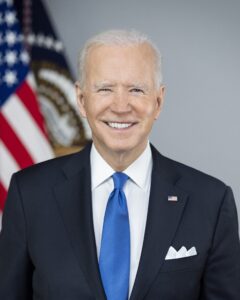
Joe Biden
Joe Biden (born 1942)
- Born in Scranton, Pennsylvania, elected to the United States Senate from Delaware in 1972 at the age of 29 — one of the youngest senators in American history — serving 36 years before becoming Vice President under Barack Obama from 2009 to 20171Wikipedia — Joe Biden — then winning the 2020 presidential election with 81 million votes, the most in American electoral history, to become the 46th President and, at 78, the oldest person ever to assume the office.
- Signed the Infrastructure Investment and Jobs Act, the CHIPS and Science Act, and the Inflation Reduction Act — the largest investment in climate action in American history — in his first two years2ABC News — Biden legacy — while the Ability variable that underpinned his capacity to govern was visibly deteriorating throughout, a decline that became impossible to manage publicly when his June 2024 debate performance against Donald Trump made what had been visible to close observers unavoidable to everyone.
- Withdrew from the 2024 presidential race on 21 July 2024 — writing that he believed it was in the best interests of his party and country to stand down3Ballotpedia — Joe Biden — an act that required genuine selflessness and which represented, paradoxically, one of the most consequential and correct decisions of his presidency — before leaving office in January 2025, succeeded by Donald Trump.
Joe Biden served as the 46th President of the United States from 2021 to 2025, having previously served as Vice President under Barack Obama from 2009 to 2017 and as a United States Senator from Delaware for 36 years. His presidency is analytically unusual in the Codex framework because the central variable — Ability — was in active decline throughout his term in a way that no other leader in the dataset presents.
Biden won the 2020 election not primarily on his own strength but on the collapse of Donald Trump's Congruence variable. He was the acceptable alternative, the safe harbour, the return to normalcy. The mandate was real but its foundations were fragile — built more on what he was not than on what he was.1Wikipedia — Joe Biden
The early legislative record was stronger than his critics acknowledged. The Infrastructure Investment and Jobs Act, the CHIPS Act, and the Inflation Reduction Act represented genuine structural investment of a kind Washington had not produced in decades.2ABC News — Biden legacy His Defined Output and Process variables in this period were functional. The team around him — particularly on economic policy — was competent.
But the Ability variable was visibly deteriorating from the first year. Press conferences became events of managed risk. Unscripted moments produced errors that required correction. The gap between the Biden of the 2020 campaign and the Biden of 2023 was not subtle. His staff managed the environment around him with increasing rigidity, which drove Corporate Drag and Bureaucracy higher as the presidency progressed. A special counsel report in February 2024, which declined to bring criminal charges over his handling of classified documents, drew as much attention for its characterisation of his age and memory as for its legal conclusions.4EBSCO Research Starters — Joe Biden
The June 2024 presidential debate against Trump was the moment the management failed publicly. What had been visible to those paying close attention became unavoidable to everyone. The pressure on Biden to withdraw from the 2024 race became irresistible, and he stood down in July 2024 — an act that required genuine selflessness and which represented, paradoxically, one of the most consequential and correct decisions of his presidency.
In Codex terms Biden presents a unique analytical problem: a leader whose Intent, Congruence, and Values variables remained largely intact while his core Ability variable — the baseline capacity to execute — declined below the threshold required for the role. The system did not fail because of corruption or ego or bad faith. It failed because the human engine was running down.
Score Comparison
Add up to 10 leaders. Click a name to visit their profile.
The 13 Equations
Scores for: Early Presidency 2021–2022The 22 Variables
Canonical scoresSources & Bibliography
The scores assigned to this leader are derived from publicly available sources. Variable inputs reflect documented behaviour, structural conditions, and historical record at the time of each snapshot.