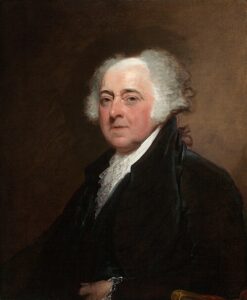
John Adams
John Adams (1735–1826)
- John Adams — son of a Massachusetts farmer and deacon, Harvard graduate, schoolteacher, lawyer, delegate to the First and Second Continental Congresses, drafter of the Massachusetts Constitution of 1780, diplomat in France and the Netherlands, negotiator of the Treaty of Paris ending the Revolutionary War, first Vice President of the United States, and second President from 1797 to 1801 — was the most intellectually formidable figure of the American founding after Jefferson, the man whose legal arguments and political courage made independence possible before Washington made it militarily credible, and whose single presidential term produced the one outcome his variable profile was most precisely built to deliver: keeping the United States out of a war with France that would have destroyed the republic before it had consolidated its institutions.1Britannica — John Adams
- His career encompassed the defence of the British soldiers accused in the Boston Massacre — the most politically costly act of legal principle in the pre-revolutionary period — the authorship of Thoughts on Government and the Massachusetts Constitution that became the template for American constitutional design, the diplomatic isolation of France and the Netherlands that secured the financial and military support the Revolution required, the negotiation of the Treaty of Paris in which he outmanoeuvred both the French and the British to secure the most favourable possible terms for the new republic, and the Quasi-War crisis of 1797 to 1800 in which he chose peace with France against the unanimous advice of his cabinet and the dominant faction of his own party, ending his political career and probably saving the republic.2Miller Center — John Adams Key Events
- The private record of a man whose Congruence was among the highest in the founding generation — whose correspondence with Abigail Adams constitutes the most analytically transparent record of a political leader's private thinking in the American dataset, whose vanity and irritability he acknowledged freely and whose commitment to principle he demonstrated repeatedly at personal political cost — is the most honest self-portrait in the founding period, and the one that most precisely explains both the extraordinary diplomatic achievement and the political isolation that accompanied it.3Massachusetts Historical Society — Adams Papers
John Adams is the most analytically honest profile in the American founding dataset and the one whose variable profile diverges most sharply from his historical reputation. He was not a great president by conventional measures — one term, no re-election, the Alien and Sedition Acts, the loss of his own cabinet's loyalty, and defeat to Jefferson in 1800. He was, by the measurable output of the single most important decision of his presidency, the leader whose Conviction and Congruence produced the outcome the republic most needed at the moment it most needed it. The equations separate the political failure from the consequential success with a precision that the conventional assessment does not.
The formation period establishes the intellectual and moral baseline with unusual clarity. Adams's defence of the British soldiers accused in the Boston Massacre of 1770 — accepting the brief when no other Boston lawyer would, winning acquittal for six of the eight accused, and doing so in the full knowledge that the political cost to his revolutionary credentials would be significant — is the Congruence variable at its most foundational expression.1Britannica — John Adams He believed that every person accused of a crime was entitled to a competent legal defence, that the rule of law was more important than the political convenience of the revolutionary movement, and he acted on that belief at direct personal cost. That is the Congruence variable producing its most precise single output in the pre-presidential record — and it established the pattern that the Quasi-War decision later replicated at presidential scale.
The Continental Congress period from 1774 to 1778 is where the Vision and Conviction variables reach their highest pre-diplomatic expression. Adams was among the earliest and most consistent advocates of independence — his diary and correspondence from 1775 reveal a man who had concluded that separation from Britain was both necessary and inevitable before most of his colleagues had reached the same position.3Massachusetts Historical Society — Adams Papers The nomination of Washington as Commander-in-Chief — Adams's proposal, made on the calculation that a Virginia commander would broaden the geographical coalition of the rebellion — reflects the People variable operating with a precision unusual for a man whose interpersonal style was frequently abrasive: he identified the right person for the right role and moved the institutional machinery to place him there, subordinating his own preference for a Massachusetts commander to the strategic requirement of the coalition.
The diplomatic period in France and the Netherlands from 1778 to 1783 is the most analytically productive phase of the career and the one most underweighted in the conventional assessment. Adams arrived in France to find that Benjamin Franklin had constructed a relationship with Vergennes — the French foreign minister — that made French policy effectively the determinant of American diplomatic strategy.4US State Department — Treaty of Paris His insistence on treating the American mission as an independent diplomatic operation rather than a French client — producing direct conflict with both Franklin and Vergennes — reflects the Conviction and Autonomy variables operating in combination against the institutional pressure of the existing diplomatic arrangement. The Netherlands mission, which he conducted essentially alone, secured a recognition of American independence from a major European power and a loan of five million guilders at a moment when the Continental Army's financial position was critical. The Treaty of Paris negotiation — in which Adams, Franklin, and Jay negotiated directly with the British against French wishes, securing the Mississippi River as the western boundary of the new republic — is the Defined Output variable reaching its highest pre-presidential expression.
The vice presidency from 1789 to 1797 is the most analytically unproductive period of the career — constrained by an institutional role that Adams himself described as the most insignificant office ever devised, conducting the Senate with procedural precision that the role required and exercising no substantive influence on the Washington administration's policy.2Miller Center — John Adams Key Events The Autonomy variable at this snapshot is at its lowest point in the career — a man of exceptional independent judgment operating within an institutional framework that systematically prevented its expression. The Learning variable records the period positively — Adams observed the Washington administration's operation at close range, understood its institutional dynamics, and arrived at the presidency with a precise knowledge of what the executive machinery required and where its vulnerabilities lay.
The presidency from 1797 to 1801 is the canonical snapshot and the most analytically complex period of the career. Adams inherited the XYZ Affair — in which French agents had demanded bribes from American commissioners as a precondition for negotiations — and managed the resulting public outrage with a combination of military preparation and continued diplomatic engagement that satisfied neither the war hawks in his own party nor the pro-French Republicans.5US State Department — XYZ Affair The Conviction variable at this snapshot is operating against the strongest possible institutional pressure — his entire cabinet, inherited from Washington and loyal to Hamilton, was advising war, and the Federalist Party's dominant faction regarded peace with France as political surrender. Adams's decision to send a second peace mission to France in 1799 — made without consulting the cabinet, against Hamilton's explicit opposition, and in full knowledge that it would split the Federalist Party — is the most analytically precise expression of the Decisiveness and Conviction variables in the American founding dataset. He made the decision, owned it completely, and accepted the political consequences.
The Alien and Sedition Acts of 1798 are the most significant Congruence failure of the presidency. Adams signed legislation that allowed the deportation of foreign nationals deemed dangerous and criminalised criticism of the federal government — measures that were directly inconsistent with the constitutional principles he had spent his career defending.6Britannica — Alien and Sedition Acts The political context — genuine fear of French subversion, Federalist pressure, and the war fever that the XYZ Affair had produced — provides the environmental explanation without constituting an exculpation. The Congruence variable records the gap between the man who had defended British soldiers in Boston on the grounds that legal principle trumped political convenience, and the president who signed legislation criminalising political dissent. The gap is real and the score reflects it.
The peaceful transfer of power to Jefferson in March 1801 — the first transfer of executive power between opposing political parties in the history of modern democracy — is the most institutionally significant single act of the Adams presidency and the one whose Value score reaches its ceiling.2Miller Center — John Adams Key Events Adams left Washington before the inauguration — an act of personal bitterness that the Communication variable records negatively — but the transfer itself was peaceful, complete, and constitutionally correct. In a world in which every comparable revolutionary republic had produced either military dictatorship or renewed monarchy within a generation, Adams's acceptance of electoral defeat and departure from office is the Congruence variable producing its most consequential institutional output: demonstrating that the American constitutional system was more durable than any individual within it.
The reconciliation with Jefferson — conducted through correspondence from 1812 to 1826, producing one of the most analytically revealing exchanges in American political history, and ending with both men dying on the same day, 4 July 1826, the fiftieth anniversary of the Declaration of Independence — is the post-presidential period's most significant variable expression.3Massachusetts Historical Society — Adams Papers The Humility variable at this snapshot is the highest in the profile — a man who had been politically destroyed by Jefferson's election, who had legitimate grievances about how the campaign had been conducted, acknowledging in correspondence the intellectual framework they shared and the personal respect that the political conflict had obscured.
The number that matters most across all four snapshots is the Conviction variable — specifically its interaction with the political cost it repeatedly imposed. Adams defended the Boston Massacre soldiers when defence was politically costly. He insisted on American diplomatic independence when deference to France was institutionally easier. He chose peace with France when war was politically popular. He accepted defeat when resistance was available. Each of these decisions reflects Conviction operating at its most expensive — not the Conviction that is easy because everyone agrees, but the Conviction that holds when holding it costs something specific and measurable. That sustained, costly Conviction is the analytical signature of John Adams, and it is the reason that the one-term president who left Washington before his successor's inauguration is ranked by historians consistently in the top tier of American presidents. The equations agree with that ranking, and they explain precisely why.
Score Comparison
Add up to 10 leaders. Click a name to visit their profile.
The 13 Equations
Scores for: Diplomatic Mission — France, Netherlands and Treaty of ParisThe 22 Variables
Canonical scoresWhat changed: Continental Congress and Boston Massacre Defence → Diplomatic Mission — France, Netherlands and Treaty of Paris
Sources & Bibliography
The scores assigned to this leader are derived from publicly available sources. Variable inputs reflect documented behaviour, structural conditions, and historical record at the time of each snapshot.