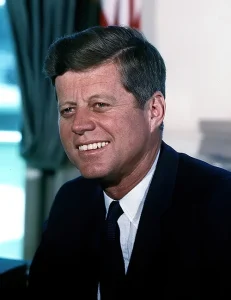
John F. Kennedy
John F. Kennedy (1917–1963)
- John Fitzgerald Kennedy — son of Joseph Kennedy Sr., decorated PT boat commander, three-term Massachusetts congressman, Pulitzer Prize-winning author of Profiles in Courage, and two-term US Senator — was elected the thirty-fifth President of the United States in November 1960 by the narrowest popular vote margin of the twentieth century, becoming the first Catholic and the youngest elected president in American history, carrying into the White House a combination of extraordinary Communication capability and a legislative record thinner than his reputation suggested.1Britannica — John F. Kennedy
- His thousand days in office from January 1961 to November 1963 encompassed the Bay of Pigs disaster, the Vienna summit with Khrushchev, the Berlin Wall, the Cuban Missile Crisis — thirteen days in October 1962 that constitute the closest the world has come to nuclear war and the most analytically precise test of presidential decision-making under existential pressure in the dataset — the Nuclear Test Ban Treaty, the founding of the Peace Corps, and the commitment to land a man on the moon before the decade was out.2Miller Center — John F. Kennedy Key Events
- The private record beneath the public presidency — chronic physical illness managed through a pharmacological regime that would have ended his political career had it been known, sustained marital infidelity including relationships that created counterintelligence vulnerabilities, and a civil rights position that moved from political caution to moral commitment only under the pressure of events in Birmingham and across the South — documents a leader whose public Congruence was high and whose private Congruence was substantially lower, a gap the equations record without the sentimentality that the assassination has historically generated.3History.com — John F. Kennedy
John F. Kennedy is the most mythologised profile in the American Political domain and consequently the most difficult to score accurately. The assassination at forty-six forecloses the counterfactual — what his presidency would have produced across two full terms cannot be known — and the myth that formed around his death has consistently inflated the contemporary assessment while obscuring the analytical reality. The equations are not sentimental. They record what happened in a thousand days, not what might have happened in three thousand.
The formation period contains the first Congruence complication. Kennedy's war record — the PT-109 incident in which his boat was rammed and sunk by a Japanese destroyer, and his subsequent leadership in getting his crew to safety — is genuine and was recognised as such.4JFK Library — PT-109 The Profiles in Courage Pulitzer, however, was substantially ghost-written by Theodore Sorensen — a fact Kennedy did not publicly acknowledge — and the political career that followed was as much a product of Joseph Kennedy Sr.'s money, connections, and ambition as of John Kennedy's own capability. The formation snapshot records a leader of genuine ability operating within an apparatus of constructed reputation, which produces a Congruence score lower than the public biography suggests.
The Bay of Pigs disaster of April 1961 is the most analytically instructive failure of the presidency. Kennedy inherited a CIA plan to use Cuban exiles to overthrow Castro, was presented with it by the agency and the Joint Chiefs as a low-risk covert operation, had private doubts he did not sufficiently act on, and authorised it anyway — then refused to provide the air cover that the plan required when the landing went wrong, producing a failure that was complete in both military and diplomatic terms.5US State Department — Bay of Pigs The Adaptability and Decisiveness variables at this snapshot are both low — Kennedy neither challenged the plan adequately before authorising it nor adjusted it adequately when it began to fail. The Humility variable, however, scores its highest point in the profile immediately afterwards: he accepted full public responsibility without deflection, dismissed CIA Director Allen Dulles, and restructured his advisory process specifically to prevent the same dynamic recurring. That restructuring is why the Cuban Missile Crisis was managed differently.
The Vienna summit with Khrushchev in June 1961 is the most consequential single meeting of the presidency and the one that most directly shaped the conditions for the Missile Crisis sixteen months later. Khrushchev concluded from the encounter that Kennedy was young, inexperienced, and could be pressured — an assessment that directly informed the decision to place missiles in Cuba.2Miller Center — John F. Kennedy Key Events The People variable at this snapshot records a specific failure: Kennedy's preparation for the summit underestimated the degree to which Khrushchev would treat the meeting as a dominance assessment rather than a diplomatic exchange. The lesson was absorbed — the back-channel communication that resolved the Missile Crisis reflected a much more sophisticated understanding of how Khrushchev actually operated.
The Cuban Missile Crisis is the canonical snapshot and the most analytically significant thirteen days in the postwar political dataset. Kennedy's management of ExComm — the executive committee he convened to advise on the crisis — reflects the full restructuring of his advisory process after the Bay of Pigs.6JFK Library — Cuban Missile Crisis He excluded himself from early deliberations to prevent his presence from constraining the options his advisers considered. He rejected the Joint Chiefs' unanimous recommendation for immediate air strikes — which subsequent evidence showed would not have destroyed all the missiles and would almost certainly have produced Soviet military response. He maintained the back channel to Khrushchev through his brother Robert and Soviet ambassador Anatoly Dobrynin, allowing both sides to retreat from public positions without public humiliation. The Humility variable at this snapshot reflects a leader who had learned from his failure and applied that learning under conditions of maximum pressure. The Process variable is at its highest point in the profile.
The civil rights record requires explicit treatment in the Congruence variable. Kennedy entered the presidency with a civil rights position calibrated to preserve the Southern Democratic coalition — moving cautiously, avoiding confrontation, and prioritising foreign policy over domestic justice.7JFK Library — Civil Rights Movement The Birmingham campaign of April and May 1963 — in which Bull Connor's fire hoses and police dogs produced images that circled the globe — forced a recalibration. Kennedy's June 1963 address to the nation, in which he framed civil rights as a moral issue rather than a political one for the first time, represents the Congruence variable moving toward its ceiling in the final months of the presidency. The Civil Rights Act he submitted to Congress in June 1963 was passed after his death. The trajectory was genuine. The timing was driven by events rather than by Kennedy's own moral initiative, and the score reflects that distinction.
The Communication variable across all snapshots is the highest in the postwar American dataset. The Inaugural Address, the Berlin speech, the American University commencement address of June 1963 — which remains the most sophisticated public argument for nuclear restraint ever delivered by an American president — reflect a leader who understood language as a strategic instrument and deployed it with a precision that his legislative output did not match.8JFK Library — Historic Speeches The gap between Communication and Defined Output is the central analytical tension of the Kennedy presidency — he could articulate a direction with extraordinary clarity and translate it into concrete legislation with considerably less consistency.
The Nuclear Test Ban Treaty of August 1963 is the most tangible foreign policy achievement of the presidency and the one that most directly connects Kennedy's Vision to a measurable outcome.9US State Department — Nuclear Test Ban Treaty The American University speech that preceded it created the political conditions for Soviet acceptance — a Communication variable producing a Defined Output in a direct causal sequence that is unusual in the profile. It suggests what a second term might have produced with the same combination operating across more issues.
The number that matters most across all three snapshots is the Learning variable — specifically its trajectory. From Bay of Pigs to Missile Crisis is an eighteen-month arc of demonstrated learning under conditions where the stakes of not learning were existential. A leader who restructures his advisory process after a catastrophic failure, applies the restructured process correctly when the next crisis arrives, and achieves an outcome that avoided nuclear war has demonstrated a Learning variable operating at its ceiling when it mattered most. That is the analytically honest assessment of John F. Kennedy — not the myth, not the debunking of the myth, but the equations applied to what actually happened.
Score Comparison
Add up to 10 leaders. Click a name to visit their profile.
The 13 Equations
Scores for: Senate, Formation and ElectionThe 22 Variables
Canonical scoresSources & Bibliography
The scores assigned to this leader are derived from publicly available sources. Variable inputs reflect documented behaviour, structural conditions, and historical record at the time of each snapshot.
- Britannica — John F. Kennedy biography
- Miller Center — John F. Kennedy Key Events
- History.com — John F. Kennedy
- JFK Library — PT-109
- US State Department — Bay of Pigs
- JFK Library — Cuban Missile Crisis
- JFK Library — Civil Rights Movement
- JFK Library — Historic Speeches
- US State Department — Nuclear Test Ban Treaty