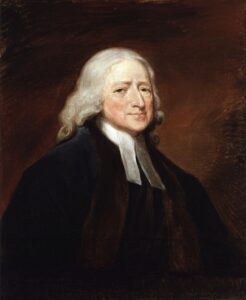
John Wesley
John Wesley (1703–1791)
- Born on 28 June 1703 in Epworth, Lincolnshire, the second surviving son of Samuel Wesley, an Anglican rector, and Susanna Wesley — narrowly rescued from a rectory fire at five years old, an event he recalled for the rest of his life as evidence of divine purpose — educated at Charterhouse and Christ Church Oxford, elected a Fellow of Lincoln College in 1726, ordained priest in 17281Wikipedia — John Wesley — led the Oxford Holy Club from 1729, sailed to Georgia in 1735 as a missionary, failed comprehensively, returned to England in 1738 having concluded he was not yet himself a Christian, and on the evening of 24 May 1738 at a Moravian meeting on Aldersgate Street felt his heart "strangely warmed" while listening to a reading of Luther's preface to Romans — the conversion that everything that followed was built on.
- From 1739 until his death rode over 250,000 miles on horseback — equivalent to ten circuits of the globe — and preached over 40,000 sermons, sometimes four or five a day, to audiences of tens of thousands in fields and collieries across Britain and Ireland2CS Lewis Institute — John Wesley — building as he went a movement architecture of unprecedented organisational precision: class meetings of twelve for mutual accountability, bands for deeper spiritual formation, societies for collective practice, lay preachers for multiplication, circuit riders for reach, and an annual conference from 1744 for governance and doctrinal consistency.
- Signed the Deed of Declaration in 1784 constituting the Methodist societies as a legal entity, ordained clergy for America in the same year, and died on 2 March 1791 having given away virtually his entire income throughout his ministry — at his death 79,000 Methodists in Britain and 43,000 in America, by 1995 approximately 23 million in 108 countries3Britannica — John Wesley — his last recorded words being "The best of all is, God is with us."
John Wesley led the most consequential religious revival in English history without ever holding an institutional position commensurate with its scale. He was an Anglican priest who never left the Church of England, built a movement that eventually outgrew it, and spent fifty-two years riding through weather and opposition to reach people his church had concluded were not worth reaching.
The formation period is the most analytically instructive failure in the Religious domain dataset. The Georgia mission of 1735–38 was a comprehensive defeat: the Native Americans he had hoped to evangelise showed no interest, his relationships with the colonists deteriorated into scandal and legal proceedings, and he retreated to England having accomplished almost nothing. What the Codex records about this period is more important than the failure: he recorded it honestly. His journal from Georgia does not perform courage or reframe the disaster. It records a man who went expecting to save others and discovered he could not save himself.3Britannica — John Wesley The Aldersgate conversion that followed was not a psychological recovery from failure — it was a structural change in his operating model. Before Georgia he was attempting justification through works. After Aldersgate he was operating from assurance of grace. The Humility variable records the change: a leader who acknowledged his previous framework had been wrong and rebuilt from a different foundation.
The canonical period — the fifty years of itinerant ministry from 1739 onward — is where the variable profile becomes analytically unusual. The stated Defined Output was "the world is my parish" — not a vague aspiration but a precise operational commitment, because Wesley immediately began acting as if every person in every location was his pastoral responsibility regardless of parish boundaries, denominational affiliation, or social class.2CS Lewis Institute — John Wesley The Process architecture he built to deliver that output was genuinely innovative: the class meeting system created accountability structures that no previous revival movement had attempted; the lay preacher system multiplied reach beyond what ordained clergy could provide; the circuit system ensured geographic coverage; the annual conference provided governance without hierarchy. These are management innovations that the Methodist movement ran on for two centuries.
The Congruence variable at this period is near ceiling — the highest in the Religious domain dataset. He tithed from his earliest income and increased the proportion as his earnings grew. By his later years, despite income of £1,400 annually from his published works, he lived on £30 and gave the rest away. He wrote against slavery decades before abolition was politically viable and continued writing against it days before his death — his last letter, to William Wilberforce, urging him to continue the fight.1Wikipedia — John Wesley He approved women preachers against the grain of 18th-century convention when the evidence of their fruitfulness persuaded him. He reversed positions, acknowledged errors, and updated his model when evidence required it. That is the Humility variable doing what it is designed to do — and it is why he sustained fifty years of effective ministry without the God Complex that typically accompanies movements of this scale.
The late period — the 1770s through 1791 — is where the Management variable reaches its ceiling. He was in his seventies and eighties, still riding circuits but necessarily delegating more. The Deed of Declaration of 1784 is the Process variable at its most legally precise — constituting the movement's governance structure in a way that would outlast him. The ordination of clergy for America in the same year was his most politically consequential decision and his most structurally uncomfortable: he was an Anglican priest authorising what was effectively a new denomination. He called it an "expedient" rather than a principle. The Congruence variable records a small decline here — he knew he was crossing a line he had spent forty years claiming he would not cross.
He died at eighty-seven, still active, still preaching, still corresponding. The movement at his death was 120,000 strong across Britain and America. Two centuries later it had become one of the largest Protestant denominations on earth. The equations record a lifetime score constrained by Resources near floor and Autonomy near floor — operating without institutional backing against institutional resistance — producing a movement that outlasted almost every institutional rival. The k variable eventually operated at scale, as it did for Confucius: the amplification arrived after the leader was gone, and far exceeded anything the lifetime variables would have predicted.
He rode a quarter of a million miles on horseback. He preached forty thousand sermons. He gave almost everything away. The equations record what variables produced that output. The number that matters most is Congruence at ceiling — and the Chaos variable that results from an Ego and Pride near floor. When those numbers compound over fifty-two years of unbroken ministry, the output is a church.
Score Comparison
Add up to 10 leaders. Click a name to visit their profile.
The 13 Equations
Scores for: The Great Revival — Field Preaching and Society BuildingThe 22 Variables
Canonical scoresWhat changed: Oxford and Georgia — Formation and Failure → The Great Revival — Field Preaching and Society Building
Sources & Bibliography
The scores assigned to this leader are derived from publicly available sources. Variable inputs reflect documented behaviour, structural conditions, and historical record at the time of each snapshot.