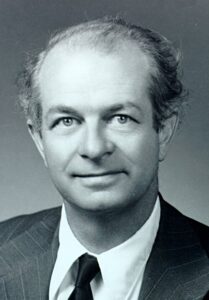
Linus Pauling
Linus Pauling 1901-1994
- As chairman of the Division of Chemistry and Chemical Engineering at Caltech from 1936 to 1958 — twenty-two years — directed the laboratories that produced foundational work on the nature of the chemical bond, quantum chemistry, the alpha helix protein structure, the molecular basis of sickle-cell anaemia, and the applications of quantum mechanics to chemical structure, publishing more than 1,200 papers and books and winning the Nobel Prize in Chemistry in 1954 for research that Scientific American described as making him one of the twenty greatest scientists of all time.1Wikipedia — Linus Pauling ↗
- Organised the petition campaign against nuclear weapons testing in 1957 — collecting 11,021 signatures from scientists in fifty countries and presenting it to UN Secretary General Dag Hammarskjöld in January 1958 — which contributed directly to the 1963 Limited Test Ban Treaty that ended above-ground nuclear testing, receiving the Nobel Peace Prize for 1962 on the same day the treaty entered into force and becoming the only person ever to win two unshared Nobel Prizes in different fields, both on the strength of personal conviction held against institutional opposition.1Wikipedia — Linus Pauling ↗
- Had his passport revoked by the US State Department during the McCarthy era for 'not being in the best interests of the United States', was denied access to scientific conferences in Europe and Asia, was subjected to FBI surveillance, was labelled a Communist — which he was not — and was not reinstated until the pressure of his 1954 Nobel Prize made the State Department's position untenable, demonstrating an Environment variable operating at its most hostile and a Conviction variable that sustained output and position regardless of those conditions for seven years.2Linus Pauling Institute — Biography ↗
Linus Carl Pauling was born on 28 February 1901 in Portland, Oregon, the son of a pharmacist who died when Pauling was nine, grew up in near-poverty, began teaching quantitative analysis at Oregon State University while still an undergraduate, earned his doctorate in physical chemistry and mathematical physics from Caltech in 1925 summa cum laude, spent fifteen months in Europe on a Guggenheim Fellowship meeting Bohr, Heisenberg, Pauli and Schrödinger and bringing quantum mechanics back to American chemistry, and joined the Caltech faculty in 1927 where he would remain for thirty-six years.3Science History Institute — Pauling ↗ The analytical profile of Linus Pauling in the Scientific domain requires two distinct phases to be scored separately: the Caltech period of scientific and institutional leadership, and the peace activism period that followed. These are not merely different activities — they reflect genuinely different Defined Output configurations, different Process approaches, different Resource bases, and different relationships with the Environment variable. The Caltech period (1927-1963) produces the highest scientific leadership scores in Pauling's profile. As chairman of the chemistry division from 1936, he directed a laboratory programme of extraordinary breadth: the nature of the chemical bond, protein structures, molecular disease, quantum chemistry. His management approach combined his own extraordinary productivity with a capacity to attract and retain excellent scientists — his textbook General Chemistry, translated into thirteen languages, shaped the field for a generation of chemists who would go on to work in his and in other laboratories.1Wikipedia — Linus Pauling ↗ The Peace Prize period (1954-1963) presents a different analytical configuration. Pauling was no longer primarily an institutional leader — he was a moral authority using his scientific credibility as a public platform. His petition campaign, which gathered 11,021 signatures from fifty countries, was an exercise in persuasion and network mobilisation rather than laboratory management. The Conviction variable scores at its ceiling: he maintained his position through passport revocation, FBI surveillance, congressional investigation, Caltech's withdrawal of support, and the sustained hostility of American Cold War political culture. The post-Caltech period is analytically more complex. His advocacy for megadose Vitamin C — beginning with his 1970 book Vitamin C and the Common Cold — was not supported by subsequent clinical evidence at the doses he recommended, and his later claims that Vitamin C could prevent or treat cancer were disputed by the medical community with whom he had been allied in his anti-nuclear work. The Congruence variable in his later career reflects a leader whose public positions on scientific questions were maintained with the same conviction that had served him well in physics and chemistry, but in a domain where the evidence did not support the certainty he expressed. He resigned from Caltech in 1963, stung by the institution's failure to celebrate his Peace Prize. He died on 19 August 1994, aged ninety-three. He remains the only person to have received two unshared Nobel Prizes.
Score Comparison
Add up to 10 leaders. Click a name to visit their profile.
The 13 Equations
Scores for: Caltech — Division Chairman and Peak Scientific LeadershipThe 22 Variables
Canonical scoresSources & Bibliography
The scores assigned to this leader are derived from publicly available sources. Variable inputs reflect documented behaviour, structural conditions, and historical record at the time of each snapshot.