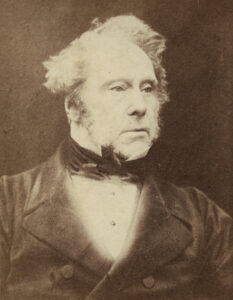
Lord Palmerston
Lord Palmerston (1784–1865)
- Henry John Temple, third Viscount Palmerston — Irish peer, Harrow and Edinburgh educated, Fellow of St John's College Cambridge, Junior Lord of the Admiralty, Secretary at War for nineteen years under five prime ministers, Foreign Secretary three times, Home Secretary, and Prime Minister twice from 1855 to 1858 and 1859 to 1865 — was the dominant figure in British foreign policy for the better part of four decades, the most recognisable British politician of the Victorian era to the general public, and the last Prime Minister to die in office, expiring two days before his eighty-first birthday having reportedly attempted to seduce a housemaid on his deathbed — a detail that is apocryphal but so consistent with the variable profile that historians have been reluctant to dismiss it entirely.1Britannica — Lord Palmerston
- His foreign policy record — the Don Pacifico affair in which he defended the right of a British subject to claim the protection of the Crown against any foreign government with a speech that kept the Commons sitting until two in the morning and produced the civis Romanus sum declaration, the Opium Wars, the management of the Crimean War, the neutralisation of British intervention in the American Civil War, the Schleswig-Holstein question, and a sustained forty-year assertion of British commercial and strategic interests across every inhabited continent — represents the most complete expression of national interest foreign policy in the British Political domain, conducted with a personal energy, a media sophistication, and a contempt for diplomatic convention that made him simultaneously the most popular politician in Britain and the most disliked British statesman in every European foreign ministry.2Oxford DNB — Lord Palmerston
- The private record of a man whose personal life was conducted with the same disregard for convention as his foreign policy — whose affairs were sufficiently numerous and sufficiently public that they generated parliamentary questions, whose marriage to Lady Cowper at the age of fifty-five confirmed a relationship that had been conducted openly for decades, and whose energy and appetite for political combat remained undiminished into his eighties — is the Congruence variable operating in a specific register: a leader who did not pretend to a private life different from his public one, which is a form of Congruence even when the conduct itself is analytically complex.3Britannica — Lord Palmerston
Lord Palmerston is the most energetically distinctive profile in the British Political domain and the one whose variable analysis most precisely captures the difference between a leader who is effective and a leader who is right. He was consistently effective — his foreign policy produced British commercial and strategic dominance across the Victorian era — and frequently wrong in ways that the long-run record has confirmed but that the contemporary popularity made politically invisible. The equations record both the effectiveness and the cost of the methods that produced it.
The formation period is analytically unusual in the British Political dataset for the length of the apprenticeship it imposed. Palmerston served as Secretary at War from 1809 to 1828 — nineteen years in the same ministerial role, managing the army's finances and administration without a seat in the cabinet, under prime ministers from Perceval to Goderich who regarded him as a competent departmental manager rather than a future foreign policy architect.1Britannica — Lord Palmerston The Process variable in this period is established through sustained administrative practice rather than political theatre — Palmerston learned how government machinery operated at the level of budget, procurement, and departmental management before he had the foreign policy platform that made him famous. The Resilience variable is built through the specific patience of a man who spent nearly two decades in a role he found insufficient without the ego investment in the role's limitations that causes most leaders to either accept those limitations or leave.
The first Foreign Secretary period from 1830 to 1841 is where the variable profile reaches its characteristic expression. Palmerston inherited a Foreign Office that Castlereagh and Canning had established as the primary instrument of British strategic interest, and proceeded to operate it with a personal energy and a disregard for diplomatic convention that his European counterparts found simultaneously impressive and infuriating.4US State Department — Palmerston Era The Belgian independence crisis of 1830 to 1839 — in which Palmerston managed the separation of Belgium from the Netherlands, secured the great power guarantee of Belgian neutrality, and prevented French territorial expansion in the Low Countries — reflects the Vision and Process variables operating at their most strategically coherent: a precise understanding of what British interests required, a diplomatic mechanism for delivering it, and the sustained attention to detail over nine years that the outcome required.
The Don Pacifico affair of 1850 is the canonical expression of the Communication variable in the profile and the one that most precisely captures the relationship between Palmerston's public effectiveness and his diplomatic cost.5Britannica — Don Pacifico Affair Don Pacifico — a Gibraltar-born British subject whose house in Athens had been burned by a Greek mob — claimed compensation from the Greek government, which refused. Palmerston ordered the Royal Navy to blockade Greek ports and seize Greek shipping as reprisal. The action violated every norm of proportionate diplomatic response, produced protests from France and Russia, and generated a censure motion in the Lords that Palmerston survived by delivering a five-hour speech in the Commons — the civis Romanus sum address — in which he argued that a British subject anywhere in the world was entitled to the protection of the British state as a Roman citizen had been entitled to the protection of Rome. The speech kept the Commons sitting until two in the morning and produced a majority of forty-six. The Communication variable at this moment is at its absolute ceiling — Palmerston converted a diplomatic embarrassment into a statement of national identity that the Victorian public found irresistible. The Congruence variable records the gap between the constitutional principle he was asserting and the specific means he had used to assert it.
The Crimean War period from 1854 to 1856 — in which Palmerston became Prime Minister specifically because the public and parliament concluded that Aberdeen's management of the war had been inadequate and that Palmerston's energy was what the situation required — is the most analytically precise expression of the relationship between the Communication and Ability variables in the profile.6Britannica — Crimean War Palmerston was appointed because his public image projected military competence and national resolve — and then managed the war's conclusion, the Treaty of Paris of 1856, and the post-war diplomatic settlement with a process capability that the Aberdeen government had not demonstrated. The k variable at this snapshot is the highest in the profile — Palmerston had spent forty years building a public reputation for decisive foreign policy, and the specific failure of a cautious predecessor created precisely the conditions that reputation was designed to exploit.
The second premiership from 1859 to 1865 is the canonical snapshot and the period of highest sustained output. Palmerston governed with a Whig-Liberal coalition that included Gladstone as Chancellor — a relationship of sustained mutual antagonism that Palmerston managed by the simple expedient of blocking every Gladstone reform proposal that threatened the foreign policy budget or the constitutional arrangements he considered settled.2Oxford DNB — Lord Palmerston The People variable at this snapshot reflects the specific capability of managing individuals of radically superior intellect — Gladstone's financial genius, Russell's constitutional instinct, Granville's diplomatic sophistication — while maintaining the foreign policy primacy that Palmerston considered the government's primary purpose. The management of British neutrality during the American Civil War — resisting Confederate pressure for recognition, maintaining cotton supply calculations against moral pressure, and avoiding the naval confrontation that the Trent affair briefly threatened — reflects the Vision and Adaptability variables operating at their most strategically sophisticated: a leader who understood that British interests were best served by staying out of a conflict whose outcome he could not control.
The Schleswig-Holstein question is the most quoted single illustration of Palmerston's Communication variable — his remark that only three people had ever understood the question, of whom one was dead, one had gone mad, and he himself had forgotten it — and the most analytically revealing foreign policy failure of the second premiership.7Britannica — Schleswig-Holstein Question Britain had indicated support for Danish resistance to Prussian and Austrian pressure over the duchies, and then failed to deliver when the military intervention that support implied was required. The Congruence variable at this snapshot records the gap between Palmerston's public commitments and Britain's actual willingness to enforce them — a gap that Bismarck had calculated precisely and exploited completely. The episode prefigures the credibility problems that over-commitment without enforcement produces, and is the clearest illustration in the profile of the Communication variable operating beyond the Defined Output variable's capacity to deliver.
The death in office in October 1865 — two days before his eighty-first birthday, having won the general election of July 1865 and prepared his ministerial dispositions for the new parliament — is the most analytically complete career ending in the British Political domain: a leader who remained at full operational capacity until the final weeks, whose variable profile showed no significant decline in the final snapshot, and whose departure from office was imposed by biology rather than by political defeat, scandal, or coalition collapse.1Britannica — Lord Palmerston The Resilience variable across all four snapshots is the highest in the Victorian Political domain — not because Palmerston faced greater adversity than Disraeli or Gladstone, but because he sustained the same operational intensity from 1830 to 1865 without the periods of political exile, parliamentary defeat, or physical collapse that punctuated his contemporaries' careers.
The number that matters most across all four snapshots is the Communication variable — and its relationship with the Congruence variable that it consistently outran. Palmerston could articulate British interests, construct public narratives around specific incidents, and mobilise parliamentary and popular opinion with a facility that no contemporary matched and few successors have equalled. The gap between what the Communication variable promised and what the Defined Output variable delivered — Don Pacifico's blockade producing European diplomatic isolation, Schleswig-Holstein producing strategic humiliation — is the analytical tension that runs through every foreign policy period of the career. That gap is not hypocrisy. It is the record of a Communication variable operating at a higher register than the institutional capacity behind it could consistently sustain. That is the Leaderment profile of Lord Palmerston.
Score Comparison
Add up to 10 leaders. Click a name to visit their profile.