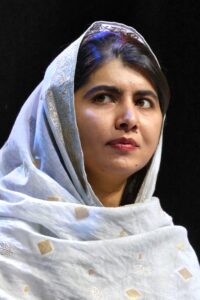
Malala Yousafzai
Malala Yousafzai (1997–present)
- Malala Yousafzai — born in Mingora in the Swat Valley of northwestern Pakistan, daughter of Ziauddin Yousafzai, a teacher and school owner who raised her with the conviction that girls' education was both a right and a necessity, began anonymous blogging for the BBC Urdu service at eleven during the Taliban occupation of Swat, was identified and shot in the head by a Taliban gunman on her school bus at fifteen, survived through emergency surgery in Pakistan and subsequent treatment in Birmingham, and returned to advocacy within months of her recovery — became at sixteen the youngest Nobel Peace Prize laureate in history and the most globally recognised advocate for girls' education in the twenty-first century dataset.1Britannica — Malala Yousafzai
- The Malala Fund — established in 2013 following her recovery, operating across Afghanistan, Brazil, Ethiopia, India, Nigeria, Pakistan, and Turkey — has directed advocacy, funding, and policy pressure toward the twelve million girls globally who are denied access to education, producing legislative commitments, institutional partnerships, and a public pressure campaign that has made girls' education a top-tier item on the international development agenda in a way that no previous advocacy organisation had achieved at equivalent speed.2Malala Fund — Malala's Story
- The variable profile that produced this record — a Conviction and Congruence combination of extraordinary consistency from childhood through the assassination attempt and beyond, a Communication capability that operates simultaneously in Pashto, Urdu, and English across audiences ranging from Swat Valley communities to the United Nations General Assembly, and a personal courage that converted the most visible possible act of targeted violence against her into the most visible possible platform for the cause it was designed to silence — is the most complete illustration in the Influencers domain of the relationship between personal cost and institutional leverage, and the clearest case in the dataset of a leader whose Visibility variable was created by her opponents rather than by herself.3Nobel Prize — Malala Yousafzai 2014
Malala Yousafzai is the most analytically unusual profile in the Influencers domain and the one that most completely tests the model's capacity to record leadership that began before the leader was old enough to vote, was interrupted by an assassination attempt, and resumed within months at a higher level of global influence than it had previously occupied. The equations capture a variable profile that was formed under conditions of existential threat and has operated consistently within that formation ever since.
The formation period is defined by the specific educational and political environment that Ziauddin Yousafzai created for his daughter in a society that did not support it. Malala's father ran a school in Mingora that admitted girls, spoke publicly about the importance of female education, and raised his daughter in the explicit conviction that her voice and her mind were as valuable as any boy's — a formation condition so structurally unusual in the Swat Valley context that it constitutes the primary analytical explanation for the variable profile that followed.1Britannica — Malala Yousafzai The Conviction variable from the earliest recorded public activity — the BBC Urdu blog begun at eleven, the public interviews given at twelve during the Taliban occupation — is not a product of political calculation but of a formation that had made the connection between education and human dignity so fundamental that advocacy for it was experienced as natural rather than as courage. The courage is analytically present — the Environment variable at this snapshot is among the most hostile in the dataset for any leader operating without military or institutional protection — but it is a courage that the formation had made structurally available rather than consciously chosen.
The Taliban occupation of Swat from 2007 to 2009 is the formation period's most analytically significant external event. The Taliban's closure of girls' schools, the public floggings, the destruction of CD and video shops, and the general imposition of a governance model that reduced women to domestic invisibility created the specific conditions in which Malala's BBC Urdu blog — written under the pseudonym Gul Makai — became the primary public record of civilian experience under occupation that reached an international audience.4BBC — Malala's Story The Communication variable in this period is operating at a level of sophistication that the age makes analytically extraordinary — the blog entries combined personal observation, emotional precision, and political clarity with a register calibrated to the BBC Urdu audience that most adult journalists would not have achieved. The Intent variable at this snapshot is at its ceiling — every entry was directed toward a specific communicative objective, delivered with the discipline of a writer who understood her audience and her purpose simultaneously.
The shooting on 9 October 2012 is the most analytically significant single event in the profile and the one that most precisely captures the relationship between the Visibility variable and the Conviction variable. A Taliban gunman boarded Malala's school bus in Mingora, asked for her by name, and shot her in the head at point-blank range.3Nobel Prize — Malala Yousafzai 2014 The attack was the Taliban's explicit attempt to silence an advocacy that the Visibility variable had made too prominent to ignore — and it produced the opposite of its intended effect. The Visibility variable, which had been building through the BBC blog, the documentary coverage, and the international media attention that the Taliban occupation had generated, reached its global ceiling within hours of the shooting. The Communication variable — which the attack was designed to terminate — was amplified by the attack to a level that no advocacy campaign could have achieved through conventional means. The Taliban's attempt to eliminate the Visibility variable created the conditions for its maximum expression. That is the k variable operating in its most analytically unusual form — fortune that is created by misfortune.
The recovery period from October 2012 to July 2013 — emergency surgery in Peshawar, medical evacuation to Birmingham, treatment at Queen Elizabeth Hospital, and the gradual return to public activity — is the Resilience variable at its most literal expression.2Malala Fund — Malala's Story Malala survived a point-blank headshot, recovered neurological function that the medical team had not initially guaranteed, and returned to public advocacy within nine months — not with a reduced message calibrated to reduced ambition, but with an expanded institutional framework, the Malala Fund, and a global platform that the attack had created. The Resilience variable at this snapshot is the highest in the Influencers domain dataset — not because the physical recovery was the most dramatic in the record, but because the recovery produced no reduction in Conviction, no moderation of message, and no concession to the logic that the attack had been designed to enforce.
The United Nations address of 12 July 2013 — her sixteenth birthday, delivered to the Youth Assembly in New York — is the canonical Communication variable output of the career and the most analytically precise expression of the profile's full variable range in a single event.5United Nations — Malala's Speech The speech — in which she addressed the Taliban directly, told them that the terrorists thought they could change her aims and stop her ambitions, but nothing had changed except weakness, fear, and hopelessness had died — is the Conviction and Communication variables operating simultaneously at their ceiling, delivered by a sixteen-year-old who had been shot in the head by the organisation she was directly addressing nine months earlier. The Intent variable at this moment is the most precisely focused in the Influencers domain — every sentence was directed toward a specific institutional objective, the mobilisation of international political will for girls' education, and every sentence delivered it.
The Nobel Peace Prize of 2014 — shared with Kailash Satyarthi — is the institutional validation of the Visibility variable reaching its global ceiling.3Nobel Prize — Malala Yousafzai 2014 Malala received it at seventeen — the youngest Nobel laureate in history — in Oslo, in a ceremony that the Taliban publicly threatened to attack. The Congruence variable at this snapshot is at its highest point in the profile — the private person and the public advocate are identical, the formation values and the institutional mission are the same, and the personal cost already paid has made the gap between stated position and lived reality effectively zero. A leader who has already absorbed the worst her opponents can deliver has no remaining incentive for the Congruence compromises that most leaders make in the interest of institutional survival.
The Malala Fund's operational record from 2013 onwards reflects the Process and Defined Output variables converting the Communication and Visibility platform into institutional output.6Malala Fund — Our Work The Fund's model — combining advocacy, journalism through the Assembly platform, direct funding of girls' education programmes, and policy engagement with governments in the target countries — reflects a strategic design that understands the relationship between public pressure, policy commitment, and programme delivery. The Defined Output variable at the current snapshot is lower than the Communication and Visibility variables — converting global attention into measurable educational outcomes for specific populations is a harder problem than generating global attention, and the Fund's impact on the twelve million out-of-school girls its mission addresses is real but partial. That gap between the visibility of the cause and the scale of the institutional response it has generated is the primary analytical tension of the current period.
The Oxford degree, the continued public advocacy, and the marriage in 2021 reflect a variable profile that has maintained its formation values across the transition from adolescent icon to adult institutional leader — a transition that most public figures formed through dramatic early experience do not navigate without significant variable change.1Britannica — Malala Yousafzai The Humility variable across all snapshots is analytically significant — Malala has consistently attributed her platform to the cause rather than to herself, acknowledged the limitations of her reach, and directed attention toward the specific girls whose situations her advocacy is designed to address rather than toward her own story. That is the Humility variable operating correctly in a context where the Visibility variable creates constant pressure toward self-referential narrative.
The number that matters most across all three snapshots is Congruence — sustained at its highest level from the BBC Urdu blog through the Nobel Prize and beyond, across a period that included an assassination attempt, global celebrity, and the institutional pressures that accompany the transition from advocacy to organisational leadership. A Congruence variable that holds at its ceiling when the incentives for its compromise are at their maximum — when the platform is large enough that moderation would reach more people, when the personal cost of maintaining the position has already been paid once, and when the institutional funders and political partners that the Fund requires might prefer a less confrontational register — is the most analytically demanding score in the dataset. It is the signature of Malala Yousafzai, and it is the reason that the youngest Nobel laureate in history is also the most analytically consistent profile in the Influencers domain.
Score Comparison
Add up to 10 leaders. Click a name to visit their profile.
The 13 Equations
Scores for: BBC Blog and Taliban Occupation — Formation Under FireThe 22 Variables
Canonical scoresSources & Bibliography
The scores assigned to this leader are derived from publicly available sources. Variable inputs reflect documented behaviour, structural conditions, and historical record at the time of each snapshot.