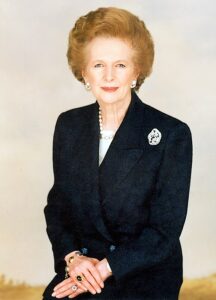
Margaret Thatcher
Margaret Thatcher (1925–2013)
- Born Margaret Hilda Roberts on 13 October 1925 above her father's grocery shop in Grantham, Lincolnshire — the daughter of Alfred Roberts, a local alderman and Methodist lay preacher whose emphasis on self-reliance, hard work and financial independence she absorbed and deployed for the rest of her career — studied chemistry at Oxford where she became president of the University Conservative Association, was called to the Bar, contested Dartford twice without success, entered Parliament as MP for Finchley in 1959, served as Secretary of State for Education under Heath where she was nicknamed "Thatcher, Thatcher, milk snatcher" for ending free school milk1Wikipedia — Thatcher — and in February 1975 defeated Edward Heath for the Conservative leadership, becoming the first woman to lead a major British political party.
- Won the 1979 general election on the back of the Winter of Discontent, was nearly removed by her own Cabinet in 1981 as recession deepened and unemployment exceeded three million, survived the 1982 Argentine invasion of the Falkland Islands by dispatching a task force 8,000 miles that retook the islands in 74 days — the victory transforming her political position — won the 1983 election in a landslide, broke the miners' strike after a year-long confrontation in 1984–85, survived the IRA's Brighton bomb that killed five people at the Conservative conference in October 19842Britannica — Thatcher — and presided over the privatisation of British Telecom, British Gas, British Airways, British Steel, Rolls-Royce and a dozen other state enterprises, tripling the number of individual shareholders.
- Won a third term in 1987 with a majority of 101, introduced the Community Charge (poll tax) in Scotland in 1989 and England in 1990 against the advice of her Chancellor and most of her Cabinet, lost Nigel Lawson as Chancellor in October 1989 and Geoffrey Howe as Foreign Secretary in November 1990 — Howe's resignation speech describing her as breaking up the Cabinet's batting before it reached the crease becoming the most devastating parliamentary demolition of a sitting Prime Minister in modern British history3Thatcher Foundation — Biography — and resigned on 22 November 1990 when it became clear she could not win the second ballot of the Conservative leadership contest, telling her Cabinet through tears that it was "a funny old world."
Margaret Thatcher served as Prime Minister from 1979 to 1990 — eleven and a half years, the longest continuous tenure of any 20th-century Prime Minister. She is the most analytically polarising profile in the Contemporary British Political domain: the same variable scores that explain her extraordinary achievements explain the mechanism of her fall, and the equations hold both simultaneously without resolving the moral verdict that her legacy continues to generate.
The first term is the analytical foundation. She inherited an economy with 27% inflation, chronic trade union disruption, a psychology of decline that had accumulated over three post-war decades, and a political class that had concluded the management of decline was the only realistic British project. Her response was to reject that framework entirely — not tactically but ontologically. The monetarist programme she implemented produced a recession worse than any since the 1930s and three million unemployed. Her Cabinet's "Wets" urged her to U-turn. She refused. "You turn if you want to. The lady's not for turning." The Conviction variable at 10 operating without the moderating influence of sufficient Humility produced both the programme's eventual success and the near-catastrophe of 1981.4EBSCO Research Starters — Thatcher
The Falklands is the k variable operating at maximum amplification. Argentina's invasion of a remote dependency with 1,800 inhabitants changed British politics in ways that no one — including Thatcher — had planned. She dispatched the task force because she judged it the right thing to do and because the alternative was political annihilation. The military campaign succeeded because the armed forces were precisely the institution Thatcher had not subjected to her reform programme — they remained professional, disciplined and capable. The political consequence — a landslide in 1983 — gave her the majority to complete the programme that 1979 had begun.
The canonical second term is the profile's peak across almost every variable. The miners' strike of 1984–85 is the defining confrontation — not because it was the most economically significant episode of her premiership but because it expressed the variable profile most completely. She had prepared for it: coal stocks had been built up, the trade union legislation of the first term had been carefully staged to prevent secondary action, and she chose the ground for the confrontation rather than accepting it as imposed. After a year, the NUM conceded without a deal. The People variable at this period is high — Howe, Lawson and Tebbit were amongst the most capable ministerial teams assembled in modern British government, and she managed them effectively. The Defined Output variable is at its ceiling: reduce inflation, break union dominance, privatise the commanding heights, rebuild national confidence. All four delivered by 1987.5Churchill Archives — Thatcher Biography
The third term is where Humility at 4 — insufficient but not floor — stopped functioning even at its baseline level. The poll tax replaced the rates as the mechanism for local government finance with a flat-rate charge applied equally to dukes and dustmen. Almost every adviser told her it was politically toxic. She proceeded because her framework told her it was correct — the principle of individual contribution to local services regardless of income was consistent with her values. The Pride variable at 7 prevented her from registering that a value she held could produce an outcome that destroyed her government. Riots in London in March 1990. Her own Cabinet concluded she had to go. Geoffrey Howe's resignation speech in November 1990 is the most precise contemporary description of the Humility variable at insufficient levels: a leader so constitutionally committed to her own framework that she had become unable to function in a team, breaking up the batting before it could reach the crease.6History.com — Thatcher
She resigned on 22 November 1990. She had not lost an election. She had not been defeated in Parliament. She was removed by her own party because it concluded she had become an electoral liability — the ultimate measure of whether the Pride variable had exceeded the operational threshold. The equations record that her Conviction at 10 produced both the transformation of British politics and the mechanism of her removal: the same absolute certainty that allowed her to hold firm in 1981 prevented her from reading in 1990 that the game had changed.
Her legacy divides opinion as sharply today as her policies did in office. The Codex does not resolve this division — it records the variables that produced it. What is analytically uncontested is that she changed the terms of British political debate so completely that her successor but one — Tony Blair — won three elections by accepting her economic settlement rather than reversing it. That is the k variable, operating across three decades, in the only measure that matters for a political leader: whether the framework they built outlasted them.
Score Comparison
Add up to 10 leaders. Click a name to visit their profile.
The 13 Equations
Scores for: Second Term — Miners' Strike, Privatisation and Peak PowerThe 22 Variables
Canonical scoresWhat changed: First Term — Recession, Falklands and Survival → Second Term — Miners' Strike, Privatisation and Peak Power
Sources & Bibliography
The scores assigned to this leader are derived from publicly available sources. Variable inputs reflect documented behaviour, structural conditions, and historical record at the time of each snapshot.