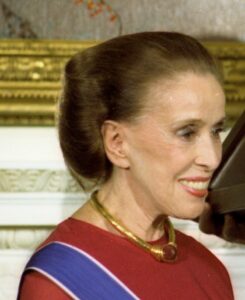
Martha Graham
Martha Graham (1894-1991)
- Founded her dance company in 1926 and led it for sixty-five years — creating 181 choreographic works, developing the Graham Technique (a codified movement vocabulary built on contraction and release, grounded gravity and spinal flexion, directly comparable to ballet in its scope and systematisation), and training the choreographers who became the next generation of American modern dance: Merce Cunningham, Paul Taylor, Twyla Tharp and Alvin Ailey all passed through her company.1Martha Graham Dance Company — History ↗
- Was named Dancer of the Century by Time magazine and compared by critics to Picasso's relationship to modern painting, Stravinsky's to music and Frank Lloyd Wright's to architecture — collaborated with sculptor Isamu Noguchi on over thirty-five productions, with composer Aaron Copland on Appalachian Spring, and commanded the artistic resources of a generation of American modernism in the service of a vision of dance as a vehicle for the expression of psychological and emotional truth.2Britannica — Martha Graham ↗
- Received the Presidential Medal of Freedom from Gerald Ford in 1976 — the first dancer and choreographer to receive it — performed at the White House, travelled internationally as a cultural ambassador with State Department support, taught actors including Bette Davis, Gregory Peck, Kirk Douglas, Madonna and Liza Minnelli movement technique at The Neighbourhood Playhouse, and continued to choreograph until her death on 1 April 1991 at the age of ninety-six, four days after the premiere of her final new work.3Wikipedia — Martha Graham ↗
Martha Graham was born on 11 May 1894 in Allegheny County, Pennsylvania, the daughter of a physician who specialised in nervous disorders and who believed that the body's physical movement could reveal its inner psychological state — a belief that, as Graham later acknowledged, was the intellectual foundation of everything she would spend her life building.4PBS American Masters — Martha Graham ↗ She did not begin dancing until she was seventeen, when she saw Ruth St Denis perform in Los Angeles and decided, against the objections of her Presbyterian parents, that dance was what she would do. She was told she was too old. She enrolled anyway. The Graham Technique — the codified movement vocabulary she developed across the 1920s and 1930s from a tiny Carnegie Hall studio, working with a company of women who were paid nothing and committed themselves entirely — is the analytical anchor of her Cultural domain profile. The word 'codex' is not metaphorical in this context: the Graham Technique is a systematic and transmissible body of knowledge, written, filmed, taught and practised globally, directly comparable in its structure and scope to the vocabulary of classical ballet that it was explicitly built in opposition to.5English National Ballet — Martha Graham ↗ The contraction and release principle — derived from the natural rhythm of breathing — gave modern dance a physical grammar that had never previously existed. The Process variable in her profile reflects sixty years of systematic development and transmission of that grammar. Her Defined Output was clear from the earliest years and never changed: to make dance a vehicle for the expression of psychological and emotional truth that other art forms could not reach — to reveal, as she put it, 'the inner man.'2Britannica — Martha Graham ↗ The works she created to deliver this output range from Frontier (1935), a solo about the pioneer woman's mastery of an uncharted domain, to Appalachian Spring (1944, with Copland), to Clytemnestra (1958, her full-evening Greek tragedy), to Acts of Light (1981, composed when she was eighty-seven). The Conviction variable scores at its ceiling across all six decades: she was ridiculed in the late 1920s — critics called her work ugly, stark and obscure — and responded by producing more of it. The decade she later called 'my period of long woolens' produced some of the most enduring works in the American dance repertoire. The company she led was simultaneously a creative instrument and an educational institution. Merce Cunningham came to her. Paul Taylor came to her. Twyla Tharp came to her. All of them worked within her framework, absorbed her technique, and subsequently built their own choreographic languages that could not have existed without it.1Martha Graham Dance Company — History ↗ The People variable reflects not just the management of a dance company but the sustained creation of a generation of choreographic leaders who each, in turn, led their own institutions. She stopped performing in 1970, at the age of seventy-six — stopped not because she chose to but because her body would no longer meet the demands of her choreography. She sank into a depression and alcohol abuse for several years before reconstituting the company in 1973 and returning to choreography, creating new works into her nineties. She died on 1 April 1991, four days after the premiere of Maple Leaf Rag, her 181st and final choreographic work. Her company continues to perform internationally. The Graham Technique is taught on every continent. She did not leave behind a building or a catalogue of products. She left behind a way of moving the human body that did not exist before her and that is now inseparable from the history of twentieth-century art.
Score Comparison
Add up to 10 leaders. Click a name to visit their profile.
The 13 Equations
Scores for: Late Choreography — Return from DepressionThe 22 Variables
Canonical scoresWhat changed: Global Recognition — 1950 to 1970 → Late Choreography — Return from Depression
Sources & Bibliography
The scores assigned to this leader are derived from publicly available sources. Variable inputs reflect documented behaviour, structural conditions, and historical record at the time of each snapshot.