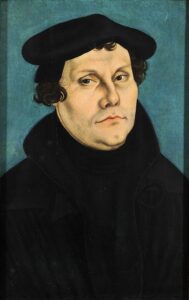
Martin Luther
Martin Luther (1483–1546)
- Published his 95 Theses in October 1517 attacking the Catholic Church's sale of indulgences — copies spreading across Germany within two weeks and throughout Europe within two months, aided by the printing press1Biography.com — Martin Luther — permanently fracturing Western Christianity, triggering his excommunication in January 1521, and being declared an outlaw and heretic under the Edict of Worms, after which Frederick the Wise sheltered him at Wartburg Castle where he translated the New Testament into German.2History.com — Martin Luther 95 Theses
- Translated the entire Bible into German vernacular, making scripture directly accessible to ordinary people for the first time and helping standardise the German language across regional dialects — with his translation also influencing the subsequent Tyndale English Bible.3Wikipedia — Martin Luther
- Authored virulently antisemitic works in his final years, including On the Jews and Their Lies (1543), calling for the burning of synagogues and expulsion of Jews — the Nazi Party displayed the treatise at Nuremberg rallies four centuries later, the city of Nuremberg presenting a first edition to the editor of Der Stürmer4Wikipedia — Martin Luther and Antisemitism — with the prevailing scholarly view since the Second World War holding that the writings exercised a major and persistent influence on Germany's attitude toward its Jewish citizens in the centuries between the Reformation and the Holocaust.
Martin Luther is one of the most analytically unusual figures in the Codex. His Effective Power in 1517 was produced with almost none of the variables that typically drive it. He had no Resources, no Autonomy, no institutional position worth protecting. He was a professor of theology at a minor university, an Augustinian friar, and by 1521 a convicted outlaw under sentence of death.5Britannica — Martin Luther What he had was Conviction at maximum, Ability deployed through writing rather than command, and an Environment that was structurally ready to fracture.
The printing press is the critical k variable in this profile. Luther did not invent it — it had existed for sixty years before 1517. But he was the first figure in history to weaponise it at continental scale. Within two weeks of the 95 Theses, copies had spread across Germany. Within two months they had reached France, England and Italy.1Biography.com — Martin Luther Without the press, the 95 Theses are a local academic dispute that Rome ignores. With it, they become the founding document of a religious revolution. That is k operating at its theoretical maximum — environmental fortune that multiplies every variable in the numerator without requiring any additional effort from the leader.
Frederick the Wise's protection of Luther after the Diet of Worms is scored as Environment, not Autonomy. Luther did not control it, could not direct it, and would have burned without it. It was an external condition that kept him alive long enough to translate the New Testament at Wartburg Castle — arguably the most consequential eighteen months of his career. The Wartburg period produced the German Bible, which did more to establish Luther's legacy than any of his theological arguments.3Wikipedia — Martin Luther
By 1530 the framework shows a different picture. The Augsburg Confession formalised Lutheran doctrine. Princely backing had converted a theological insurgency into an institutional church. Resources and Autonomy both rise as secular rulers adopt the Reformation for their own political purposes. Effective Power consolidates — but the cost is visible in the variables. Corporate Drag and Bureaucracy begin to appear as the revolutionary movement becomes an organisation. Congruence starts to slip as Luther's behaviour towards the peasants' revolt of 1525 — in which he urged the nobility to slaughter the rebels — reveals the gap between his rhetoric of Christian freedom and his instinct for social order.1Biography.com — Martin Luther
The final snapshot is a study in variable decay. Pride and Ego have risen throughout the career as Luther's certainty about his own righteousness hardened into something uglier. The antisemitic writings of 1543 are not a late aberration — they are the logical end of a trajectory visible from the 1520s onwards. When his early attempts to convert Jews through kindness failed, his response was not reflection but escalation. Congruence collapses because the man who preached grace and salvation for all ended his life calling for the destruction of synagogues.4Wikipedia — Martin Luther and Antisemitism The say-do gap is absolute. Intent drops accordingly.
Luther's theological legacy and his antisemitic legacy are not separable quantities to be weighed against each other. They came from the same source: a man of extraordinary Conviction who believed with absolute certainty that he alone understood the truth, and who became progressively less capable of tolerating any evidence to the contrary. The framework captures this. The scores tell the story across three snapshots that the biography alone cannot.
Score Comparison
Add up to 10 leaders. Click a name to visit their profile.
The 13 Equations
Scores for: The Bitter EndThe 22 Variables
Canonical scoresWhat changed: The Reformation Established → The Bitter End
Sources & Bibliography
The scores assigned to this leader are derived from publicly available sources. Variable inputs reflect documented behaviour, structural conditions, and historical record at the time of each snapshot.