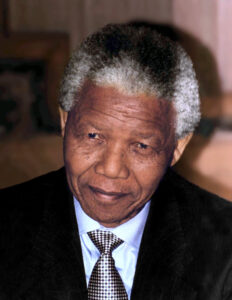
Nelson Mandela
Nelson Mandela (1918–2013)
- Joined the ANC in 1943, co-founded its Youth League in 1944, led the Defiance Campaign of 1952, then co-founded uMkhonto we Sizwe in 1961 and was sentenced to life imprisonment at the Rivonia Trial in 1964 — delivering from the dock a three-hour address stating that he had cherished the ideal of a democratic and free society and was prepared to die for it.1Nelson Mandela Foundation — Biography
- Spent twenty-seven years in prison, eighteen of them on Robben Island in a cell measuring eight feet by seven feet, allowed one visitor and one letter every six months2Wikipedia — Nelson Mandela — refused a conditional release offer in 1985 on the grounds that only free men could negotiate3Famous Trials — Nelson Mandela — and was released by F.W. de Klerk on 11 February 1990 after twenty-seven years and eight months.4Wikipedia — Rivonia Trial
- Negotiated the end of apartheid, won the Nobel Peace Prize jointly with de Klerk in 1993, became South Africa's first democratically elected president in May 1994, wore the Springbok shirt to present the Rugby World Cup trophy to Francois Pienaar in 1995, and later publicly admitted his personal failure to engage with the HIV/AIDS pandemic that killed millions during and after his presidency.5Britannica — Nelson Mandela
Nelson Mandela presents the Codex with a profile that contains a genuine internal tension the framework must hold without resolving. The Conviction variable sits at or near maximum across all four snapshots. The Congruence variable sits high but not at its ceiling — because the historical record contains documented gaps between stated values and operational behaviour that the Codex must record honestly. Both things are true simultaneously. The profile holds them without adjudication, because the historical record has not adjudicated them either, and because the combination of high Conviction with slightly constrained Congruence is precisely what produced the leader who negotiated the end of apartheid rather than the one who might have demanded its violent destruction.
The early activism and Defiance Campaign period establishes the variable template against conditions of systematic state oppression that the Environment variable records at its near-minimum. The apartheid system was designed to make the variables the Codex measures impossible to exercise — it criminalised political organisation, banned leaders from public appearances, jailed activists without trial and constructed a legal architecture specifically intended to produce Administrative Impotence in those it oppressed.2Wikipedia — Nelson Mandela Against this, the ANC's growth during the Defiance Campaign is a People and Intent variable event recorded under conditions that should have prevented it. Mandela's shift during this period — from Africanist suspicion of communists and non-blacks to a genuinely multiracial conception of the liberation struggle — is documented in his own account as an intellectual evolution driven by evidence rather than ideology. That is the Humility variable operating at its documented level: a leader who updated his framework when the evidence required it.
The Congruence variable in this period sits below its ceiling because the historical record contains two documented divergences from stated values. Mandela co-founded uMkhonto we Sizwe while the ANC maintained a public commitment to nonviolence — a pragmatic decision that he consistently described as necessary but that created a gap between the organisation's stated position and his own operational behaviour.2Wikipedia — Nelson Mandela He was also a member of the South African Communist Party while publicly denying it — something confirmed after his death by both the ANC and the SACP. The Codex does not judge the pragmatism. It records the gap.
The Rivonia Trial and imprisonment period is the profile's most analytically unusual. Autonomy at its near-minimum. Resources at their minimum. Bureaucracy and Corporate Drag at their highest levels across the profile — the prison system on Robben Island was an institutional structure specifically designed to eliminate the variables the Codex measures. Against this, Conviction and Value at or near their peaks produce a Leaderment percentage that the framework records as extraordinary precisely because the Leadership equation captures personal quality independently of operational output. What Mandela produced on Robben Island was not measurable in conventional output terms but was analytically real: the University of Robben Island where prisoners lectured in their areas of expertise, the study of Afrikaans to build mutual understanding with warders and convert some of them to his cause, the maintenance of dignity that the prison system was designed to prevent.6Canadian Museum for Human Rights — Nelson Mandela The Rivonia speech — a three-hour address that stated the values of the movement he led and accepted the consequences of doing so — is Intent at its documented maximum.
The negotiations and election period is the canonical snapshot and the Codex records its highest score for a specific analytical reason. The operational challenge Mandela faced from February 1990 to May 1994 was not to articulate a vision — the vision had been stated at Rivonia and remained consistent through twenty-seven years of imprisonment. The challenge was to translate that vision into a constitutional outcome against an environment of genuine complexity: a de Klerk he increasingly distrusted but needed, an Inkatha movement engaged in violence that threatened to derail the process, ANC militants who believed he was conceding too much, and an international community that wanted resolution on a timeline his opponents could exploit.5Britannica — Nelson Mandela The People variable at its high reading in this period records his ability to hold all of these simultaneously — the handshake offered to de Klerk on national television, the speech after the Boipatong massacre that pulled the ANC back from the brink of abandoning negotiations, the personal meetings with Afrikaner generals and politicians that brought the far right inside the democratic tent. The Defined Output was the 1994 election. It was delivered.
The presidency and post-presidency period is where Value reaches its ceiling and Congruence sits at its same constrained level — but for a different documented reason. The HIV/AIDS pandemic killed more South Africans than any other single cause during and after his presidency. By 1999, ten percent of the population were HIV positive. Mandela later admitted publicly that he had personally neglected the issue, leaving it to Mbeki while political reticence made engagement costly.5Britannica — Nelson Mandela That admission is itself a Congruence event of a particular kind: the acknowledgement of failure is the highest Congruence act available to a leader who has failed. The Codex records the constrained variable because the failure was real, and records the admission as part of the same variable reading because it was genuine.
Against this sits Value at its ceiling — the Springbok shirt at the 1995 Rugby World Cup final, the Truth and Reconciliation Commission that moved a society from a history of institutionalised violence toward a documented record rather than a suppressed one, the donation of a third of his presidential salary to the Nelson Mandela Children's Fund while making his own bed in the presidential residence. These are the Value variable at its documented maximum — a leader who delivered what he said he would deliver while acknowledging honestly what he failed to deliver.1Nelson Mandela Foundation — Biography
He said he was not a messiah but an ordinary man who had become a leader because of extraordinary circumstances. The Codex records the circumstances in the Environment variable at near-minimum for most of his career, and records the leader in the personal variables at or near their peak throughout. The gap between those two readings — maximum personal quality operating against minimum structural conditions — is what the framework was designed to measure. Mandela's profile demonstrates it across sixty years of documented evidence.
Score Comparison
Add up to 10 leaders. Click a name to visit their profile.
The 13 Equations
Scores for: Early Activism — Defiance CampaignThe 22 Variables
Canonical scoresSources & Bibliography
The scores assigned to this leader are derived from publicly available sources. Variable inputs reflect documented behaviour, structural conditions, and historical record at the time of each snapshot.