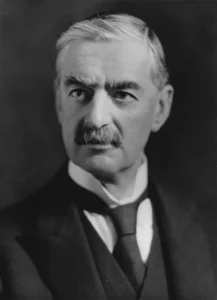
Neville Chamberlain
Neville Chamberlain (1869–1940)
- Born on 18 March 1869 in Edgbaston, Birmingham — the son of Joseph Chamberlain, the radical Liberal politician and civic reformer, and younger half-brother of Austen Chamberlain, Foreign Secretary — spent six years managing a sisal plantation in the Bahamas on his father's instruction, returned to Birmingham, became Lord Mayor at forty-six, entered Parliament in 1918, and served as Minister of Health (1923, 1924–29, 1931) and Chancellor of the Exchequer (1931–37) — building a domestic record in health, housing and social insurance that contemporaries regarded as genuinely accomplished and that history has almost entirely forgotten in the shadow of what followed.1Wikipedia — Neville Chamberlain
- Became Prime Minister in May 1937 at sixty-eight, flew personally to meet Hitler three times in September 1938 as the Sudetenland crisis escalated — the first British prime minister ever to travel by aircraft — and on 30 September 1938 returned from Munich waving the joint declaration he and Hitler had signed, telling the crowd at Downing Street "I believe it is peace for our time"2Britannica — Neville Chamberlain — having at Munich ceded the Sudetenland to Germany without consulting Czechoslovakia, whose representatives waited in a Munich hotel while their country's fate was decided, and simultaneously ordered the acceleration of British rearmament, which suggests he understood rather more than the crowd understood.
- When Hitler seized the rest of Czechoslovakia in March 1939 Chamberlain repudiated appeasement, guaranteed Poland, and on 3 September 1939 broadcast to the nation that Britain was at war — led the country through the first eight months of the war before being forced to resign on 10 May 1940 following the Norway debate in which members of his own party turned against him, served loyally in Churchill's War Cabinet until his health collapsed, and died of cancer on 9 November 1940 — six months after leaving office, having written privately that he did not fear the historian's verdict.1Wikipedia — Neville Chamberlain
Neville Chamberlain is the Codex profile where the Congruence variable and the Humility variable produce the most analytically instructive divergence in the dataset. His Congruence score is high: he did precisely what he said he would do, believed precisely what he said he believed, and never performed a position he did not hold. His Humility score is near floor: he could not update his model of Hitler as a rational actor amenable to negotiated settlement even when the evidence mounted systematically against it.
The domestic record deserves its own analysis because it is the part of his profile that the Munich narrative has permanently obscured. As Chancellor of the Exchequer from 1931 to 1937, Chamberlain managed Britain's recovery from the Great Depression with genuine competence — balancing budgets, stabilising the currency, overseeing the beginnings of rearmament long before it became politically uncontroversial. As Minister of Health in the 1920s he passed more social legislation than any minister in the period, building the framework of council housing, health insurance and local government reform that his contemporaries regarded as substantial. The Process variable at this period is high. The Defined Output is clear. The results were real.2Britannica — Neville Chamberlain
The canonical snapshot is the Munich period, and the Codex analysis differs from the standard verdict in one important respect: the analytically precise failure was not Conviction but Humility. Chamberlain's Conviction was extraordinarily high — "peace for our time" was not a performance, it was a genuine belief, held with the same certainty before Munich and after it. The problem was that the belief was wrong, and the Humility variable — the capacity to update a model when evidence contradicts it — was near floor. He had constructed a framework in which Hitler was a rational statesman with legitimate grievances who would honour agreements once his demands were met. That framework survived Anschluss, survived Sudetenland, and survived even the seizure of the rest of Czechoslovakia in March 1939 — which Chamberlain framed as Hitler's betrayal of the Munich agreement rather than as confirmatory evidence that his model of Hitler had been wrong from the start.3National Archives — Chamberlain and Hitler
The revisionist case for Chamberlain is not without merit and the equations capture it. At Munich Britain had no radar network, insufficient Spitfires, and a public traumatised by the memory of 1914–18 that made declaration of war politically difficult. The eleven months between Munich and the outbreak of war were used to accelerate rearmament — Chamberlain himself ordered the acceleration the day he returned from Germany. The question is whether those eleven months of rearmament justified the strategic cost of allowing Germany to absorb Czechoslovakia's industrial base, its thirty-five trained divisions, and its Skoda armaments factories. The equations record that question in the Value variable — and score it low, because the net effect of Munich was to make Germany stronger and Britain's eventual war harder, not easier.
The Confidence variable is the other analytically unusual feature of this profile. Chamberlain flew to meet Hitler in the first place — an act of personal courage and diplomatic initiative unprecedented in British political history. He was sixty-nine years old and had never flown before. He went three times. The Confidence to attempt a solution that no one else had attempted is recorded correctly in the equations. The failure was not of nerve but of model: he was attempting the right thing — preventing the war — through a framework that could not work because his assessment of the adversary was wrong.4National WWII Museum — Appeasement
Churchill's verdict — "You were given the choice between war and dishonour. You chose dishonour and you will have war" — was correct about the outcome. It was not entirely correct about the mechanism. Chamberlain did not choose dishonour in the sense of knowingly accepting a bad bargain. He chose what he genuinely believed was honour — a settlement that would hold, a peace that would last, a rational actor who could be appeased. The Congruence variable records that belief as genuine. The Humility variable records the incapacity to revise it. Both are the same man.
He died six months after leaving office, convinced he would be vindicated by history. The equations record that he was wrong about that too.
Score Comparison
Add up to 10 leaders. Click a name to visit their profile.
The 13 Equations
Scores for: Appeasement and Munich — Peace for Our TimeThe 22 Variables
Canonical scoresWhat changed: Chancellor — Domestic Record and Rearmament → Appeasement and Munich — Peace for Our Time
Sources & Bibliography
The scores assigned to this leader are derived from publicly available sources. Variable inputs reflect documented behaviour, structural conditions, and historical record at the time of each snapshot.