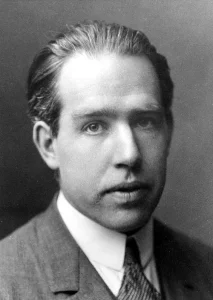
Niels Bohr
Niels Bohr 1885 - 1962
- Founded the Institute for Theoretical Physics at the University of Copenhagen in 1920 — subsequently renamed the Niels Bohr Institute — building it into the international centre of quantum physics through the 1920s and 1930s, attracting Heisenberg, Pauli, Schrödinger, Dirac, Gamow, Meitner and dozens of other physicists who came to Copenhagen specifically to work with him, and creating what Britannica called 'the Copenhagen Spirit': an informal, intensely collaborative atmosphere in which physics was discussed without institutional constraint, producing the Copenhagen interpretation of quantum mechanics that remains the dominant framework for understanding atomic phenomena.1Wikipedia — Niels Bohr Institute ↗
- Mentored Werner Heisenberg, Wolfgang Pauli, Lise Meitner, Erwin Schrödinger, Paul Dirac and numerous other physicists whose subsequent Nobel Prizes and foundational contributions to twentieth-century physics were developed in, or substantially shaped by, their time at Copenhagen — producing a People variable achievement that is analytically unusual in the Scientific domain because his primary institutional output was not a laboratory product or a policy outcome but the generation of scientists whose work multiplied his contribution beyond any individual achievement he could have made alone.2Britannica — Niels Bohr Copenhagen ↗
- During the Nazi occupation of Denmark, used his international connections and institutional standing to help Jewish physicists escape Germany, fled Denmark himself in September 1943 hidden in a fishing boat when warned of his imminent arrest, was evacuated to Britain, joined the British Tube Alloys project and then the Manhattan Project — but spent his time at Los Alamos less as a technical contributor and more as a moral interlocutor, pressing Oppenheimer and others about the political implications of nuclear weapons and arguing for international control of atomic energy before the war ended.3Wikipedia — Niels Bohr ↗
Niels Henrik David Bohr was born on 7 October 1885 in Copenhagen, the son of a professor of physiology who was nominated twice for a Nobel Prize, grew up in an intellectually extraordinary household, studied physics at the University of Copenhagen, completed his doctorate in 1911, travelled to England to work with J.J. Thomson at Cambridge and Ernest Rutherford at Manchester, and returned to Denmark in 1913 to publish the trilogy of papers on atomic structure that established his international reputation at the age of twenty-eight.3Wikipedia — Niels Bohr ↗ The analytical profile of Bohr within the Scientific domain is built around the People variable operating in a mode with almost no parallel in the dataset: his primary institutional contribution was the creation and maintenance of a community rather than the production of a specific output. The Institute for Theoretical Physics was not a factory producing papers; it was a gravitational field that attracted the finest theoretical physicists of a generation and concentrated them in an environment where the informal exchange of ideas was the primary institutional activity. The 'Copenhagen Spirit' that Britannica describes — completely informal atmosphere, opportunity to discuss physics without any concern for other matters, the unique opportunity of working with Bohr — is the analytical expression of a People variable operating at its ceiling in a specific and unusual way.2Britannica — Niels Bohr ↗ Bohr did not manage his institute in the conventional sense. He managed it by being the kind of physicist and the kind of person that other extraordinary physicists wanted to be near, by asking the right questions in the right way, and by creating institutional conditions in which those physicists could do their best work without interference from administrative, financial or reputational pressures. The Humility variable scores at or near its ceiling throughout Bohr's career — a striking contrast with several other leaders in the Scientific domain. His approach to knowledge was explicitly predicated on uncertainty: he coined the complementarity principle precisely because he believed that the nature of subatomic reality could not be captured by any single description, and he extended this epistemic humility into his personal and institutional style. His famous remark 'We are all agreed that your theory is crazy. The question is whether it is crazy enough' reflects a mind that genuinely held its own positions provisionally and engaged with alternatives as potentially valid rather than as threats to be defeated. The wartime and post-war period presents a different expression of the same character. Bohr's arguments to Churchill and Roosevelt — and later his open letter to the United Nations — for international control of atomic energy before the Cold War arms race solidified were not politically successful, but they were intellectually courageous and morally consistent with the values he had expressed in his scientific work. The Conviction variable reflects a man who held his positions regardless of whether the political environment made them welcome. He died on 18 November 1962 in Copenhagen, the city where he had been born, educated, and spent virtually his entire professional life. His son Aage shared the Nobel Prize in Physics in 1975. His institute continues to operate as the Niels Bohr Institute, ranked among the leading physics research institutions in the world.
Score Comparison
The 13 Equations
Scores for: Copenhagen Institute — Peak of Quantum Physics GenerationThe 22 Variables
Canonical scoresSources & Bibliography
The scores assigned to this leader are derived from publicly available sources. Variable inputs reflect documented behaviour, structural conditions, and historical record at the time of each snapshot.