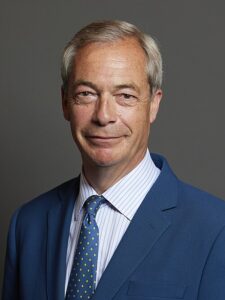
Nigel Farage
Nigel Farage (Born 1964)
- Co-founded the United Kingdom Independence Party in 1993 — serving as its leader from 2006 to 2009 and again from 2010 to 2016, building it from fringe single-issue party to the force that won the 2014 European Parliament elections (the first national poll won by any party other than Conservative or Labour since 1906), produced sustained electoral pressure on David Cameron's Conservative government, and became the principal external driver of the political conditions that led to the 2013 Conservative manifesto commitment to a referendum on European Union membership.1Wikipedia — Nigel Farage ↗
- Was the most visible campaigner for the Leave side in the 2016 European Union referendum — operating outside the official Vote Leave campaign through Leave.EU, providing the explicit anti-immigration framing that Vote Leave's leadership had sought to avoid, and continuing to campaign through to the 23 June 2016 referendum result that produced the Leave victory by 52% to 48%, an outcome he described in his immediate post-result remarks as having been achieved "without a single bullet being fired" — language that drew significant subsequent criticism in light of the murder of Labour MP Jo Cox by a white nationalist eight days before the vote.2Wikipedia — 2016 EU referendum ↗
- Founded the Brexit Party in 2019 (renamed Reform UK in 2021) — winning the 2019 European Parliament elections with 30.5% of the UK vote, stepping back from leadership in March 2021, returning to lead Reform UK in June 2024, winning Clacton with a majority of over 8,000 in the July 2024 general election as Reform UK took 14% of the national vote and five seats, and continuing to lead Reform UK as leader of the parliamentary party with 2025 polling at multiple points placing the party first in national voting intention.3Wikipedia — Reform UK ↗
Nigel Paul Farage was born on 3 April 1964 in Farnborough, Kent, the son of a stockbroker, and was educated at Dulwich College in south London where he was Head of College.1Wikipedia — Nigel Farage ↗ He did not attend university, joining the City of London commodities trading floor in 1982 at age eighteen and working as a metals trader at Drexel Burnham Lambert and subsequently at Crédit Lyonnais Rouse and Refco. He was a Conservative Party member from his teenage years until 1992, leaving the party over the Maastricht Treaty's transfer of sovereignty to European Union institutions, and was a co-founder of the Anti-Federalist League which became the United Kingdom Independence Party in 1993. He was elected to the European Parliament for South East England in 1999 and served as an MEP for the same constituency continuously until the United Kingdom's departure from the European Union in January 2020. He has been married twice, has four children, and has been a candidate at seven UK general elections, succeeding at the eighth in July 2024 when he was elected MP for Clacton. The framework reads three distinct phases of his political career. The analytical profile of Farage in the political domain is unusual in that the variables that distinguish his case in the dataset are concentrated in the personal-character cluster rather than in the operational-output cluster. Where the dataset's Faker Detection profiles (Archer, Belfort) show high Perceived scores concealing low Actual scores in Congruence and Humility, Farage's profile reads at unusually high Congruence by the framework's measurement convention regardless of one's view of the values themselves. The framework's Congruence variable measures alignment between stated values and observed conduct, not whether the values are good. Farage's stated values across thirty-two years of political career — opposition to British membership of the European Union, restriction of immigration, anti-establishment populism, free trade, low tax, social conservatism — were the values his conduct pursued through three party vehicles, eight general election campaigns, the 2016 referendum campaign, and his 2024 return to frontline politics. The say-do alignment is unusually high. The framework registers this regardless of whether the reader regards the values themselves as desirable. The UKIP Building phase from 1993 to 2014 was the long wilderness period during which most variables read at modest values but Conviction and Congruence read high. UKIP polled below 5% nationally for most of the 1990s and 2000s. Farage was elected as MEP for South East England in 1999 alongside two other UKIP candidates as Britain's first proportional-representation European elections produced the party's first electoral breakthrough. He led the party from 2006 to 2009 and again from 2010 to 2016. The Defined Output during the snapshot was modest by national-political standards — three consecutive European Parliament elections with growing UKIP vote share, no Westminster seats, sustained presence in the right-populist political space that the Conservative Party had partially abandoned. The Conviction variable scores high because the directional energy was sustained without significant deviation across a period when the political reward was modest and the establishment derision was substantial. Farage was polled at near-zero recognition in the early 2000s; by 2014 he was the most recognisable opposition political figure in Britain after the Labour leader. The Brexit Referendum and Aftermath phase from 2014 to 2019 produced the snapshot at which Farage's Defined Output peaked.2Wikipedia — 2016 EU referendum ↗ The 2014 European Parliament election delivered UKIP a 26.6% national vote share, beating both the Conservatives and Labour and producing the first national poll won by anyone other than the two main parties in over a century. The political pressure this created on the Cameron government produced the 2013 Conservative manifesto commitment to a referendum on EU membership, which Cameron honoured following the 2015 general election. The referendum campaign of 2015-2016 saw Farage operating outside the official Vote Leave campaign through Leave.EU, providing the explicit anti-immigration framing that Vote Leave's leadership had wanted to avoid. The 23 June 2016 result produced a 52% to 48% Leave victory, an outcome at the favourable end of plausible scenarios for the project Farage had pursued for over twenty years. The Defined Output at the system level was substantial: a fundamental constitutional and economic redirection of the United Kingdom achieved through a referendum that would not have occurred without sustained UKIP electoral pressure. The Reform UK and Westminster Return phase from 2019 to the present is the canonical snapshot under the framework rule that canonical equals the latest snapshot for living and active leaders.3Wikipedia — Reform UK ↗ The Brexit Party, founded in early 2019 in response to the post-referendum political negotiations Farage regarded as betraying the referendum result, won the May 2019 European Parliament elections with 30.5% of the UK vote — a higher share than UKIP had achieved at peak. Following the UK's departure from the EU in January 2020, the party was renamed Reform UK in 2021 with a broader policy platform. Farage stepped back from frontline leadership in March 2021, returned in June 2024 four weeks before the general election, contested Clacton, and was elected with a majority of over 8,000 as Reform UK took 14% of the national vote and five Westminster seats. Through 2025 Reform UK polling has at multiple points placed the party first in national voting intention, in some polls reaching the high twenties. The framework reads the canonical snapshot as a sustained populist insurgency that has now achieved Westminster representation and is operating as a credible threat to the Conservative Party's continued existence as the principal centre-right vehicle. The Recognition variable in the canonical snapshot scores in the upper-mid band rather than at the framework's higher levels, reflecting the structural divide in how Farage is read. From his core electoral constituency and from international right-populist movements (the Trump campaigns of 2016 and 2024, where Farage operated as an active campaigner and post-election figure), Recognition is high. From the Westminster establishment, Recognition is hostile but increasingly forced to acknowledge his political weight. From the broader political class outside his own movement, Recognition is contested in ways that the framework should not collapse into either direction. The Visibility variable scores higher than Recognition because Visibility measures signal strength regardless of accuracy or warrant: Farage is among the most visible British political figures of his generation, with the GB News presence (suspended during his 2024 campaign return), the international right-populist circuit, the consistent media presence, and the personal brand operating at substantial scale. The Pride variable scores in the mid-band rather than at the higher levels associated with leaders whose Pride produces terminal system failure. Farage shows selective rigidity — strong on the strategic core (Brexit, immigration, anti-establishment positioning) but tactically flexible on personnel, alliance, and presentation. He has accepted setbacks, returned from defeats, and adjusted his vehicle (UKIP to Brexit Party to Reform UK) when each ceased to serve the underlying directional energy. The combination of high Conviction, high Congruence, mid-band Pride, and high Confidence is a structurally functional pattern for sustained political insurgency, distinct from the Pride-rigid pattern of leaders such as Stockton Rush or Roscoe Conkling whose Pride at the framework ceiling produced terminal system failure. The Humility variable reads in the mid-band rather than at the higher levels reserved for leaders whose epistemic openness is a defining characteristic. Farage's media presence is performative and confident, but his operational humility — accepting Richard Tice's leadership of Reform UK from 2021 to 2024, working within a partnership rather than a personal vehicle on the 2024 candidate selection — has been higher than his public style would suggest. The k variable for the canonical snapshot scores moderately positive. The 2024 general election landscape was substantially externally arriving from Farage's perspective: the Conservative collapse under Sunak, the post-Truss instability of the Conservative brand, the post-Boris-Johnson erosion of the Conservative-as-Brexit-party identity, Labour winning power but with a shallow coalitional base. The Truss premiership disaster of 2022 was severely negative k for the Conservatives that became positive k for Reform UK as the centre-right vote fragmented. The international right-populist political environment of 2024-2025, including Trump's return to the US presidency in January 2025, has been favourable for the kind of politics Farage has been practising for thirty years. The framework's Value variable reads in the upper-mid band: to the intended beneficiaries of Reform UK as a political vehicle — the political constituency that wants harder immigration restriction, lower taxes, and an alternative to the post-Brexit Conservative Party they perceive as having failed — the system has delivered substantial Value. The broader question of Value to the polity is contested in ways that the framework rule deliberately reserves for the bio prose and the Virtue calculation rather than collapsing into the variable. The framework reads Farage as one of the more electorally successful British political insurgents of the post-war period, with a Leaderment profile that distinguishes him by Conviction and Congruence rather than by operational scale or institutional Defined Output, and whose ultimate Value to the British polity will be assessed by historians on a timescale longer than the framework's current canonical snapshot.
Score Comparison
Add up to 10 leaders. Click a name to visit their profile.
The 13 Equations
Scores for: UKIP Building — 1993 to 2014The 22 Variables
Canonical scoresSources & Bibliography
The scores assigned to this leader are derived from publicly available sources. Variable inputs reflect documented behaviour, structural conditions, and historical record at the time of each snapshot.
- Wikipedia — Nigel Farage
- Wikipedia — 2016 United Kingdom European Union membership referendum
- Wikipedia — Reform UK
- Farage, N. — The Purple Revolution: The Year That Changed Everything (2015)
- Crines, A.S., Heppell, T. — Nigel Farage: Patriot or Charlatan (2017)
- Goodwin, M., Milazzo, C. — UKIP: Inside the Campaign to Redraw the Map of British Politics (2015)