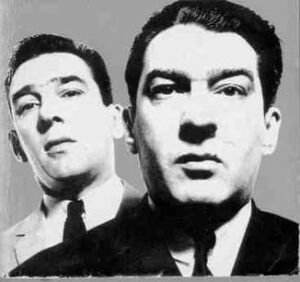
Reggie Kray
Reggie Kray (1933-2000)
- Co-founded and operationally managed The Firm alongside his twin brother Ronnie, demonstrating greater business acumen, strategic discipline and capacity for legitimate enterprise than any other figure in the London criminal landscape of the 1950s and 1960s — with his biographer John Pearson concluding that without Ronnie, Reggie would almost certainly have achieved success and freedom, a verdict the equations bear out.1A&E — Kray Twins ↗
- Killed Jack 'the Hat' McVitie in October 1967 in a Stoke Newington basement flat — at Ronnie's instigation, four months after the suicide of his wife Frances Shea, while drinking heavily — stabbing McVitie repeatedly after his gun jammed, an act driven by grief, alcohol, loyalty to Ronnie and the internal logic of The Firm rather than by the cold operational calculation that had characterised his earlier leadership.2Biography.com — Reggie Kray ↗
- Served 31 years in prison, the longest sentence of the two brothers, writing memoirs and becoming a born-again Christian, was released on compassionate grounds in August 2000 with inoperable bladder cancer, died six weeks later on 1 October 2000 — his funeral cortège through the East End drew an estimated hundred thousand people, larger than Ronnie's, for a man who had spent three decades confined.3Crime and Investigation — Kray Twins ↗
Reginald Kray was born ten minutes before his twin brother Ronnie on 24 October 1933 in Hoxton, East London, and the ten-minute gap in their birth order is the biographical fact that most consistently shapes the analysis of their separate profiles.4Wikipedia — Kray Twins ↗ Reggie was the older twin, the calmer boxer, the more disciplined operator, and — when Ronnie's paranoid schizophrenia first became acute in the late 1950s — the one who demonstrated that the operation could be run effectively without the volatility that would eventually destroy it. The period during which Ronnie was imprisoned for eighteen months between 1960 and 1961 is the most analytically significant single phase of Reggie's career, and is the canonical snapshot in this profile precisely because it is the only period in which Reggie's own leadership variables operated without Ronnie's distortion.3Crime and Investigation — Kray Twins ↗ During that period Reggie acquired Esmeralda's Barn in Knightsbridge — a legitimate West End nightclub that Peter Rachman sold him to avoid further extortion — and used it to expand The Firm's reach into celebrity and political society. He steered the operation toward more legitimate enterprises, developed profitable nightclubs and gambling dens, and demonstrated the capacity to manage complex commercial relationships without the threat of unpredictable violence that characterised Ronnie's operating style. His Process score during this period is the highest in the Criminal domain among the UK profiles. His People score reflects a man who understood that loyalty built on respect is more durable than loyalty built on fear — a distinction Ronnie was constitutionally incapable of making. The celebrity phase of the early 1960s was substantially Reggie's creation. The David Bailey photographs, the nightclub circuit, the relationships with Frank Sinatra, Judy Garland, Diana Dors and Barbara Windsor — these were managed enterprises rather than accidental celebrity, and Reggie managed them.5All That's Interesting — Kray Twins ↗ The Congruence variable during this phase reflects a man whose public and private selves were in closer alignment than most accounts suggest — he genuinely believed the operation could be legitimised, and he was making progress toward that belief until Ronnie's deteriorating mental health and escalating violence made it impossible. The killing of Jack McVitie on 29 October 1967 is the moment where Reggie's profile diverges most sharply from anything his own leadership variables would have produced independently.2Biography.com — Reggie Kray ↗ Frances Shea — his wife of two years, a woman who had reportedly left him within weeks of the wedding out of fear and whose suicide the coroner recorded without contention — had died in June 1967. Reggie, by his brother Charlie's account, never fully recovered. He was drinking heavily by October. Ronnie, whose own grip on operational reality had been loosening for years, pressured him to kill McVitie — a minor Firm member who had taken £500 for a contract killing and not delivered. The gun jammed. Reggie stabbed McVitie instead, with a violence that went far beyond what the operational situation required. The Intent and Process variables in the second snapshot reflect the state he was in when he did it. He was convicted in March 1969, sentenced to life with a minimum of thirty years, and spent the next three decades in various prisons and eventually Maidstone, separated from Ronnie who was in Broadmoor.3Crime and Investigation — Kray Twins ↗ He wrote, married twice, found religion, and maintained his cultural presence through journalists and publishers for whom the Kray name remained commercially valuable. He was released in August 2000 with inoperable bladder cancer, married his second wife Roberta Jones hours after his release, and died six weeks later. His funeral drew an estimated hundred thousand people to the East End streets — more than Ronnie's — for a man whose most effective leadership had been visible for less than a decade, and whose longest chapter was thirty-one years in a cell.
Score Comparison
Add up to 10 leaders. Click a name to visit their profile.
The 13 Equations
Scores for: Prison and DeathThe 22 Variables
Canonical scoresWhat changed: The Murders and Conviction → Prison and Death
Sources & Bibliography
The scores assigned to this leader are derived from publicly available sources. Variable inputs reflect documented behaviour, structural conditions, and historical record at the time of each snapshot.