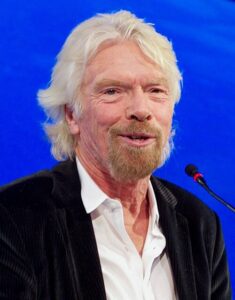
Richard Branson
Richard Branson (born 1950)
- Founded Virgin as a mail-order record business in 1970, launched Virgin Records in 1972 with Mike Oldfield's Tubular Bells — which sold an estimated fifteen million copies worldwide and provided the financial foundation for the entire group1EBSCO Research Starters — Richard Branson — then signed the Sex Pistols when every other major label had refused them, building Virgin Records into the world's largest independent record label before selling it to Thorn EMI in 1992 for $1 billion to keep Virgin Atlantic solvent.2Biography.com — Richard Branson
- In September 2006 pledged to invest $3 billion in research for environmentally friendly fuels over the following decade3Wikipedia — Richard Branson — of which activist Naomi Klein documented that well under $300 million had been contributed by 2014, while Virgin airlines' greenhouse gas emissions had increased considerably in the same period.3Wikipedia — Richard Branson
- During the COVID-19 crisis asked staff to take unpaid leave while Necker Island was posted as collateral for a commercial loan, drawing widespread criticism — then expanded the Virgin Group to over 400 companies across unrelated sectors with no consolidated group-level performance reporting and only Branson himself exercising oversight across the portfolio.4CNN — Richard Branson Fast Facts
Richard Branson built the Virgin Group from a mail-order record business into one of the world's most recognised brands. His early leadership was characterised by exceptionally low internal friction — minimal bureaucracy, genuine cultural alignment, and a willingness to back unfashionable bets with sustained conviction. The signing of Mike Oldfield and the Sex Pistols were not accidents; they were the product of a leader whose instinct for market gaps was sharper than his operational systems, and who compensated for the latter by hiring people he trusted and leaving them alone.1EBSCO Research Starters — Richard Branson
The early Virgin was a high-force, low-friction system operating in a target-rich environment. That combination produced outsized results that the brand's later scale could never replicate, because scale introduced the friction the early model had deliberately avoided.
The structural weakness was always management architecture. Branson delegated extensively but built no formal group-level oversight — only he exercised control across the Virgin companies, and consolidated performance data was never produced. This worked when the portfolio was small enough for intuition to substitute for process. As the group expanded to over 400 companies across unrelated sectors,4CNN — Richard Branson Fast Facts the absence of that architecture became a permanent ceiling on what the individual businesses could achieve without him.
The Congruence trajectory is the sharpest variable movement in his record. The gap between Branson's public positioning — champion of employees, environmental pioneer, humanitarian — and his operational behaviour narrowed and then widened across his career. The climate pledge of three billion dollars, of which well under three hundred million was delivered within a decade,3Wikipedia — Richard Branson is the most documented instance. The COVID crisis produced the starkest single moment: staff asked to take unpaid leave while Necker Island was posted as collateral for a commercial loan. The organisation absorbed that signal and responded accordingly.
What the equations capture that the standard narrative misses is that Branson's most effective leadership period ended long before his public profile peaked. The brand kept growing after the system that built it had already plateaued.
Score Comparison
Add up to 10 leaders. Click a name to visit their profile.
The 13 Equations
Scores for: Virgin Empire PeakThe 22 Variables
Canonical scoresWhat changed: Virgin Records — The Early Empire → Virgin Empire Peak
Sources & Bibliography
The scores assigned to this leader are derived from publicly available sources. Variable inputs reflect documented behaviour, structural conditions, and historical record at the time of each snapshot.