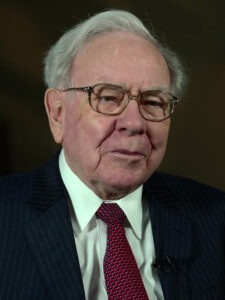
Warren Buffett
Warren Buffett (born 1930)
- Bought his first stock at eleven, took control of Berkshire Hathaway in 1965 when it was a failing textile company, and over six decades transformed it into one of the world's largest conglomerates — with Berkshire's publicly traded shares gaining roughly 28% annually from the 1960s through the 1990s, against the market's 11%1Britannica — Warren Buffett — while paying himself a salary of $100,000 a year and continuing to live in the house he bought in 1958 for $31,500.2Foundation Guide — Warren Buffett
- Declined to invest in technology stocks throughout the late 1990s, absorbed years of criticism for missing the boom, held his position, and was vindicated when the dot-com bubble collapsed3Wikipedia — Warren Buffett — then during the 2008 financial crisis published an op-ed telling Americans to buy equities while investing $5 billion in Goldman Sachs.1Britannica — Warren Buffett
- In 2006 pledged to give away 99% of his fortune to charitable causes — the single largest act of charitable giving in US history at the time2Foundation Guide — Warren Buffett — co-founded the Giving Pledge with Bill Gates in 2010, and in May 2025 requested that the board appoint Greg Abel to succeed him as CEO, ending a six-decade tenure at Berkshire's helm.3Wikipedia — Warren Buffett
Warren Buffett presents the Codex with its purest Business domain profile and one of its most analytically clean cases. The variables that reward him are the variables that explain him — and they are not the ones most people would predict.
The conventional account of Buffett focuses on investment genius: value investing, the long holding period, the compounding machine. That is real. But the Codex is not primarily measuring investment returns. It is measuring leadership architecture. What makes Buffett's profile extraordinary is not the stock picks. It is the near-total absence of the variables that destroy most leaders at his level of power and wealth.
Ego and Pride sit lower than almost any leader of equivalent power and duration in this dataset — but lower is not absent. He bought a private jet, named it The Indefensible in acknowledgement of the contradiction, then renamed it The Indispensable when he found he could not do without it. He disowned his adopted granddaughter for participating in a documentary he disapproved of. He stood in front of 20,000 people at the annual shareholder meeting — the Woodstock of Capitalism — and presided with evident enjoyment.4CNBC — Warren Buffett Archive He publicly challenged every hedge fund manager in the industry to a decade-long bet. These are not the acts of a man without Ego or Pride. They are the acts of a man who has built a framework rigorous enough to contain them. The Chaos variable sits well below the dataset average as a result — not because the variables are absent, but because the discipline is real.
The Congruence score is anchored by the alignment between his stated investment philosophy and his actual conduct across seven decades. The rules he articulated under Benjamin Graham — never lose money, hold for the long term, invest within your circle of competence — he followed with remarkable consistency. He publicly acknowledged the mistakes: ConocoPhillips bought at the peak, the IBM investment he later reversed, the General Re acquisition that presented difficulties.3Wikipedia — Warren Buffett This willingness to declare error publicly without defensiveness is a direct expression of the Humility variable, which sits unusually high for someone of his stature and tenure.
The Conviction score reflects something more specific than stubbornness. When the index fund bet was running against every hedge fund manager he had challenged, he held. When the entire investment community was chasing technology stocks in the late 1990s, he declined and absorbed years of criticism for missing the boom. His explanation — that he would not invest in businesses he did not understand — held even when it appeared to cost him.3Wikipedia — Warren Buffett It was later vindicated when the dot-com bubble collapsed. That is Conviction correctly applied: a principle held under sustained external pressure and ultimately validated.
The People variable is where Buffett's profile diverges most sharply from the typical CEO archetype. He hired Charlie Munger as Vice-Chairman and kept him for over forty years. He gave subsidiary managers extraordinary autonomy and largely left them to operate. He described his management approach as finding exceptional people and then getting out of their way.5EBSCO Research Starters — Warren Buffett The Berkshire model — decentralised, low-interference, high-trust — is the organisational expression of his Humility score. A leader who trusts his team without requiring control is a leader whose People variable compounds over time rather than degrading.
The Defined Output variable captures something specific about his business model that distinguishes it from conventional corporate leadership. Most CEOs define output as revenue, market share, or earnings per share. Buffett defined it as intrinsic value per share, compounded over decades, with a willingness to hold cash when no suitable investments presented themselves. That clarity of destination — unusual in its long time horizon and its tolerance for short-term underperformance — is the Defined Output variable operating at its most coherent.1Britannica — Warren Buffett
The philanthropic commitment deserves separate analytical treatment. Pledging 99% of his fortune to charitable causes, founding the Giving Pledge with Bill Gates, donating tens of billions to charitable foundations2Foundation Guide — Warren Buffett — these are not incidental to his leadership profile. They are an expression of the Congruence variable at its most complete. He said publicly, decades before he was in a position to act on it, that he intended to give his wealth away. He is doing so. The Value variable extends well beyond Berkshire Hathaway's balance sheet as a result.
The succession decision of 2025 — requesting that Greg Abel be appointed CEO while he remained chairman — is the final analytical note. Most leaders of his tenure and stature find succession genuinely difficult. The Ego variable explains why: leaving is an acknowledgement that the system can function without you. Buffett had publicly identified his successor years in advance, prepared the organisation, and stepped back in an orderly way.3Wikipedia — Warren Buffett For a man who ran the same company for over fifty years, that is not a small thing. The Defined Output variable — does the institution outlast the leader — scores accordingly.
The Codex identifies the mechanism: minimum Chaos, exceptional Conviction, high Congruence, and the rare discipline to operate at the highest level of wealth and power for half a century without being consumed by either.
Score Comparison
Add up to 10 leaders. Click a name to visit their profile.
The 13 Equations
Scores for: Peak Influence 1990–2010The 22 Variables
Canonical scoresWhat changed: Early Berkshire 1970–1990 → Peak Influence 1990–2010
Sources & Bibliography
The scores assigned to this leader are derived from publicly available sources. Variable inputs reflect documented behaviour, structural conditions, and historical record at the time of each snapshot.