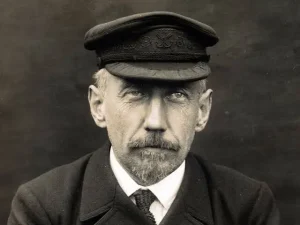
Roald Amundsen
Roald Amundsen (1872-1928)
- Led the first successful transit of the Northwest Passage aboard the Gjøa from 1903 to 1906 — a feat attempted for four centuries — spending two winters with the Netsilik Inuit from whom he learned the dog-sledging and clothing techniques that would prove decisive in his South Pole expedition.1Britannica — Roald Amundsen ↗
- Reached the South Pole on 14 December 1911 with four companions, 52 dogs and four sledges, returning all five men safely to base camp on 25 January 1912 — thirty-four days ahead of Scott's party — in a 99-day expedition that covered over 1,800 miles without a single fatality.2Wikipedia — Amundsen's South Pole Expedition ↗
- Disappeared on 18 June 1928 while flying a rescue mission for the crew of the crashed airship Italia in the Arctic, aged 55 — having already become the first person verified to have reached both poles, the first to traverse both polar passages by ship, and one of the defining figures of the heroic age of exploration.3Antarctic Heritage Trust — Expeditions of Roald Amundsen ↗
Roald Amundsen was born in Borge, Norway in July 1872 into a family of shipowners and captains, promised his mother he would study medicine, and abandoned that promise the day she died, at which point he began the systematic preparation for polar exploration that would define the next three decades of his life.4Wikipedia — Roald Amundsen ↗ The word systematic is the analytical key to Amundsen's profile. Where Scott's Terra Nova expedition is a study in Process failure, Amundsen's South Pole expedition is its precise opposite — a study in Process so thorough that the outcome was never seriously in doubt. The foundation of that Process was built during the Northwest Passage expedition of 1903–06, which is the profile's first snapshot and analytically underrated relative to the South Pole achievement.1Britannica — Roald Amundsen ↗ Amundsen spent two winters at King William Island living alongside the Netsilik Inuit, learning their methods for surviving in polar conditions — dog-sledging techniques, the use of animal skins rather than heavy woollen clothing, the management of food and cold over extended periods.3Antarctic Heritage Trust — Expeditions of Roald Amundsen ↗ He did not observe these methods from a distance and adapt them theoretically. He learned them by living with the people who had developed them over generations. The Learning and Ability variables in his profile reflect this — a leader who understood that what he did not know was more valuable to him than what he did. The South Pole expedition of 1910–12 was strategically deceptive in its inception and operationally flawless in its execution — a combination that generates analytical tension in the Congruence variable.2Wikipedia — Amundsen's South Pole Expedition ↗ Amundsen had publicly announced an Arctic expedition. His backers, his crew and his country believed that was where the Fram was going. He changed the destination to Antarctica after learning the North Pole had been claimed, told only his brother, and sent a telegram to Scott from Madeira — "Beg leave to inform you Fram proceeding Antarctic. Amundsen" — that functioned simultaneously as a courtesy, a provocation and a statement of intent. The deception lowered his Congruence score in a way that the South Pole achievement cannot fully offset. He knew it. He acknowledged in his memoir that the secrecy had been ethically uncomfortable. The execution, however, was the most analytically precise example of high Process leadership in the Explorers domain. Amundsen established Framheim at the Bay of Whales — sixty miles closer to the Pole than Scott's base at McMurdo Sound — and spent the Antarctic winter of 1911 in meticulous depot-laying and equipment refinement.3Antarctic Heritage Trust — Expeditions of Roald Amundsen ↗ The carpenter Olav Bjaaland redesigned the sledges, reducing their weight from 195 pounds to 50 pounds. Amundsen planned to use the dogs as food on the return journey — a cold-blooded calculation that ensured the party would have protein at precisely the point where man-hauling teams were failing from exhaustion and starvation on the opposite side of the continent. He departed on 19 October 1911 with five men, 52 dogs, and four sledges. He reached the South Pole on 14 December. He returned all five men to base camp on 25 January 1912.2Wikipedia — Amundsen's South Pole Expedition ↗ The expedition took 99 days. Not one man was lost. The contrast with Scott's simultaneous expedition is the most precise natural experiment in the Explorers dataset — same objective, same conditions, same period, different Process scores, different outcomes. Amundsen's Defined Output was specific: reach the Pole and return every man safely. His Process was designed from first principles to deliver that output in the specific environment. Scott's Defined Output was identical. His Process was not. Amundsen disappeared in June 1928, aged 55, flying a rescue mission for the crew of the crashed airship Italia in the Arctic.1Britannica — Roald Amundsen ↗ His remains were never found. He had, by that point, been the first to transit the Northwest Passage, the first to reach the South Pole, and one of the first to cross the North Pole by air. The Conviction variable in his final snapshot scores at 10 — a man still risking his life for others at the end of a career defined by exactly that.
Score Comparison
Add up to 10 leaders. Click a name to visit their profile.
The 13 Equations
Scores for: Northwest PassageThe 22 Variables
Canonical scoresSources & Bibliography
The scores assigned to this leader are derived from publicly available sources. Variable inputs reflect documented behaviour, structural conditions, and historical record at the time of each snapshot.