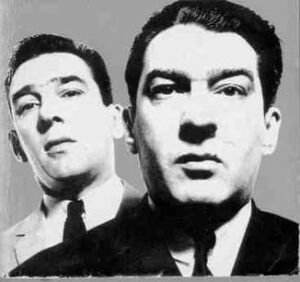
Ronnie Kray
Ronnie Kray (1933-1995)
- Co-founded and dominated The Firm, the criminal organisation that controlled organised crime across the East End and parts of the West End of London through the 1950s and 1960s, running protection rackets, gambling operations, arson and armed robbery while simultaneously cultivating a celebrity network that included Frank Sinatra, Judy Garland and Diana Dors and maintaining a wall of silence through a combination of community loyalty, financial generosity and the credible threat of extreme violence.1Wikipedia — Kray Twins ↗
- Shot George Cornell in the head in the Blind Beggar pub in Whitechapel on 9 March 1966 in front of multiple witnesses — Cornell had defected to the rival Richardson Gang and made a remark about Ronnie's sexuality — an act of public, undisguised murder that Ronnie characterised as essential to maintaining the authority of The Firm, and which was the act that ultimately destroyed it.2London Museum — Kray Twins ↗
- Convicted at the Old Bailey in March 1969 and sentenced to life imprisonment with a minimum of thirty years — the longest sentence passed at the Old Bailey for murder at that time — spent the remainder of his life in Broadmoor Hospital as a certified paranoid schizophrenic, dying of a heart attack on 17 March 1995, whose funeral procession through the East End drew crowds that treated it as a civic event.3Biography.com — Ronnie Kray ↗
Ronnie Kray was born on 24 October 1933 in Hoxton, East London, ten minutes after his twin brother Reggie, into a family of Irish and Romani heritage whose father spent most of their childhood as a fugitive from military conscription.4All That's Interesting — Kray Twins ↗ The absence of their father and the overwhelming devotion of their mother Violet are the biographical facts that most consistently appear in accounts of how Ronnie became what he became — a man whose need for dominance was absolute, whose tolerance for perceived disrespect was zero, and whose paranoid schizophrenia, diagnosed while he was in prison in the late 1950s, made those characteristics progressively more dangerous as the decade advanced. The analytical framework must handle Ronnie Kray differently from Griselda Blanco, who built a genuinely large-scale international criminal enterprise and maintained operational discipline across fifteen years of activity. Ronnie's operation was smaller, geographically contained, and increasingly subordinated to his personal psychology rather than any commercial logic.1Wikipedia — Kray Twins ↗ The Firm at its peak controlled the East End and had interests in the West End through the nightclubs. It was not a Medellín Cartel. What Ronnie and Reggie built was a territorial criminal operation of the kind that had existed in the East End for generations, distinguished by the unusual intelligence with which they managed their public image, the unusual severity of the violence they were willing to deploy, and the unusual effectiveness of their intimidation of witnesses and press alike. The celebrity phase of the early to mid-1960s is where the Congruence variable produces its most complex analytical reading. Ronnie modelled The Firm explicitly on Al Capone's Chicago operation, had his hair cut by a personal barber because he had read that was how Capone operated, and cultivated the photographs with Frank Sinatra and the nightclub ownership as deliberate image management.1Wikipedia — Kray Twins ↗ There was genuine alignment between his self-image and his behaviour — he believed himself to be a serious criminal figure operating at the level he aspired to, and he was. The Congruence variable is not undermined by the fact that the image was criminal; it is undermined by the degree to which Ronnie's mental illness was creating a gap between the reality of the operation and his perception of it. The murder of George Cornell on 9 March 1966 is the defining analytical moment — and the moment of self-destruction.2London Museum — Kray Twins ↗ Cornell had called Ronnie a fat poof. Ronnie walked into the Blind Beggar pub in Whitechapel in the middle of the afternoon, in front of multiple witnesses, and shot Cornell through the head while Walker Brothers played on the jukebox. The pub fell silent. Ronnie walked out. The Process variable in the murder snapshot scores at its minimum — this was not a calculated elimination of a rival but an act of personal rage that created a direct evidential path to conviction. The East End's wall of silence held for another two years. When it cracked, it cracked completely. He was arrested in May 1968, convicted in March 1969, and spent the remaining twenty-six years of his life in Broadmoor. He married twice in prison, held court for journalists and admirers, and continued to present himself as a significant figure — which, in terms of his cultural legacy, he was. He died of a heart attack on 17 March 1995. Reggie was allowed out of prison to say goodbye. The funeral cortège through the East End drew tens of thousands of people. The People variable in his profile reflects the genuine loyalty he commanded — the same community whose silence protected him for years lined the streets to watch him go.3Biography.com — Ronnie Kray ↗ Value is negative throughout. The equations will produce a moderate score. Both are analytically correct.
Score Comparison
The 13 Equations
Scores for: The Murders and FallThe 22 Variables
Canonical scoresWhat changed: Building the Firm → The Murders and Fall
Sources & Bibliography
The scores assigned to this leader are derived from publicly available sources. Variable inputs reflect documented behaviour, structural conditions, and historical record at the time of each snapshot.