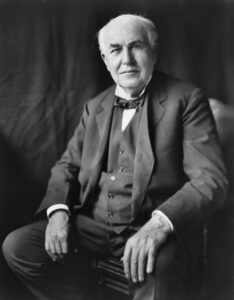
Thomas Edison
Thomas Edison 1847-1931
- Founded the world's first industrial research and development laboratory at Menlo Park, New Jersey in 1876 — described by Norbert Wiener as 'Edison's greatest invention' and the direct institutional model for Bell Laboratories and every corporate R&D operation that followed — instituting a management system that converted invention from the work of individual genius into an organised industrial process with explicit output targets: a minor invention every ten days, a major invention every six months, sustained by a team of specialists across disciplines working simultaneously on multiple problems.1ETHW — Edison at Menlo Park ↗
- Held 1,093 US patents — more than any other individual in American history — across a range that included the phonograph, the incandescent lightbulb, the motion picture camera, the carbon telephone transmitter and a complete electrical power distribution system, demonstrating a Defined Output variable operating across multiple simultaneous timelines and a Process variable that was explicitly designed to industrialise the invention process: stock every conceivable material, run experiments in parallel, follow the most promising results, and iterate without sentimentality about failed approaches.2Wikipedia — Thomas Edison ↗
- Recruited, directed and managed a team of technically specialised 'muckers' at Menlo Park and later at the much larger West Orange laboratory complex, working 18-hour days and expecting the same from his staff — a management approach that one employee described as 'the limits of human exhaustion' but that produced in the eight years at Menlo Park alone more than 400 patents for electrical and electrotechnical devices, including the first demonstration of practical incandescent lighting at a public event on New Year's Eve 1879.2Wikipedia — Thomas Edison ↗
Thomas Alva Edison was born on 11 February 1847 in Milan, Ohio, lost most of his hearing at around twelve years old from an unknown cause, worked as a telegraph operator across the Midwest in his teenage years, began inventing improvements to telegraph technology, and sold his first major invention — an improved stock ticker — in 1869 for $40,000, a sum he immediately invested in equipment and assistants.2Wikipedia — Thomas Edison ↗ The Menlo Park laboratory, opened in 1876 in a rural stretch of New Jersey twelve miles south of Newark, represented the systematic application of his insight that invention itself could be managed as an industrial process. The analytical entry point for Edison's profile in the Scientific domain is the Process variable, which scores at its ceiling throughout the Menlo Park period. His contribution was not primarily the individual inventions — though those were genuine and significant — but the institutional system that produced them. He created the first research facility explicitly designed to convert capital, talent and materials into intellectual property at a defined rate of output. The stock of 'almost every conceivable material' he assembled at Menlo Park was not the hoarding of an obsessive but the inventory of a production facility: he needed to be able to prototype any solution that occurred to him without waiting for materials to be sourced.3Menlo Park Museum — Edison ↗ The People variable reflects a complex management reality. Edison drove his staff at intensities that would be illegal by contemporary workplace standards, worked alongside them rather than above them, and created a genuinely collaborative intellectual environment within which the formal credit for inventions was attributed to him regardless of the individual contributions of his assistants — a Congruence complication that the equations register. Francis Upton, who provided the mathematical expertise that Edison lacked; Charles Batchelor, his principal experimental assistant; and John Kruesi, who built the first phonograph, were essential to the outputs attributed solely to Edison's patents.4Google Arts — Edison Menlo Park ↗ The transition from Menlo Park to the larger West Orange laboratory complex in 1887 is analytically significant: the scale increased, the resources increased, the patents continued, but the creative intensity of the Menlo Park years — which Hans Bethe's equivalent note for Oppenheimer might have called 'the most productive period of any single industrial research operation in history' — did not fully replicate. The canonical snapshot scores the Menlo Park peak. His later years were marked by the AC/DC current wars, in which he backed direct current against Nikola Tesla and George Westinghouse's alternating current — a position he maintained with increasing dogmatism beyond the point where the technical evidence had settled against him. The Ego and Pride variables in his later snapshot reflect a leader whose earlier intellectual flexibility had been replaced, in a specific domain, by the pattern the equations are designed to detect: identity fused with a position, sustained past the point where evidence justified it. He died on 18 October 1931, aged eighty-four. Towns across the United States dimmed their lights in his honour.
Score Comparison
Add up to 10 leaders. Click a name to visit their profile.
The 13 Equations
Scores for: Menlo Park — Peak Invention FactoryThe 22 Variables
Canonical scoresSources & Bibliography
The scores assigned to this leader are derived from publicly available sources. Variable inputs reflect documented behaviour, structural conditions, and historical record at the time of each snapshot.