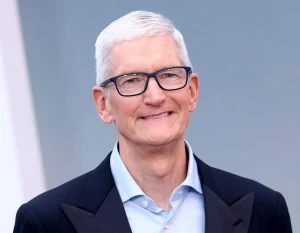
Tim Cook
Tim Cook (born 1960)
- Joined Apple in 1998 as Senior Vice President of Worldwide Operations, immediately closed factories and warehouses, replaced them with contract manufacturers, reduced inventory from months to days, and pre-purchased flash memory capacity years ahead of competitors — securing Apple's supply chain for the iPod Nano, iPhone and iPad before those products existed in final form, in moves that a Hewlett-Packard executive later acknowledged had left their cancelled tablet built from cast-off Apple parts.1Wikipedia — Tim Cook
- Became CEO on 24 August 2011, six weeks before Jobs died — under his tenure Apple's revenue doubled, its profits doubled, and its market capitalisation grew from $348 billion to $1.9 trillion2Kiddle — Tim Cook — while in 2014 becoming the first CEO of a Fortune 500 company to publicly come out as gay, an editorial in Bloomberg Business written after consulting Anderson Cooper on timing to ensure it would not distract from business.1Wikipedia — Tim Cook
- In 2016 signed a five-year $275 billion deal with the Chinese government in exchange for lighter regulations — a deal that preceded the removal of the Hong Kong protest app from the App Store, the manipulation of Apple Maps to support Chinese territorial claims, and the transfer of Chinese users' data to a state-owned corporation3SEC filing — Tim Cook Apple proxy — while continuing to speak publicly on privacy as a fundamental human right.
Timothy Donald Cook was born in 1960 in Mobile, Alabama, the son of a shipyard worker and a pharmacy assistant. He graduated salutatorian from high school, took an industrial engineering degree at Auburn, and an MBA at Duke. He spent twelve years at IBM learning supply chain and fulfilment operations, then moved through Intelligent Electronics and Compaq before Steve Jobs called him in 1998.4Apple — Tim Cook Leadership By his own account, he decided to join Apple within five minutes of meeting Jobs, ignoring every rational analysis that pointed the other way. That decision — intuition over calculation, once-in-a-lifetime over comfortable — defined the arc that followed.
His first act at Apple was to dismantle it. He closed factories and warehouses, replaced them with contract manufacturers, and reduced inventory from months to days. He characterised inventory as "fundamentally evil" and compared Apple to a dairy — products should be sold while they were fresh.5Britannica — Tim Cook He pre-purchased flash memory capacity years before competitors understood why it mattered, securing Apple's supply chain for the iPod Nano, the iPhone, and the iPad before those products existed in final form. Cook did not invent the products. He built the machine that made them possible at scale.
He became CEO in August 2011. Jobs died six weeks later. The question everyone asked — whether Apple could survive without its founder — turned out to be the wrong question. Under Cook, Apple's revenue doubled, its profit doubled, and its market capitalisation grew from $348 billion to $1.9 trillion.2Kiddle — Tim Cook He did not do this by being Jobs. He did it by being the precise operational complement to what Jobs had built — replacing micromanagement with collaboration, reducing executive rivalry, and executing with a discipline that the creative chaos of the Jobs era had never required.
The Chaos score is the defining variable in Cook's profile. He has spent more than a decade as CEO of the world's most valuable company while remaining genuinely difficult to caricature. He does not perform dominance. He is solitary, private, fitness-focused, and disciplined about protecting his personal life.1Wikipedia — Tim Cook The equations reward this consistently — low Chaos means the denominator does not fight the numerator, and exceptional structural variables flow through to Effective Power without the internal friction that self-regard generates.
The Congruence picture is more complicated. Cook has spoken forcefully on privacy, climate change, LGBTQ rights, and surveillance reform — and Apple's actions broadly support those positions. The China relationship is the visible gap. A $275 billion deal negotiated personally by Cook paved the way for censorship of human rights content, the removal of the Hong Kong protest app, and the manipulation of Apple Maps to support Chinese territorial claims.3SEC filing — Tim Cook Apple proxy Cook publicly champions values above market access. His actions in China represent the largest single compromise of those stated values in his tenure. The equations register it but do not collapse his score — the China decisions are strategic rather than catastrophic, and the overall alignment between his stated values and his conduct remains meaningfully positive across his tenure as a whole.
In 2014 he became the first Fortune 500 CEO to publicly come out as gay, consulting with Anderson Cooper on the timing to ensure it would not distract from business. The careful management of that disclosure is itself a Cook signature — significant, genuine, and executed with operational precision.1Wikipedia — Tim Cook
He has pledged his fortune to charity. His net worth as of 2025 is $2.6 billion — a striking number for a man who has run the world's most valuable company for fourteen years, and one that suggests he means what he says about money.6Leader Portfolio — Tim Cook
Score Comparison
Add up to 10 leaders. Click a name to visit their profile.
The 13 Equations
Scores for: Apple CEO — AI and Geopolitics 2023–presentThe 22 Variables
Canonical scoresWhat changed: Apple CEO — Services Era 2014–2023 → Apple CEO — AI and Geopolitics 2023–present
Sources & Bibliography
The scores assigned to this leader are derived from publicly available sources. Variable inputs reflect documented behaviour, structural conditions, and historical record at the time of each snapshot.