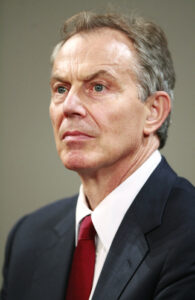
Tony Blair
Tony Blair (born 1953)
- Born in Edinburgh, educated at Fettes College and Oxford, became the youngest Prime Minister since 1812 when Labour won a 179-seat majority in May 19971Britannica — Tony Blair — granted the Bank of England independence on his first day in office, introduced the national minimum wage, and co-brokered the Good Friday Agreement in 1998, resolving decades of conflict in Northern Ireland and establishing a power-sharing assembly for the first time since 1972.2GOV.UK — Tony Blair
- Ordered British troops into combat five times in his first six years — more than any other Prime Minister in British history — including Kosovo, Sierra Leone, Afghanistan and twice in Iraq3Wikipedia — Tony Blair — with the 2003 invasion of Iraq, justified on the basis of weapons of mass destruction that were not subsequently found, permanently destroying the public trust that had made him the most electorally dominant Labour leader in the party's history.
- Won an unprecedented third consecutive general election victory for Labour in 2005, but with a majority reduced by nearly fifty seats as a direct consequence of Iraq4Wikipedia — Premiership of Tony Blair — resigned on 27 June 2007 under sustained pressure from Gordon Brown's allies, and was subsequently appointed Special Envoy of the Quartet on the Middle East, a role he held until 2015 without discernible effect on the peace process he was appointed to advance.
Tony Blair served as Prime Minister of the United Kingdom from 1997 to 2007, leading Labour to three consecutive general election victories and becoming the longest-serving Labour Prime Minister in British history. He is also the leader whose legacy was most comprehensively destroyed by a single decision taken at the peak of his power.
The 1997 landslide was not merely an electoral victory — it was a systemic realignment. Blair had rebuilt a party that had lost four consecutive elections by repositioning it so completely that the Conservatives spent a decade unable to define what they were for. The early years of his government produced genuine structural reform: Bank of England independence on day one, the Good Friday Agreement in Northern Ireland, devolution to Scotland and Wales, the minimum wage, and sustained investment in public services.1Britannica — Tony Blair His Congruence variable in this period was high. He said what he would do and largely did it.
The second term began the erosion. Iraq was not a sudden aberration — it was the culmination of a leadership style that had always placed excessive weight on personal conviction over institutional counsel. The intelligence was sexed up. The legal basis was contested. The post-invasion planning was catastrophically absent. Blair knew the public was against it. He went anyway.2GOV.UK — Tony Blair Conviction, when untethered from Humility and Congruence, becomes the most dangerous variable in the Codex.
The Leaderment score reflects the arc precisely. The 1997–2001 first term produces a transformational reading. By 2006, as the Iraq occupation deteriorated and the domestic agenda stalled, the variables had shifted dramatically. He resigned in 2007 under pressure from Brown's allies, the authority that had seemed unassailable in 1997 having been spent almost entirely on a single foreign policy decision.4Wikipedia — Premiership of Tony Blair
What makes Blair uniquely interesting in the Codex framework is that his personal variables — Charisma, Confidence, Visibility, Recognition — remained extraordinarily high even as his Congruence collapsed. He could still command a room in 2006. The population had simply stopped believing what he said in it. Trust, once lost at that scale, does not recover within a political career. You can only behave your way back — and there was not enough time.
His post-premiership career as Middle East peace envoy and global speaker circuit regular has done little to rehabilitate the legacy. The Chilcot Inquiry concluded what most had already concluded.5EBSCO Research Starters — Tony Blair The variables that made him transformational — Conviction, Confidence, Charisma — were the same variables that made the disaster possible.
Score Comparison
Add up to 10 leaders. Click a name to visit their profile.
The 13 Equations
Scores for: Post-Iraq — Final YearsThe 22 Variables
Canonical scoresWhat changed: First Term Prime Minister → Post-Iraq — Final Years
Sources & Bibliography
The scores assigned to this leader are derived from publicly available sources. Variable inputs reflect documented behaviour, structural conditions, and historical record at the time of each snapshot.