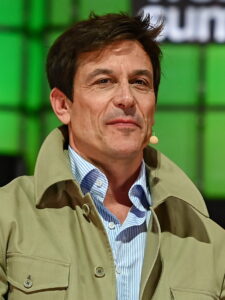
Toto Wolff
Toto Wolff - Born 1972
- Joined Mercedes as managing partner in 2013, acquiring a 30% stake, and led the team to eight consecutive Formula One Constructors' Championships from 2014 to 2021 — the most dominant sustained run in the history of the sport — winning 121 of 255 races, 129 pole positions and 283 podium finishes across that period, a winning percentage of 47% that no team has approached across a comparable span in the turbo-hybrid era.1Wikipedia — Toto Wolff ↗
- Built and sustained a high-performance culture at a factory team operating under the constraint of corporate ownership — managing the relationship between Daimler AG, INEOS and his own 33% stake, retaining key technical leadership through the hybrid era's extraordinary engineering complexity, and maintaining competitive output while navigating the Abu Dhabi 2021 controversy, the 2022 zero-pod concept failure and the competitive reset required by the budget cap regulations, demonstrating that the organisational systems he built were resilient enough to survive significant external disruption.2Race Sundays — Toto Wolff ↗
- Was the subject of a Harvard Business School case study in 2022 — authored by Anita Elberse, who had previously written the Ferguson case study — in which his approach to organisational culture, high-performance team management and sustained excellence was analysed as a model for any organisation seeking to maintain competitive advantage across multiple competitive cycles, making him one of two sporting leaders (alongside Ferguson) whose management approach has been formally adopted as Harvard MBA curriculum.3Harvard Business School — Toto Wolff Case Study ↗
Torger Christian Wolff was born on 12 January 1972 in Vienna, Austria, to a Polish mother and Romanian father, caught the motorsport enthusiasm at seventeen watching a Formula 3 race at the Nürburgring, competed in Formula Ford in the early 1990s, won his class at the 1994 Nürburgring 24 Hours, quickly recognised that he lacked the talent to reach the top of the sport as a driver, and redirected his energy toward investment — founding Marchfifteen in 1998 and Marchsixteen in 2004, focusing initially on internet technology companies during the late-1990s boom.1Wikipedia — Toto Wolff ↗ His route into Formula One management began with a minority investment in Williams F1 in 2009, rising to Executive Director by 2012 — a period during which Williams achieved its first race victory in eight years, demonstrating that his management approach could unlock performance from an underperforming institution. Mercedes's top management asked him to analyse why their Formula One programme was not progressing, he delivered a comprehensive assessment, and they offered him a position that included a 30% equity stake — ensuring, as the Mercedes leadership explicitly noted, that he had 'skin in the game.'4Motorsport.com — Toto Wolff ↗ The Corporate Drag variable in Wolff's profile is the most analytically distinctive feature of his leadership context within the Sports domain. Formula One team operations are conducted within a corporate framework of extraordinary complexity: engine supply contracts, technical regulations that change on multi-year cycles, commercial agreements with the Formula One organisation, manufacturer obligations to parent companies, partnership and sponsorship structures, and since 2021, a budget cap that fundamentally changed roster and development economics. Managing competitive performance within this framework requires a Process variable that is simultaneously tactical — the engineering and race strategy decisions made in real time — and structural, managing the organisational conditions that allow those decisions to be made well.3Harvard Business School — Toto Wolff ↗ The People variable earns its highest score during the Hamilton era. Managing Lewis Hamilton — the most successful driver in Formula One history, with requirements and expectations that no other driver in the sport's history had made — across eight championship-winning seasons required a precision of interpersonal management that most team principals have not approached. The driver-team relationship in Formula One is structurally different from a coaching relationship in team sports: the driver is simultaneously an employee, the most critical performance variable, a brand asset, and a potential rival whose interests may diverge from the team's at any moment. Wolff sustained Hamilton's commitment to Mercedes across eight championships and seven drivers' titles. The 2021 Abu Dhabi finale — in which Max Verstappen was awarded the Drivers' Championship through a race control decision that Mercedes publicly challenged as a rules violation — produced Wolff's most visible moment of public crisis. His on-air confrontations with race direction, captured on the Netflix Drive to Survive series, were analytically significant not as emotional outbursts but as a communication approach consistent with his general leadership style: direct, high-stakes, public accountability asserted without diplomatic softening.2Race Sundays — Toto Wolff ↗ The subsequent period — 2022 to 2024, in which Mercedes did not win a Constructors' Championship — represents the most analytically interesting phase of his profile: a leader whose systems had produced eight consecutive championships now managing the organisation through the longest competitive drought in its modern history, with the budget cap creating structural constraints that the eight-championship era had not encountered.
Score Comparison
Add up to 10 leaders. Click a name to visit their profile.
The 13 Equations
Scores for: Post-Abu Dhabi Reset — Budget Cap EraThe 22 Variables
Canonical scoresWhat changed: Mercedes — Eight Consecutive Constructors' Championships → Post-Abu Dhabi Reset — Budget Cap Era
Sources & Bibliography
The scores assigned to this leader are derived from publicly available sources. Variable inputs reflect documented behaviour, structural conditions, and historical record at the time of each snapshot.