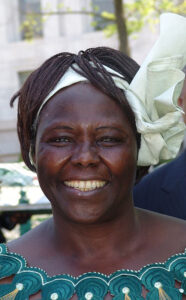
Wangari Maathai
Wangari Maathai 1940-2011
- Founded the Green Belt Movement in Kenya in 1977, which by 2011 had planted over 51 million trees through a network of more than 4,000 community nurseries and trained more than 30,000 women in forestry, beekeeping, food processing and income-generating trades — demonstrating that environmental restoration, women's economic empowerment and democratic participation are not separate causes but a single integrated system that must be addressed together rather than sequentially.1Green Belt Movement — Wangari Maathai ↗
- Was beaten, imprisoned and attacked multiple times by the government of President Daniel arap Moi, had her Green Belt Movement offices confiscated with twenty-four hours' notice after ten years of occupation, was publicly denounced in parliament and in the press as 'subversive' — and continued, was elected to parliament in 2002 with 98% of the vote, was appointed Assistant Minister for Environment, Natural Resources and Wildlife, and in 2004 became the first African woman and the first environmentalist to receive the Nobel Peace Prize.2Nobel Prize — Wangari Maathai ↗
- Articulated in her Nobel acceptance speech and in her four books a systems-level analysis of African governance failure — arguing that environmental degradation, political corruption, women's disempowerment and poverty were a single interlocking system that required simultaneous intervention at the community, national and international level — establishing a conceptual framework that the Nobel Committee described as a 'holistic approach to sustainable development that embraces democracy, human rights, and women's rights in particular.'3Britannica — Wangari Maathai ↗
Wangari Muta Maathai was born on 1 April 1940 in Nyeri, Kenya, in the traditional Kikuyu community, was selected in 1960 as one of 300 Kenyans to study in the United States through the Kennedy Airlift, graduated in biology from Mount St Scholastica College in Kansas in 1964, completed a master's degree at the University of Pittsburgh in 1966, and returned to the University of Nairobi where she earned her doctorate in 1971 — becoming the first woman in East and Central Africa to obtain a PhD.2Nobel Prize — Wangari Maathai ↗ She became chair of the Department of Veterinary Anatomy in 1976 and an associate professor in 1977, in both cases the first woman to hold those positions in the region. The analytical profile of Wangari Maathai within the Influencers domain is distinctive in the dataset for one specific reason: she began with Resources approaching their floor — no funding, no institutional backing, a government actively hostile to her work — and built an organisation that, by her death, had planted 51 million trees, trained 30,000 women and influenced environmental movements across multiple African countries. The equations must record the trajectory, not just the endpoint. The Green Belt Movement's analytical logic is the integration of environmental and institutional variables that conventional analysis treats as separate. Maathai identified that deforestation was not an environmental problem with environmental causes. It was a governance problem: political elites were distributing state forest land to supporters, women were walking further each year to collect firewood because the forests were gone, food insecurity was rising because soil erosion was worsening, and the international community was treating these as separate issues requiring separate solutions.4LSE — Wangari Maathai ↗ She treated them as one problem and applied one solution — tree planting — that simultaneously addressed all of them. The Conviction variable scores at its ceiling across her career, but it requires analytical precision. Her conviction was not ideological stubbornness. It was a systems-level analysis held with sufficient certainty to sustain action against a government that beat her, imprisoned her and seized her offices. When her offices were taken with twenty-four hours' notice, she continued working. When she was beaten at a political protest, she continued. When Moi publicly denounced her as a threat to African culture, she responded in writing. The Conviction that enabled this sustained persistence in the face of state violence was not different from the Conviction that enabled her to identify the single intervention — tree planting — that could address multiple systemic problems simultaneously. The Congruence variable scores at its ceiling. She stated that women, trees and democracy were inseparable. She planted trees. She trained women. She demanded democracy. Her conduct across decades is precisely consistent with her stated analysis. The Environment variable in Maathai's profile scores near its floor for her career under Moi, rising significantly after his 2002 electoral defeat. The shift in Environment between the pre-2002 and post-2002 periods is one of the most analytically clear Environment variable demonstrations in the dataset: the same leader, the same personal variables, the same process — producing dramatically different outcomes in the pre-Moi-defeat and post-Moi-defeat environments. She died on 25 September 2011 of ovarian cancer, aged seventy-one. The Green Belt Movement continues to operate under her principles.
Score Comparison
Add up to 10 leaders. Click a name to visit their profile.
The 13 Equations
Scores for: Green Belt Movement — Under Moi, Low Resources, High ConvictionThe 22 Variables
Canonical scoresSources & Bibliography
The scores assigned to this leader are derived from publicly available sources. Variable inputs reflect documented behaviour, structural conditions, and historical record at the time of each snapshot.